Showing posts with label Antarctica. Show all posts

Monday, 2 December 2024

Penguins again . . .
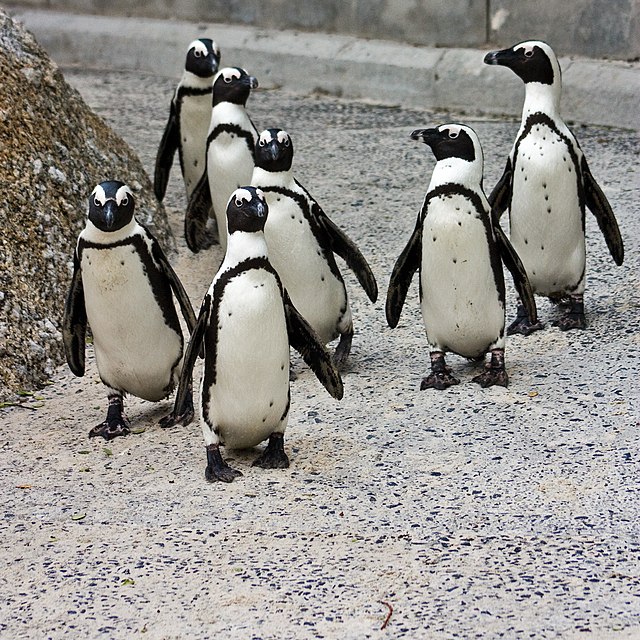
 

Penguins again . . .

                            African penguins (Spheniscus demersus)
                                        Image courtesy Wikimedia Commons

This post is compiled from others I have written with additional facts gleaned at a later time.

There are about five million penguins in Antarctica. If I were to create a collective noun for penguins, I would choose ‘a perfection.’ The standard collectives are colony, crèche, formality, huddle, parade, parcel, raft (if they are in the water) rookery and waddle. 

However, not all penguins live in the frozen wastes of Antarctica. The Galápagos penguin lives near the equator in the Galápagos Islands, while the Little Blue or Fairy penguin inhabits the coastal areas of Australia and New Zealand, and the Fiordland crested penguin is endemic to the temperate coastal forest of New Zealand’s South Island. The African penguin can be found along the southwest coast of Africa, while the Humboldt and Magellanic penguins live along the South American coasts, particularly in Chile and Argentina. 

Some penguins, like the Adélie, mate for life, while others, the Emperor, for example, are serially monogamous.

                Adélie penguins in the South Shetland  Islands, Antarctica
                                        Image courtesy Wikimedia Commons

Same-sex behaviour is common among penguins and has been observed more closely in zoos, which allow easier scrutiny. King penguin males at Berlin Zoo, Magellanic male penguins in San Francisco, a male Gentoo pair at Sea Life Aquarium in Sydney, a female Gentoo pair at L’Oceanogràfic in Valencia in Spain, male Chinstraps in Central Park Zoo, and a male Humboldt pair in London are just some of the pairings that have been recorded. Some have successfully incubated eggs and raised chicks. One male African penguin in the Netherlands stole an egg to incubate from a female pair.

The parents share responsibility for feeding and raising their chick, so, apart from the biological technicalities of mating, same sex couples are as adept at rearing chicks as their heterosexual peers.

When a penguin dies, members of the colony gather and use their wings and beaks to dig a deep hole. Then they roll the body into the grave and bury it, after which they congregate in a circle and sing, ‘Freeze a jolly good fellow, freeze a jolly good fellow . . . ‘

In fact, dead penguins are scavenged by skuas and petrels. The few that die on land rather than ice do not decay but gradually dry out. Fierce winds progressively ablate the corpses, turning them into dust.

The following photograph by cameraman Daniel J. Cox shows a colony of Emperor penguins bowed down in grief after their chicks died.

The next photograph, also copyright of Daniel J. Cox, shows the chicks’ bodies strewn across the Antarctic ice. The cause of death was unknown.


Unusually for wild animals, most penguins die of old age. Adélie penguins can live for up to fifteen years, while the much larger Emperor penguins can live for forty years. Unfortunate individuals fall prey to seals, sea lions, sharks, or orcas.
Emperor penguin (Aptenodytes forsteri) with chick
Image courtesy Wikimedia Commons

The Emperor penguin is the largest of the penguins and can attain a height of more than four feet.
Little Blue penguin family (Eudyptula minor) emerging from burrow, Bruny Island, Tasmania
Image courtesy Wikimedia Commons

By contrast, the Little Blue or Fairy penguin, at thirteen inches, is just over one foot. Fairy penguins return to their burrows at night after a day spent at sea.

Wednesday, 6 December 2023

Pumpkin Mice Tales (3)


Pumpkin Mice Tales (3)


When the colder weather came, the Pumpkin Mice decided to move to a warmer shelter. They found a lovely hole deep underground between the roots of an old oak tree.

One morning, White Mouse with the exceedingly long and beautiful green tail peeped out of the den. She squeaked with excitement. The other Mousekins scurried across to look.


They saw that visitors had arrived on the Tall Tower. Big Brown Mouse joined them. He had eaten a lot of books in his life and digested a lot of information. He told the Mousekins about the new inhabitants.

‘They have travelled from Antarctica,’ he said. ‘The black and white birds are penguins and the white animals are seals.’

The Mousekins gazed at Big Brown Mouse in awe, wondering if they would ever be as wise as him.    

       Big Brown Mouse continued, ‘Seals and penguins don’t like each other because seals eat penguins.’


 In this, though, Big Brown Mouse was mistaken for these particular penguins and seals were great friends. There are exceptions to every rule.

The penguins were brothers. The oldest, the one with the bobble hat, was called Bob Bobble. The first thing he and his brothers did was to build an igloo. They chipped the ice off the puddles and fashioned a rather fine dwelling just big enough for all the penguins to live in.

Mysteriously, the seals created a pond and stocked it with fish. They enjoyed watching Blue Scarf hauling fish from the icy pond. He was generous and shared his catch with them.

His brother, Rufus Red, was the youngest penguin and he was excited every night by the coloured lights that twinkled so brightly on the Tall Tower, lighting up the snowman he had built. ‘They’re better than the Northern Lights,‘ he said.

Little Grey, the smallest Mousekin, asked, ‘How long will they stay?’

Big Brown Mouse smiled kindly at him and answered, ‘I think they will stay until the weather starts to get warmer, then they will return to Antarctica.’ Seeing the disappointment on the Mousekins’ faces he added gently, ‘That will be a long time.’

White Mouse with the exceedingly long and beautiful green tail said, ‘How did they get here?’

Big Brown Mouse sighed and said, ‘Nobody knows, ‘Tis a secret never to be told,’ and they all wiggled their whiskers and skittered back into the warmth and safety of their nest.

Monday, 21 August 2023

Penguins


Penguins
 

Macaroni penguins
Image courtesy of Wikimedia Commons
There are about five million penguins in Antarctica. When a penguin is found dead, members of the colony use their beaks and wings to dig a big hole. When the hole is deep enough, the dead body is rolled into it and buried. The rest gather round in a circle and sing, ‘Freeze a jolly good fellow, freeze a jolly good fellow . . . ‘
Actually, dead penguins are scavenged by skuas and petrels. The few that die on land rather than ice do not decay but dry out. Strong winds erode the bodies, gradually turning them into dust.