This year my blog posts for the April 2024 A to Z Challenge will be about the recipients of the Dickin Medal, which you can read about here. They are in alphabetical, not chronological order, within the different letters.
R
Reckless c.1948-1968
Reckless, also known as Sergeant Reckless, and ultimately Staff Sergeant Reckless, was thought to be about four years old when she was purchased in Korea by the U.S. Marine Corps in 1952. She was a small Mongolian mare and was originally trained as a pack horse, carrying equipment for the Recoilless Rifle Platoon of the 5th Marine Regiment.
However, she proved to be a much more enterprising animal, learning new routes quickly, often travelling without a handler to deliver supplies on her own and evacuating wounded and dead soldiers on her back. On one memorable day, in March 1953, she made 51 trips, mostly by herself, to resupply front line units. On each trip she carried several 24-pound shells. She was wounded twice by shrapnel but continued to work.
Reckless had a remarkable ability to recognise danger and would not move forward if she sensed an enemy attack was imminent. She saved many lives by these actions.
She was very popular with the troops and moved freely among them, accepting whatever they chose to give her to eat, frequently helping herself to anything in reach and often moving into their tents to lie down with them. Her name was derived from ‘Recoilless’.
.jpg)
Image courtesy Wikimedia Commons
Reckless was honoured with two Purple Hearts, a Marine Corps Good Conduct Medal, a Presidential Unit Citation with bronze star, the National Defense Service Medal, a Korean Service Medal, the United Nations Korea Medal, a Navy Unit Commendation and a Republic of Korea Presidential Unit Citation, all of which she wore on her horse blanket, with a French fourragère the Marines had been awarded in the First World War. LIFE magazine named her ‘one of America’s 100 all-time heroes.’
Lieutenant General Randolph McC. Pate, United States Marine Corps said of her, ‘I was surprised at her beauty and intelligence, and believe it or not, her esprit de corps. Like any other Marine, she was enjoying a bottle of beer with her comrades. She was constantly the center of attraction and was fully aware of her importance. If she failed to receive the attention she felt her due, she would deliberately walk into a group of Marines and, in effect, enter the conversation. It was obvious the Marines loved her.’
After the war, she lived in retirement in Pendleton.
In 2016, Reckless was posthumously awarded the PDSA Dickin Medal, for her Korean War service in 1952 -1953 and the ‘Animals in War and Peace Medal of Bravery’.

Image courtesy Wikimedia Commons

Image source
Regal was a bay gelding, working with the Metropolitan Police from 1940 to 1944, in the Muswell Hill area of London.
There were about 186 horses in the mounted division of the Metropolitan Police. Patrols worked throughout London, to help with traffic control and to raise the morale of the citizens, during the period of the V1 and V2 bombing raids. More than 3,000 V2 rockets were launched against Britain, causing 9,000 deaths.
Each horse had the same handler during its career and was trained to remain calm in all situations. Regal’s handler was P.C. Hector Poole.
In April, 1941, incendiary bombs were dropped near the Police stables in Muswell Hill. Fire spread to the area near Regal’s stable from flames in the food store. The horse was not injured and did not panic and was led to safety. Three years later, in July, 1944, another bomb caused the roof to collapse, injuring Regal with flying debris.
Regal was awarded the DM in April 1947. The citation stated, ‘Was twice in burning stables caused by explosive incendiaries at Muswell Hill. Although receiving minor injuries, being covered by debris and close to the flames, this horse showed no signs of panic.’
Regal’s grave is at the Metropolitan Police Mounted Training Establishment at Thames Ditton in Surrey.
Rex

Image source
Rex was an Alsatian search and rescue dog, working with Civil Defence units. He worked in extremely difficult conditions in bombed buildings to find casualties. His DM was awarded in April 1945 for bravery. The citation said, 'For outstanding good work in the location of casualties in burning buildings. Undaunted by smouldering debris, thick smoke, intense heat and jets of water from fire hoses, this dog displayed uncanny intelligence and outstanding determination in his efforts to follow up any scent which led him to a trapped casualty.’
Ricky
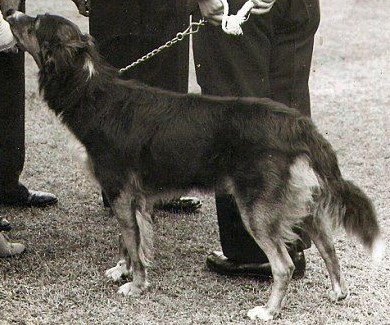
Mrs Litchfield lent her Welsh Collie Ricky to the war effort in 1944, and was adamant that the dog was on loan only. Ricky joined the War Dogs Training School and soon showed his mettle and ability to become a mine detection dog.
By December 1944, Ricky was working with his handler, Maurice Yielding, clearing mines along a canal bank in Noordevaart, in the Netherlands. There was a multitude of mines – at least 26 different types – as well as booby traps. Ricky was constantly detecting devices, although they were concealed in gravel and deep mud. When a mine was accidentally set off very close to him, he was unfazed and continued his work, even though he had shrapnel wounds to his head.
Realising the great value of Ricky’s ability as a sniffer dog, the Army was extremely keen to buy him from Mrs Litchfield, but she would not be persuaded and so he returned home to Kent at the end of the war.
When he was awarded the DM in March 1947, his citation ran, ‘This dog was engaged in cleaning the verges of the canal bank at Noordevaart, Holland. He found all the mines but during the operation one of them exploded. Ricky was wounded in the head but remained calm and kept at work. Had he become excited he would have been a danger to the rest of the section working nearby.’
Rifleman Khan

Image source
When the British Government asked for donations of dogs to help in the war in 1942, the Railton family in Surrey offered their pet Alsatian. After training at the War Dogs Training School, he was assigned to Lance Corporal James Muldoon of the Cameronians (Scottish Rifles). Given the name ‘Khan’, he worked well with his handler and the two became very close.
In 1944, an assault craft they were in was heavily bombarded and capsized. Khan swam ashore, but Jimmy Muldoon could not swim and was laden down by his heavy pack. On hearing his cries, Khan swam back to him, grabbed him by his uniform collar and hauled him the 200 yards to shore.
When the war had ended, Khan returned to his home in Surrey. His citation for the Dickin Medal, which he received in March 1945, said, ‘For rescuing L/Cpl Muldoon from drowning under heavy shell fire at the assault of Walcheren, November 1944, while serving with the 6th Cameronians (SR)’
Two years after the award, Rifleman Khan was invited to take part in the National Dog Tournament, alongside fifteen other DM recipients. Barry Railton wrote to Jimmy Muldoon to ask him to attend. He and Khan had not seen each other for two years and their reunion was a joyous occasion, so much so that the Railton family suggested that Khan should go to live with Jimmy Muldoon. They lived out their days in the small town of Strathaven and in 2021 a statue of Khan was unveiled there.
Rip ?-1946

Image source
Rip was a stray mongrel in Poplar, East London. He was found by Air Raid Warden Mr E. King after a heavy bombing raid and became the mascot of the local Air Raid patrol. He was not trained as a rescue dog, but proved it was instinctive when he started indicating where there were casualties. In one year, he found more than 100 victims of the London air raids. His DM, ‘For locating many air-raid victims during the blitz of 1940’ was awarded to him in 1945 and he wore it on his collar until his death in 1946.
.jpg)
Image courtesy Wikimedia Commons
Rob 1939-1952

Rob was a working collie and family pet on the Shropshire farm of the Bayne family. He was a gentle dog, even picking up straying chicks and returning them to the mother hens, and allowing the little boy, Basil, to hold onto him as he started toddling. In 1942, Edward Bayne offered him to the War Effort and he was trained as a messenger and guard dog. He was the first dog to be assigned to the SAS (Special Air Service)
Rob was alleged to have made 20 parachute jumps, but in 2006 this was revealed as a probable hoax, in a bid to prevent him going back to his family, who had requested that he be returned. That seems to me to be unlikely. Why would the Bayne family ask for Rob to be returned when the war was still ongoing?
Nonetheless, Rob was a brave member of the SAS, and he was awarded the DM in January 1945, the citation reading, ‘Took part in landings in the North Africa Campaign with the Infantry Unit. From September 1943 he served with the Special Air Unit in Italy. Most of these operations were of an unpleasant nature. He was used as a patrol dog and guard on small detachments lying-up in enemy territory. There is no doubt that his presence with these parties saved many of them from being discovered, and thereby from being captured or killed.’
Rob returned to his family in Shropshire, readily picking up his farm work. He was buried on the farm when he died in 1952 and the two Bayne children erected a stone memorial, engraved with the words, ‘To the dear memory of Rob, war dog no 471/322, twice VC, Britain’s first parachute dog, who served three and a half years in North Africa and Italy with the Second Special Air Service Regiment. Died 18th January 1952 aged 12½ years. Erected by Basil and Heather Bayne in memory of a faithful friend and playmate 1939-1952.’
Rob also
received the RSPCA Red Collar and Medallion for Valour.
Royal Blue

Image source
Royal Blue was a male blue pigeon hatched in the Royal Lofts at Sandringham. He belonged to King George VI and served with the RAF pigeon service.
Bombers and reconnaissance aircraft carried messenger pigeons, so that, should they be forced to land, their location could be conveyed to their base. Thus, it might be possible to conduct a rescue attempt.
On 10th October, 1940, Royal Blue was released in the Netherlands and flew 120 miles back to base in four hours and ten minutes. In March, 1945, he was awarded the DM with the citation, ‘For being the first pigeon in this war to deliver a message from a forced landed aircraft on the Continent while serving with the RAF in October, 1940.’
Royal
Blue is one of 32 pigeons who have received a Dickin Medal.
Royal Blue's DM citation
Image courtesy Wikimedia Commons
Ruhr Express

Image source
Ruhr Express was bred and trained at RAF Detling in Kent. The station was bombed several times during the Battle of Britain. Its motto was ‘Dare to be wise.’
Ruhr Express was a large, dark chequered male, so successful in his work that he was used to train other pigeons. In 1945, he was selected to join a US force on reconnaissance behind enemy lines in the Ruhr. As the heart of German steel and coal production, this area was a significant centre of industry. The objective of the exercise was to gather information on troops and defences.
Ruhr Express had to fly 300 miles overnight, and the information he carried was vital to the Allied invasion of the Ruhr. The following month, he was awarded the Dickin Medal, ‘For carrying an important message from the Ruhr Pocket in excellent time, while serving with the RAF in April, 1945.’
He was put up for auction at the Royal Hospital, Chelsea, to raise money for the RAF Benevolent Fund and the Allied Forces Animals’ War Memorial. He sold for £420, the equivalent of £22,717 in 2024. His new owner used him, and another bird, called ‘Per Ardua’ (Through adversity) as the foundation birds in a new line of long-distance flyers.