Showing posts with label Cornwall. Show all posts

Monday, 12 October 2026

A was an ant


A was an ant

A was an ant
Who seldom stood still,
And who made a nice house
In the side of a hill.
Nice little ant!

(from an illustrated alphabet poem by Edward Lear)

How many times do we curse these industrious little creatures when they find their way into our homes and despoil our food? For once they have laid their trail, their fellows will follow it relentlessly, laughing with their tiny ant stridulations at our feeble efforts to deter them.

A mediaeval name for the ant is ‘pissemire,’ originating from ‘pisse,’ meaning urine, and ‘mire,’ an old Scandinavian word for ant (‘myre’ in Danish, ‘myra’ in Swedish)

Literally, pismire means urinating ant. It is associated with the pungent aroma of anthills saturated with the formic acid ants secrete.

Pismire was used pejoratively. An ant is small and insignificant, so to call someone a pismire was to draw attention to their worthlessness.

The modern form of pismire is pissant.

‘Emmet’ is another name for an ant. The emmet is presented in heraldry as a signifier of industry and wisdom. In 1610, John Guillim of the English College of Arms wrote: ‘By the Emmet or Pismire may be signified a Man of great Labour, Wisdom, and Providence in all his Affairs, and of a pregnant and ready Memory.’

Emmet is also a Cornish (UK) dialectical word for tourists or incomers. Incomers are people who were not born in the county but have moved to live there.


Tuesday, 14 May 2024

Pumpkin Mice Tales (4)


Pumpkin Mice Tales (4)

The holiday – part one

                                                Big Brown Mouse

It was summer and the Pumpkin Mice were going on holiday to the seaside. The youngest mice had just finished their MATs (Mouse Assessment Tests), and Big Brown Mouse, and White Mouse with the exceedingly long and beautiful green tail, (startling green and quite the longest tail ever seen in Mousedom) felt that they deserved a treat after all their hard work.

White Mouse with the exceedingly long and beautiful green tail, (startling green and quite the longest tail ever seen in Mousedom)

The Mousekins were very excited, because they were going to stay with their cousins, the Fishermice. They knew they would be spending a lot of time in the water, swimming and sailing. They hoped they would learn how to water-ski and surfboard, too. Big Brown Mouse told them that if they were very good, they might be invited to go out in the fishing smack with their cousins and help to haul in the nets of silvery fish.

There was much noisy chatter as they journeyed to their holiday destination, with Little Grey, the smallest mouse, asking, ‘Are we nearly there?’ so often that Big Brown Mouse simply answered, ‘Yes’, each time.

White Mouse with the exceedingly long and beautiful green tail (startling green and quite the longest tail ever seen in Mousedom) handed round some snacks to occupy the Mousekins and when they had finished them, she suggested they sing some songs to pass the time. They started with ‘Hickory dickory dock’ which they sang as a round until they got muddled and had to stop because they were giggling so much. Then they sang ‘Three blind mice’, but Tiny Grey and Small Brown started wailing that they didn’t want to be blind or have their tails cut off.

                                                    Small Brown

Before they became completely hysterical, Big Brown Mouse sang out in his beautiful deep bass voice, ‘A mouse lived in a windmill in old Amsterdam’, and everyone stopped to listen. They liked the song so much that they begged him to sing it again and again, and very soon they all knew the words and could sing along with him.

After a few hours, they arrived in Cornwall and soon came to the signpost for Mousehole, for, of course, that is where all good mice go for their holidays, (though sometimes they might go to East Mouse, or Middle Mouse in Anglesey.)

Image courtesy Wikimedia Commons

They were tired and it was late, so, after a tasty supper of Mousetrap cheese, they tottered off to bed and, despite their excitement, they soon fell fast asleep, to dream of the wonders they might see. What would the morrow bring?

Wednesday, 7 February 2024

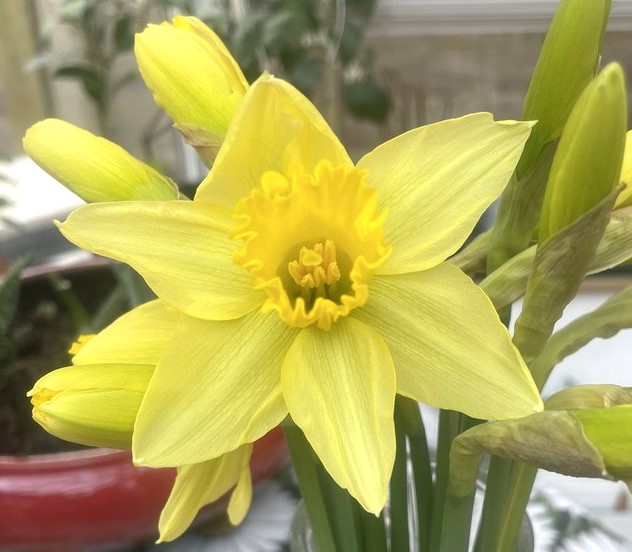
Daffodils – Day 5


Daffodils – Day 5


I don’t know what happened with the numbering system – Days 3 and 4 were confused and so was I, apparently. Anyway, this is Day 5!

I need not have worried that the daffodils would fail to open. 

 Today’s poem is called ‘My Daffodils’ and was written by the American poet Arthur Goodenough (1871-1936)

When April thrills the wakening hills,

The sunshine on their summits spills

The charm divine of amber wine –

Then come the darling daffodils –

The darling, darling daffodils!


While winter chills yet rarely kills,

And slowly yet the Dream fulfils,

In mist and rain they come again,

The dainty, dancing daffodils –

The dream-descended daffodils.


When vapor crawls and mountain walls

Give back the cuckoo’s ringing calls,

Old friends and dear they reappear,

The dauntless, dainty daffodils,

The hope-inspiring daffodils!


Before the swallow wings his flight,

Or frosts have ceased to blast and blight,

With rapture fine their faces shine;

The bliss-begotten daffodils,

The bliss-bestowing daffodils.

National Trust Cotehele in Cornwall has a unique collection of heritage daffodils, including 19th century hybrids, the descendants of the once-thriving flower industry in the valley of the River Tamar. The ‘Little Gardens’, as the fields were known locally, were farmed by generations of families, sending flowers and fresh produce by rail to the large city markets. After WWII the industry declined and the fields were no longer tended.  Discarded daffodil bulbs were thrown away but continued to flower unnoticed for years.

Volunteers at Cotehele collected many of the rare daffodils and a local grower added old ‘historic’ bulbs from his collection. These flowers have been catalogued and are established and protected in the Cotehele gardens.

Monday, 1 February 2010

Radiation alert!


In the wake of announcements that body scanners are to be used routinely in airports a television journalist today reported that there was concern over the risk of radiation. If passengers are really worried about radiation they would be well advised not to fly at all since flying increases exposure to cosmic radiation which can harm DNA and cause cancers. As one travels further from the surface of the earth the atmosphere becomes thinner and the magnetic field weaker and exposure to cosmic radiation increases. It is one of the major problems of space travel.
Thus, passengers flying at 30,000 feet in an aircraft confront a greater risk of harmful radiation than from an airport body scanner. The amount of radiation emitted by a scanner used for security purposes is negligible.
Perhaps people who have concerns should avoid areas of high natural radiation – Cornwall in the UK for example, or Yangjiang in China, Kerala in India, Guarapari in Brazil, or the area with the highest level of background radiation, Ramsar in Iran.
Doubtless the worries over body scanners will persist for as long as ill-informed reporters continue to make alarmist remarks.