The Battle of Sluys, known also as the Battle of l‘Ecluse, was the naval battle that marked the beginning of the Hundred Years’ War. It was fought on 24th June, 1340 in Sluys, in an inlet between Zeeland and West Flanders. At that time Sluys had a harbour able to accommodate large fleets and was considered to be the best anchorage in Europe. It was later silted up by the River Eede.

To mark his claim on the French crown, Edward III quartered the three lions of England with the fleur-de-lys of France in his royal arms.
Image courtesy of Wikimedia Commons
The adversaries were the English against a combined fleet of French, Castilian and Genoese. The English fleet was commanded by King Edward III and the opposing admirals were the French Hugues Quiéret and Nicolas Béhuchet and the Genoese Bocanegra. It is probable that neither the English nor the French had custom-built warships but relied on merchant vessels which were adapted for battle by the addition of crows’ nests, forecastles and aftcastles, fortifications from which archers could fire their arrows. The English ocean-going merchantmen were called Cogs and had a single mast and were steered either by an oar or a rudder. Both prow and stern were pointed and they had a deep draught, making them less manoeuvrable than the lighter shallow-draught French vessels. Though some of the Cogs were large, most were small, carrying a crew of five or six and perhaps fifteen longbowmen and other soldiers. One or two of the larger ships were armed with guns.
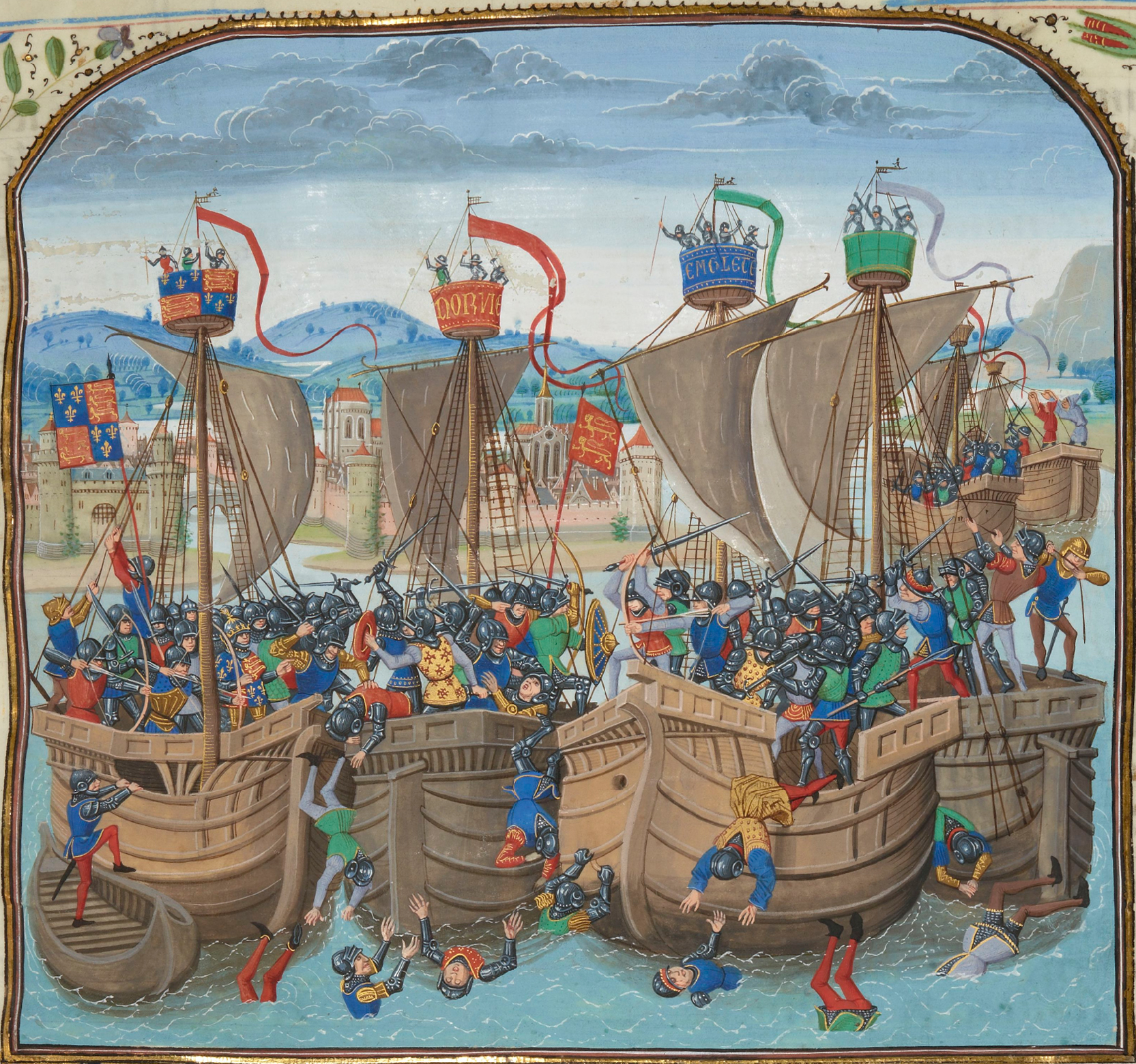
Image courtesy of Wikimedia Commons
As Edward’s fleet approached Sluys they found their enemies adopting a defensive tactic common in mediaeval times. The ships were organised in two lines chained together. This made it easier for men to travel between ships, repelling boarders. The drawback was that the vessels were unable to manoeuvre. Edward sailed his ships to windward with the sun behind them and the archers let loose a hail of arrows. The longbowmen were able to fire five times faster than enemy archers armed with crossbows.
The standard practice was to demolish a ship’s crew with a rain of arrows and heavy stones which allowed the men-at-arms to board, overpower the survivors and take possession of the craft. If captured prisoners were thought to be capable of fetching a ransom, they were spared. Otherwise they were thrown overboard. Most drowned.
As Edward’s men fought their way along the line, capturing ship after ship in dreadful hand to hand combat, the French second row began slipping their boarding lines, trying to avoid the same fate. In the end, after much bloody battling, the French were overwhelmed, their marine defences destroyed. By nightfall, the sea ran red with blood and bodies and the English were victorious.
Bocanegra had fled, Quiéret was killed in action and Béhuchet was captured and hanged. Edward III was injured but survived. His wife, Queen Philippa, was in Ghent and his ship had been carrying the ladies of her household to join her. They were guarded on board by archers and soldiers, but one of them was killed during the battle.
France’s fleet had been destroyed, guaranteeing that there was no prospect of a French invasion of England and ensuring that the rest of the war would be fought mainly on French soil. There is no record of the number of casualties but it is supposed that there must have been thousands.
King Philip VI of France was informed of the annihilation of his fleet by his court jester, no other courtier daring to impart the news. The exchange ran along these lines:
‘Our knights are much braver than the English,’ said the jester.
‘How so?’ said Philip.
‘The English do not dare to jump into the sea in full armour,’ replied the jester.
ABC Wednesday is the brainchild of the Splendid Denise Nesbitt and She is assisted in her task by a Supreme Squad of Superb colleagues. To see more Ss please click here.
