Mnemonics
Images courtesy of Wikimedia Commons
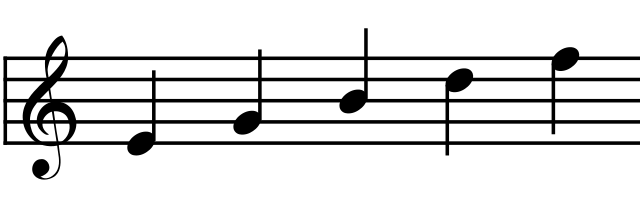
Mnemonics are techniques or tricks to aid memory. One well-known to those who have had piano lessons is ‘Every Good Boy Deserves Fruit’ for the notes on the lines of the treble clef – E, G, B, D, F. To remember the spaces of the bass clef, A, C, E, G, the mnemonic is ‘All Cows Eat Grass’.
Mnemonics take many forms. For children it may be a song to learn the alphabet, for example, or an acronym in sentence form to remember the colours of the rainbow – Richard Of York Gave Battle In Vain. It might be a word – HOMES, to recall the names of the North American Great Lakes – Huron, Ontario, Michigan, Erie. Superior.
It could be a list, like ‘divorced, beheaded, died, divorced, beheaded, survived’ to remember the fate of Henry VIII’s six wives.
Can’t
remember how many days there are in each month? There’s a rhyme to help.
Thirty days
hath September,
April,
June and November,
All the rest
have thirty-one
Except for
February alone,
And that has
twenty-eight days clear,
And twenty-nine in each leap year.
I’ve just learnt a new mnemonic, which is easier and involves the knuckles of the hand. Starting with the left hand and the first fist knuckle, January (31 days), depression between the knuckles, February (not 31 or 30 days, so has to be remembered along with the leap year bit!), second knuckle, March (31), second depression, April, (30) and so on across the knuckles. Of course, there is a spare depression and knuckle at the end!

Spelling can often be helped with a mnemonic – ‘Big Elephants Can’t Always Use Small Elevators’ spells ‘because’, or, a particular favourite from the film ‘Matilda’ – ‘Mrs D, Mrs I, Mrs F, F, I, Mrs C, Mrs U, Mrs L, T, Y.’
A mnemonic might be a little rhyme to aid spelling – ‘i before e, except after c’, although there are many exceptions to that rule. Sometimes, the first part is followed by, ‘Or when sounded as ‘a’, as in neighbour and weigh’.
A mnemonic can help in distinguishing homophones – is it here or hear? ‘I hear with my ear’. Should it be which or witch? ‘The witch had an itch.’
Once past primary age and into secondary school and beyond, mnemonics take on a wider-ranging cast, in electrical engineering, geology, physics, chemistry, foreign languages – it seems that many disciplines benefit from an aide-memoire. Are they necessary (one collar, two sleeves) or superfluous?
