Showing posts sorted by relevance for query bees knees. Sort by date Show all posts

Tuesday, 6 June 2023

The bee’s knees


The bee’s knees

This expression has been in use since the 1920s, along with similar phrases, like the cat’s whiskers or the gnat’s elbow. All such idioms are used to describe something superlative.

I wondered, ‘Do bees actually have knees?’  In fact, they do. Not only that, they have hairy knees, the hairs being an intrinsic part of collecting pollen. The knees do not form the pollen baskets but are the joints between them. Only the females collect pollen, which is pressed into pollen baskets. Male bees don’t collect pollen; they visit flowers solely to drink the nectar for immediate energy.


The pyracantha bushes are in full flower now and a rich source of pollen. There is a gentle humming of many bees, a relaxing backdrop to a sunny day. The honey bees are very industrious, collecting pollen and drinking nectar.  

They regurgitate nectar to cover the pollen and form pellets which they take back to their hives. The pollen pellets are then formed into bee bread, which is a mixture of pollen, nectar, honey and bee saliva. It is the main food source for adult honey bees and their young, and is stored in cells to feed developing worker and drone larvae.

Newly-emerged worker bees have the job of making beeswax for the colony. Special cells on the bee’s abdomen produce small scales of wax. Bees constantly groom themselves and each other, taking the wax and chewing it with honey and pollen to create the hexagonal wax cells of the honeycomb.

Honey is made from nectar mixed with proteins produced in the bee’s mouth. The resultant mixture is stored in the honeycomb until the water content has been reduced. 

Honey bees are the major producers of honey. Bumble bees make small amounts of honey, but do not live in huge colonies like honey bees, so their honey production could never become a commercial enterprise.

Humans have been benefitting from bee products for about 9,000 years. Ancient pottery artefacts from Europe, the Near East and North Africa have carried traces of beeswax, which suggests that the first farmers kept bees.

Bees originated in Asia around 300,000 years ago and spread rapidly across Europe and Africa. Today, honey bee colonies are under threat across the world. Colony collapse disorder (CCD) was first reported in the USA in 2006. When this happens, the majority of worker bees in a hive disappear and the Queen and remaining young die because they are not being serviced by the huge army of workers that they need to survive.

The causes of CCD are not fully understood and are still being researched. However, it is believed that pesticides, parasites, disease and loss of habitat are major contributory factors.

There are several suggestions that bee-keepers can try in their bid to prevent CCD. One proposal is to replace the old honeycomb with a new one every two or three years to avoid a concentration of harmful chemicals. Stress is not good for bees so it is helpful to make sure there is good ventilation in the hive and also that there is access to plentiful appropriate food.

A parasite that only breeds in honey bee hives and contributes to CCD is the Varroa mite, an external microscopic mite that attaches to the bee and feeds on it, weakening it. It also transmits diseases like deformed wing virus (DWV) to bee larvae. It is the most serious pest for honey bees across the world.

Bees pollinate a huge variety of crops but the bee population is declining and it is imperative to protect it. Our landscapes and our lives would be unimaginable without the intervention of these little insects.

Sunday, 15 January 2012

The Bee's Knees


White-tailed bumble bee (Bombus lucorum) on veronica longifolia
‘They think they’re the bee’s knees’ is an expression used rather disparagingly to describe people who think they have achieved something that sets them above others. Avid followers of fashion, otherwise known as fashion victims, may consider themselves the bee’s knees because they are up to the minute, following the latest trends.
Honey bee (Apis mellifera) on ceanothus
Where did the expression originate? Do bees have knees? They must have feet because they have inbuilt crampons. If they have knees do they have ankles as well?
Bombus lucorum on nasturtium
Brewer’s Dictionary of Phrase & Fable informs me that it is ‘said of something or someone outstanding.’ It is believed that a US columnist, T.A. (Tad) Dorgan first coined the phrase in the early 1920s. It may refer to ‘the pollen containers on a bee’s legs (the process of removing the pollen involves much bending of the bee’s knees and is performed with great precision), or maybe it is simply surreal (as with such contemporary synonyms as ‘ant’s pants’ and ‘cat’s pyjamas.’
Bombus lucorum on pyracantha
With my anthropomorphic turn of mind I can imagine boy bees eyeing up girl bees and judging them by the relative merits of their limbs.

Boy bee 1: ‘Nice turn of ankle, but her pollen baskets are a bit thin.’

Boy bee 2: ‘She’s got nice knees. Nice eyes, too.’

Boy bee 1: ‘Slender waist – almost a wasp waist.’

Boy bee 2: ‘I couldn’t fancy a wasp, though. They’re quick to anger and then you really feel the sting.’

Boy bee 1: ‘What do you think of her antennae?’

Boy bee 2: ‘Not bad. I’ve seen better on a moth.’

Boy bee 1: ‘Given the choice, which would you go for – bumble bee or honey bee?’

Boy bee 2: ‘Bumble bee every time. I like a bit of substance.’

Boy bee 1: ‘Honey bee for me. Hard-working, nice smooth skin – you’d never go hungry with a honey bee.'
Apis mellifera on ceanothus
Boy bee 2: 'Look at the knees on that!'

Thursday, 15 May 2025

As busy as a bee


As busy as a bee

All images courtesy Wikimedia Commons


There wouldn’t be sunflowers,
Wouldn’t be peas,
Wouldn’t be apples,
On apple trees,
If it weren’t for fuzzy old,
Buzzy old bees,
Dusting pollen
From their knees.

Aileen Fisher (1906-2002)

It has been a pleasure to see so many bees recently in the garden, flying from flower to flower, taking the nectar and filling their pollen baskets. 

 Honey bees usually sleep for up to eight hours at night-time in the hive, though they will sometimes sleep in flowers. Young bees may take frequent daytime naps.


Sleeping bees sometimes hold each other’s legs, but a single bee may fall over sideways, holding on with its mandibles to its sleeping post.

Some bees require emergency treatment. A bee that is not flying or collecting nectar is a bee needing help. The quickest way to help it is to find a flower. Otherwise, prepare a sugar water solution of one part sugar to two parts water, and offer it to the bee. Sugar water should not be left out for bees as a general rule, because it will not give them the nutrition they need and may prevent them from visiting flowers and pollinating them. One would think that honey would be a good thing to offer tired bees, but that is a way of introducing potential disease to a colony.


It can take as long as thirty minutes for a bee to recover sufficiently to gather enough energy to fly away.
                                                     

However, if the bee does not respond and consume the sugar water, it is likely that she has reached the end of her life.

I have never seen a sleeping bee and the photographs I have included in this post show something I hope I will one day experience.


Tuesday, 20 February 2024

The cat’s whiskers


The cat’s whiskers

Jellicoe
The origins of this expression are uncertain. It may have arisen in 19th
century girls’ boarding schools. Another source suggests that the cartoonist Thomas Dorgan was responsible for the term in the early 20th century.

What is certain is that it carries the same meaning as ‘the bees’ knees’ which I wrote about here and here. It is not an expression commonly heard in the 21st century.

Last night we were commenting on our cats’ splendid whiskers and started discussing their purpose. We knew they were a means for cats to determine whether a space was big enough for them to pass through, a sort of inbuilt tape measure, but when we investigated further, we discovered some interesting facts.

The formal name for whiskers is vibrissae, from the Latin vibrio, to vibrate. They are much thicker than normal cat fur and have roots three times deeper. The tips have sensory organs that send information to the brain. They enable the cat to judge distance and direction and even texture. They can sense air movements and changes, sometimes alerting them to danger.

Cats are symmetrical, at least, their cheek or mystacial whiskers are. Every cat has at least 24 tactile facial whiskers, arranged symmetrically in four horizontal rows of three on each side of their muzzle.  Some cats may have more than 24, but there will always be an even number on each side in symmetrical formation, so that they can accurately assess their surroundings.

I think Herschel has 30 muzzle whiskers

Whiskers can indicate the mood of a cat. Pinned back whiskers signify a scared animal. Whiskers pointing forward, particularly if the ears are also erect, show alertness, as when a cat is hunting or curious. If the ears are flattened and the whiskers are forward, the cat is showing signs of aggression. When relaxed and happy, the whiskers droop.

The length of the whiskers is dependant on the size of the cat. A larger, fatter or fluffier cat will have longer whiskers than a hairless cat. A large Maine Coon may have whiskers that are six inches long. Conversely, a little Cornish Rex will have very short, curly whiskers. 

Cats cannot easily see things less than about eleven inches in front of them. By touching an object with their whiskers they know where and how big it is. At night, their whiskers detect air currents, alerting them to objects they may need to avoid. Outside, whiskers can sense sharp objects, thus protecting their eyes and faces from injury.

Whiskers, like fur, go through a natural sequence of growth and shedding. It is not unusual to find a mystacial whisker on a cushion or chair. If a number are found it could indicate something amiss, like an infection, or an allergy.

Most cats have white whiskers though they sometimes change colour with age, looking grey or black. A colour change may indicate that that whisker is about to be shed.

Cats’ whiskers should never be trimmed – they are essential to a cat’s well-being.

Herschel
Cats have whiskers on other parts of their bodies. Leg whiskers grow at the back of the front legs. They are quite difficult to photograph but are easily seen in 'real life.' These carpal whiskers help when the cat is climbing, sensing the texture of the tree or fence. As cats cannot see detail well close up, their carpal whiskers are used when hunting to indicate whether the prey they have caught is still moving. 

The whiskers above their eyes, their eyebrows, are sensitive to the lightest touch, warning them to blink or move, though I have sometimes seen Jellicoe with wispy cobwebs on his eyebrows. He's not providing board and lodging to a spider, just using his whiskers as brooms. The word whisker comes from the Middle English 'wisker' for anything that whisks or sweeps. 

Now, go and find a cat and count its mystacial whiskers!

Saturday, 6 July 2024

What’s in your bag?


 What’s in your bag?

I don’t often carry a bag, but needed one as I was going to a funeral. This begs the question, is a bag an essential requirement when attending a funeral? The answer is probably, ‘Yes’.


I went through the contents – my youngest daughter calls it ‘editing the bag’ – and was nonplussed to discover two packets of Nigella seeds. Nigella, or Love-in-a-mist, is a cottage garden annual, which attracts bees and other pollinators, and self-seeds readily. It has pretty flowers in shades of blue amidst a froth of finely cut leaves. I have no idea why the seed packets were in my bag. There are no expiry dates on them, so we’ll plant them and see what happens.

There were also a couple of receipts, one for a railway ticket - I haven’t travelled by train for many years – and the other for a family ‘birthday lunch’ ten years ago when we used to do such things.

I found wipes of differing kinds – for grazed knees, for sore eyes, for refreshing hands and for cleaning the lenses of glasses. There was a tube of hand cream – car journeys are times for hand care if I’m the passenger - a bottle of perfume and a stainless steel water bottle.

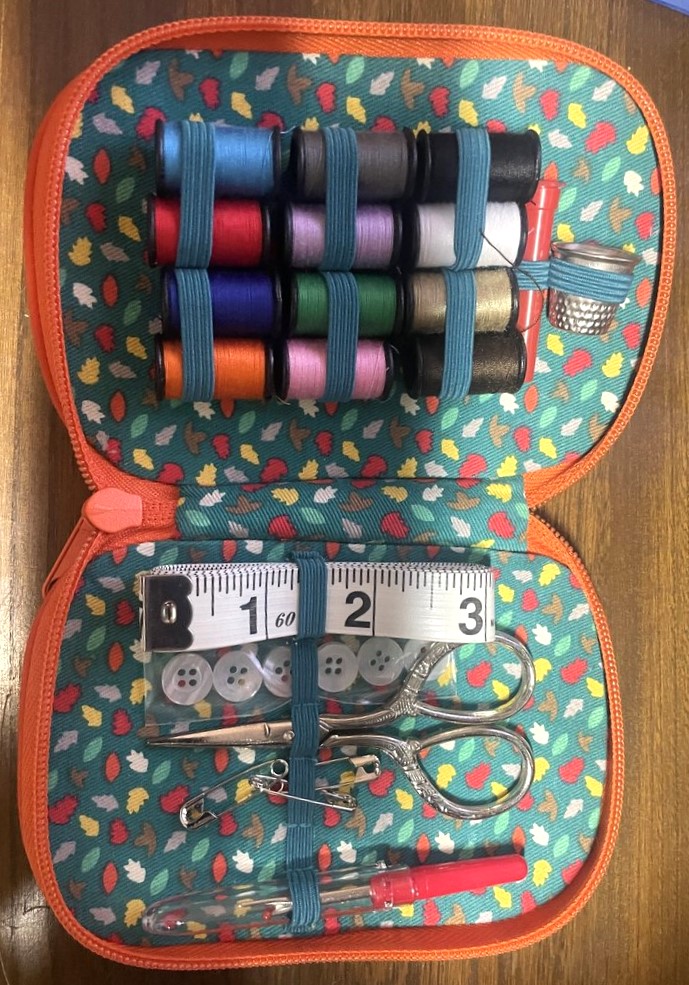
I also had a small sewing kit – you know, just in case I had to sew on a button or darn a sock or measure something.


To this collection would have to be added spectacles, tissues, a small hairbrush, a coin purse and credit cards. I travel light! 😏

Ultimately, the editing, though interesting, was unnecessary as something cropped up to prevent me attending the funeral.