Showing posts with label 1939. Show all posts

Saturday, 12 July 2025

1939


1939

After the end of the First World War, the Duke of York, later to become King George VI, following his elder brother’s abdication, wanted to try and break down some of the class barriers rampant in Great Britain. He founded week-long summer camps, which ran annually until 1939, just before the outbreak of World War Two.

His ambition was to bring boys together from dissimilar circumstances to enjoy outdoor pursuits and find common ground and friendship. About five hundred boys from backgrounds as varied as public (fee-paying) boarding schools and mining communities were invited to join.

Southwold Common in Suffolk was a frequent location, and the Duke of York often joined the boys at the camps for a day, even after he became King. He enjoyed taking part in activities, which included games, swimming, talks and entertainments, and sleeping under canvas with the boys. The boys knew him as the Great Chief, and he wore the same uniform of shorts and shirt as they did. The importance of teamwork was emphasised.

In 1939, when it was clear that the country would soon be going to war again, and the young lads would be embroiled in combat, the King decided that he wanted to spend more than one day with ‘his boys’ and so invited them to Abergeldie Castle, three miles from Balmoral.

For this final camp, which he renamed the King’s Camp, the King invited just two hundred boys, and altered the emphasis from games and competition to discovering the wonders of nature. He planned all the activities, including mapping out hikes they would take. The boys were invited to tea at Balmoral Castle, where they met the Queen and the princesses.

The last camp commenced on 5th August. War was declared on 1st September, four weeks later.

Pathé News, which produced documentaries and newsreels for sixty years, from 1910 to 1970, presented a review of 1939. Part of it showed George VI and other members of the Royal Family at camp, singing ‘Underneath the spreading chestnut tree.’  It was a favourite song of his and was chosen for the 1948 Royal Command Performance.

It was also a favourite of mine, and one I enjoyed teaching. The lyrics, inspired by the first line of ‘The Village Blacksmith’ by Henry Wadsworth Longfellow (1807-1832) were written by J and H Kennedy. Hal Kemp set them to music and the song was recorded by the Glenn Miller Orchestra in 1939, with Marion Hutton. It’s delivered at a spanking pace, and I can imagine anyone attempting to add the actions would be quite breathless by the end.     

Below are the actions to the words, as clearly as I can set them out.


Underneath the spreading chestnut tree (spread arms above head, then touch chest, head and lift arms high)

I loved him and he loved me.                              (hands on heart, then hug)

There I used to sit upon his knee,                     (hands on knees)

‘Neath the spreading chestnut tree.                 (as before)


There beneath the boughs we used to meet,   (spread arms, then clasp hands)

All his kisses were so sweet:                            (kiss fingers)

All the little birdies went ‘tweet-tweet’         (fingers make bird beaks)

‘Neath the spreading chestnut tree.             (as before)


I said, ‘I love you and there ain’t no ifs or buts, (hands on heart, shake finger)

He said, ‘I love you’ and the blacksmith shouted, ‘Chestnuts!’ (hands on heart)


Underneath the spreading chestnut tree          (as before)

There he said he’d marry me,                           (mimic placing ring on finger)

Now you ought to see our family     (hand indicates heights of children on ‘fa-mi-ly)

‘Neath the spreading chestnut tree.                (as before)


 As with all songs or dances, there were adaptations. The following clips show two. The first shows the King and his family singing at a camp sing song.

 The second shows how the song emigrated to the USA to become a dance.


Monday, 2 April 2012

April A-Z blogging challenge 2012 B is for Brothers

This is the second of 26 short stories about a fictional character called Alice.


When Alice was born in her parents’ bedroom in 1932, Edward was nine years old. Daniel and Charles were eleven and fourteen respectively.

At first they were not very interested in her, a squalling, red-faced unprepossessing bundle of fury and could not understand their mother and her female friends cooing over her and declaring how beautiful she was. They were even more surprised to see their father rocking her in his arms and singing softly to her.

Once she began to look ‘more human’, as Edward put it, the boys took a greater interest in her and began to celebrate her developmental milestones. By the time she took her first tottering steps all three brothers were entranced by their little sister who repaid their attentiveness with flirtatious smiles.

They took pride in teaching her to ride her bicycle, to swim and fish. They taught her to climb trees and tie knots, to build camp fires and construct Meccano models. Alice enjoyed all these pursuits and adored her brothers as much as they doted on her. Happy and secure, no little girl could have lived a more enviable existence until war was declared in 1939 and everyone’s world changed.

Friday, 24 September 2010

Underneath the spreading chestnut tree


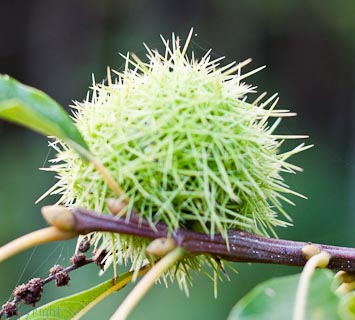
In the forest the sweet chestnuts are ripening and falling to the ground, there to be collected by children and squirrels. The nuts are soft and sweet and worth the considerable effort required to remove them from their prickly outer casing and then the closely-fitting shiny brown shells. There are many hints and tips for releasing the chewy nuts but whichever method is used is fiddly, sticky and results in sore fingers (or is that just me?)

Some of the chestnut trees are getting on in years and have spreading canopies to provide welcome shade on September days that can still be very warm. Yesterday I took some photographs and they are here together with some macro shots of chestnuts that Barry captured a couple of days ago.
Pathé News presented a review of 1939, part of which showed King George VI and other members of the Royal Family at the Duke of York’s Camp for Boys singing ‘Underneath the spreading chestnut tree.’ Apparently, he didn’t seem very comfortable performing the actions, but it was a favourite of his and was chosen for the 1948 Royal Command Performance.
It was also a favourite of mine when I was teaching music and many are the children who learnt the actions and enjoyed performing it. I wonder if any of them remember it now?
The lyrics, inspired at least by the first line of the poem, ‘The Village Blacksmith’ by Henry Wadsworth Longfellow (1807-1832) were written by J. and H. Kennedy and were set to music by Hal Kemp. The song was recorded by the Glen Miller Orchestra in 1939 with Marion Hutton. It’s delivered rather speedily and I can imagine that anyone attempting to fit in the actions would be somewhat breathless by the end!
I’ve added the ‘actions’ to the words, as clearly as I can. Remember, practice makes perfect ;-)

Underneath the spreading chestnut tree         (spread arms above head, then touch chest, head and lift arms up)
I loved him and he loved me.                                     (hands on heart, then hug)
There I used to sit upon his knee                         (hands on knees)
‘Neath the spreading chestnut tree.                    (as before)

There beneath the boughs we used to meet     (spread arms, then clasp hands)
All his kisses were so sweet;                                       (kiss fingers)
All the little birdies went ‘tweet- tweet’          (fingers make bird beaks)
‘Neath the spreading chestnut tree.                        (as before)
                                          
I said, ‘I love you and there ain’t no ifs or buts,       (hands on heart, shake finger)
He said, ‘I love you' and the blacksmith shouted, 'Chestnuts!'     (hands on heart)

Underneath the spreading chestnut tree              (as before)
There he said he’d marry me,                                         (mimic placing ring on finger)
Now you ought to see our family                               (hand indicates heights of children on ‘fa-mi-ly;)
‘Neath the spreading chestnut tree!                         (as before)