Showing posts with label Afghanistan. Show all posts

Tuesday, 9 April 2024

A to Z Challenge 2024


A to Z Challenge 2024


This year my blog posts for the April 2024 Challenge will be about the recipients of the Dickin Medal, which you can read about here. They are in alphabetical, not chronological order, within the different letters.

H

Hertz  2011(?)-present

Hertz, wearing his Dickin Medal
Image source

Hertz is a liver or liver roan German short-haired Pointer. He was born in Croatia and joined the RAF Police when he was one year old. He had already demonstrated an outstanding talent for drug detection and became the first Military Working Dog to be trained as a Digital Media Detection dog, discovering Personal Electronic Devices (PEDs).

Taking advice from the Prison Service, whose sniffer dogs are used to discover smuggled electronic gadgets, such as smartphones, Hertz’s handler, Warrant Officer Jonathan Tanner, trained him intensively.

His training was extremely specific and very precise in that he learnt to identify TPPO, (Triphenylphosphine Oxide) which is found in the coatings of small devices, like USB flash drives, SIM and SD cards. This work required great concentration.

                                    WO Tanner and Hertz 

Image source 

WO Tanner and Hertz were deployed to Camp Bastion in Afghanistan in the first half of the 21st century, and in his first search, Hertz uncovered mobile devices being used to convey data to the enemy. He was subsequently responsible for detecting more than 100 items of electronic communication equipment, as well as caches of drugs. Many of these finds enabled the gathering of intelligence about significant threats of attack to military personnel and civilians.

For 13 months Hertz and WO Tanner patrolled Camp Bastion daily. There were no rocket attacks on the camp during that period, thanks to their vigilance and Hertz’s skill.
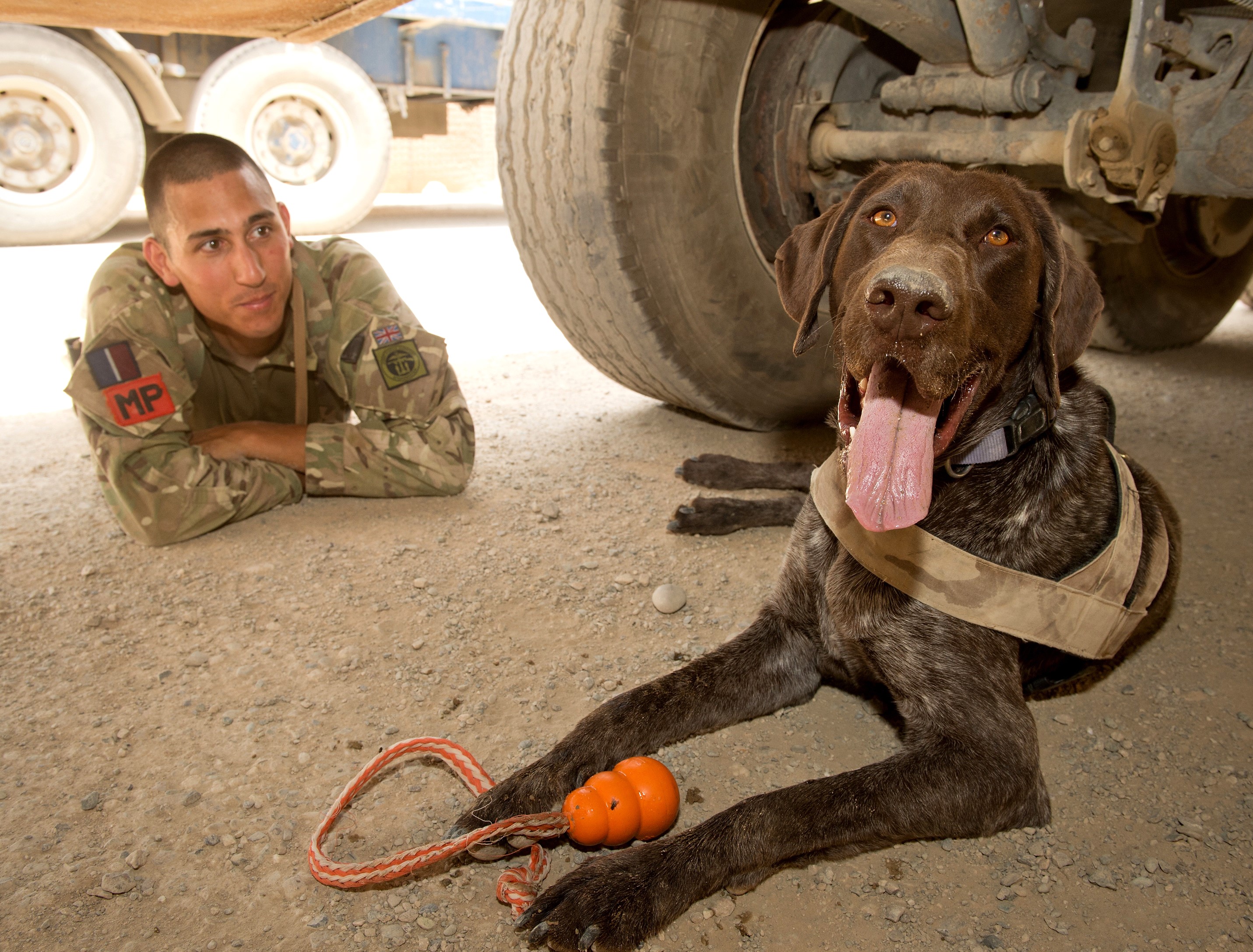
                        Corporal Dack with Hertz. Playtime?
                                            Image source 

When Jonathan Tanner’s tour of duty ended, Hertz was assigned to Corporal Simon Dack, and continued to work assiduously, a change of handler making no difference to his attitude and competence. In Helmand and Kabul, Hertz continued his detection work, ensuring the safety of servicemen and women, and civilian workers.

He was a pioneering dog in a world of rapidly advancing and developing digital intelligence.

He received his Dickin Medal in 2022 for protecting British and Allied troops.

‘Hertz is a truly remarkable animal hero and a trailblazer in his field.

His exceptional skills undoubtedly protected troops from the ever-evolving advances in digital intelligence. His actions changed the course of countless missions, saving the lives of military personnel and civilians.

“For this bravery and devotion to duty, we are honoured to welcome him as the latest recipient of the PDSA Dickin Medal.'

                        WO Jonathan Tanner, Cpl Simon Dack and Hertz
                                                        Image source 

WO Jonathan Tanner, RAF Police, said, ‘For a Military Working Dog that I have trained and handled to be recognised in this way is fantastic. At no point during the training process or our operational deployment did I expect or even suspect that Hertz would be acknowledged on the global stage by the PDSA. I will forever look back at what we achieved with a massive smile on my face.'

Corporal Simon Dack, RAF Police, said, ‘As a team I would put Hertz into an area in which I believed prohibited items were hidden, and without fail he would find them. Hertz has an incredible drive to search, paired with a finely tuned nose, making him one of the most naturally gifted dogs I have had the privilege to work with.’ 

Wednesday, 26 August 2009

The Jackson Factor

The late unfortunate Michael Jackson is in the news again – and again – and again. It would appear that UK news stations are determined to continue to exploit him. We think there is a phenomenon at work which we call 'The Jackson Factor'. It works thus – the amount of news coverage is in inverse proportion to the importance of any event. The highest Jackson Factor score would be 10 where news items of no global impact are given excessive/continuous exhaustive air time. The lowest score of 1 would be awarded to events of global significance that receive little or no media attention.

To illustrate the point take the example of serious life-threatening water shortage for millions of people. For many years the UN has warned that water shortages will become one of the most urgent problems worldwide in coming years. One estimate is that four billion people will be affected by 2050. India, with a growing population and increasing agricultural and manufacturing output, is facing huge problems of water supply in rural and urban areas. Climate change may mean there will be less rainfall in future. Northern India has experienced the driest season for more than eighty years; the monsoon is late and the people are praying for rain as they struggle to live through a widespread drought. Fights have broken out and murders have been committed as desperate people rush to fill vessels with water during the limited periods that water flows through the pipes. For example, in Bhopal, known as the 'City of Lakes', the thousand-year-old largest man-made lake has shrunk from 38 sq km to 5 sq km. The population, some 1.8 million, has had water rationed to 30 minutes' supply every other day since last October. That ration is now reduced to one day in three. Indore, not far from Bhopal, is rationed to 30 minutes' supply every seven days.

In the south Mumbai has had heavy rainfall and flooding but even so levels in the lakes have dropped, forcing the water supply to be cut by 30%.

This startling, appalling chain of events scores extremely low on the Jackson Factor scale. It fails to grab reporting honours for the following reasons: it lacks 'celebrities', it is happening in an impoverished continent not inhabited by Westerners, it has no spectator participation with the attendant thrill of feeling that 'your vote counts'.

Recent Michael Jackson UK media coverage scores 10. Calamitous events in Bhopal score 1. Casualties in Afghanistan, while not global, affect many nations whose military forces are engaged and receive very little coverage. Deaths are reported while large numbers of maimed survivors are barely mentioned. Civilian casualties in Afghanistan are rarely mentioned. Low Jackson Factor of ??

Can we expect or predict that this over-reporting of 'non-news' will continue in a downward spiral to banality? Are we seeing the end of serious reporting of dramatic global events that will affect us all? Has sensationalist celebrity reporting overtaken the serious business of presenting information on matters of international and global importance?

It would be interesting to know if this phenomenon is being seen in other countries around the world.

Tuesday, 14 July 2009

Chinook helicopters

What's the first thing you do when you buy a new car? Maybe you're an organised owner and sit down with the handbook/s and diligently read all the information therein. Perhaps you take it for a long drive, testing its capacity for speed, braking efficiency, safety, fuel consumption, noise, comfort, desirability in the eyes of other motorists. Do you look under the bonnet and calculate whether you can carry out all necessary servicing? Conceivably you give it a thorough valeting to validate your ownership. Would you consider removing the engine and replacing it with another from a different make and model? That seems unlikely as you would then have many other puzzles to solve.

However, that is precisely what the Ministry of Defence did in 1995 when ordering eight Special Operation Mk3 Chinook helicopters from US manufacturer Boeing. The MoD specified engines which would be built in UK, presumably to provide employment in a Member of Parliament's constituency. Access to security codes to test airworthiness was not included in the contract to which UK officials agreed.

In 2001, six years later, when the Chinooks were delivered they did not meet airworthiness standards, being considered safe only to fly not more than 500 feet from the ground in good visibility. They were then put into storage hangars.

A year later, in 2002, less complex Mk2 Chinooks were equipped for night flying but the infra-red computer screens had to be upgraded as the original screens partially obscured vision, making them less safe to fly. The upgrade cost £32.3 million.

Two years after this, in 2004, the MoD declared that in order to make the 'new' helicopters airworthy by 2008 it would spend £215 million on a high-level upgrade. Organising the contract took far longer than expected and it was soon abundantly clear that the Chinooks would not be ready to fly until 2011.

In 2007 the upgrade was cancelled because the MoD said it would take too long. That decision cost £17.25 million for the work already completed. The MoD decided on a cheaper option with a new night vision system. This was estimated at a cost of £53 million. This has since risen to £112 million with an unknown sum for night vision equipment.

The MoD confidently stated that it would have one of the eight Chinooks operational by 2009 with the other seven ready by 2010. It is now the seventh month of 2009 and no 'new' Chinooks are yet in service.

The RAF's 48 Chinooks are ageing; some are in poor condition and are being used to provide spare parts to keep others in the air in Afghanistan. There are currently ten deployed in Afghanistan(February 2009)

When or perhaps if the eight Mk3 Chinooks, now all 'reverted' to Mk2/2a to make them available more quickly, finally take to the air the whole procurement fiasco will have cost more than £422 million. In all probability it will cost more than £500 million. It seems that they may not now see service in Afghanistan but will be used in training aircrew.

In the meantime, in-service RAF Chinooks will fly more hours, new rotor blades have been fitted to Sea King helicopters and six Danish Air Force Merlins have been bought and are being converted.

And still the Government insists that the Military are better equipped than they have ever been –they don't seem to realise that's not at all the same as saying they are 'best equipped' which is what all the friends and relations of serving personnel desperately want to hear.

Today eight more bodies were repatriated to the UK. There was, as usual, no coverage of casualties in the media. They will be supported by charity.


Information gathered from David Hencke's article of 4th June 2008 in The Guardian; BBC News diplomatic correspondent Paul Adams, 4th June 2008; Sky News defence correspondent Geoff Meade, 24th February 2009; Wikipedia

Wednesday, 8 July 2009

Seven days - seven fatalities! . . . and this is just the UK!!


So - seven more men have died in Afghanistan in the last seven days fighting for a cause they may not believe in but have to engage in because they have 'signed up' and are 'following orders'.
Undoubtedly many more have been traumatised if not also actually physically injured. Our young service personnel are being exposed to huge dangers - and, as is the custom in the British Army, they are being led by their officers and their senior NCOs - and the costs are tremendous. The dead pose no problems other than immense grief - I can only imagine how raw their grieving can be - but the survivors present a tremendous puzzle. How can these maimed young men and women be absorbed into the care system?

The National Health Service does what it can in its overstretched way but the slack - the very large slack - is taken up by CHARITY. Help for Heroes is working hard to ensure that returning victims are given the best possible treatment.

A Hog Roast for Help for Heroes

Magnetic 'medal' displaying the Help for Heroes logo
On Saturday Barry and I went to a Hog Roast in aid of Help for Heroes. It was beautifully organised in lovely surroundings and was very well attended. The weather was kind and there was light in the sky well into the evening.
Everyone there was fully aware of the driving force behind the event. Our hosts' son had been very severely injured in January 2009 and for several days it was unclear whether he would recover and if he did how handicapped he might be. He had been blown up in Afghanistan and was evacuated immediately to Selly Oak Hospital in Birmingham, undergoing surgery in the aircraft during the journey. The care he received both immediately and at the hospital was superb. He then went on to the Defence Medical Rehabilitation Centre at Headley Court where injured service personnel are put carefully through exercise regimes designed for individual needs by dedicated skilful physiotherapists.
His shocked grateful family, seeing at first hand the outstanding treatment he was receiving, decided that they must do something to ensure that all returning wounded troops would receive the same superlative care so started raising funds and lobbying for Help for Heroes
The young officer is still undergoing rehabilitation but expects to return to full military duty later in the year. He told us of a Gurkha who was shot in the hand and lost the top of his thumb. He was treated at Camp Bastion and sent back to work. He was shot again, in the same hand, this time losing a finger. Patched up he returned to his duties and was involved in an incident that removed both his legs.
Fatalities are reported in the media but injured personnel get very little coverage and yet many of these brave souls will require treatment and support for years to come. Some of them are very young and the wounds are not always visible – post traumatic stress disorder is just one of the non-physical afflictions that can blight a person's life.
Fundraising is organised in diverse ways – a quick look at the Help for Heroes website gives an insight into the imaginative and enterprising events that have taken place and are being planned.
British Army Hero the Bear fridge magnet

Tuesday, 7 July 2009

Exit from Celebrity Culture

I cannot believe that the lead story on Sky News today was the funeral of Michael Jackson, a black man who tried hard to turn himself into a white man, judging by his increasingly bizarre appearance. I was not a fan. His singing voice did not impress me though his dancing did.

Yesterday the news of a fresh agreement between USA and Russia over nuclear weapons was overshadowed by excited speculation over who might be attending the funeral of this celebrity and who might win a lottery to the following Memorial Service in the Staples Centre. Indeed, since the poor benighted man died last week the media has been filled with repeated reports and videos of his rather sad life. It was interesting to note that Elizabeth Taylor, a friend of the deceased, declined an invitation to attend what she referred to as a 'hoop-la' event.

Meanwhile, there is serious unrest in China, Burmese dissidents are still being repressed, soldiers are being blown up in Afghanistan, there are further clues to the origins of whales, talk of hominids that died out thousands of years ago, new discoveries in space . . . there are so many fascinating and interesting things happening in the world but they are eclipsed by 'celebrity'. I think celebrity news is a gift to lazy journalism – the researchers do the work of tracking down appropriate stills and video clips while the presenters regurgitate tired facts. However, they have to report what they're told to so perhaps it's management that needs to wake up, shape up or ship out.

Is it surprising that when children are asked what they want to do when they grow up many of them reply that they want to be pop singers or simply famous? Is it not time that 'reality shows'- an invitation to the voyeuristic – were replaced with real entertainment?

Michael Jackson – Requiescat in pace – if you're allowed to.

Monday, 6 July 2009

A Tribute to Heroes

They shall grow not old as we that are left grow old,

Age shall not weary them nor the years condemn,

At the going down of the sun and in the morning

We will remember them

We will remember them

(Laurence Binyon 1869-1943)

It was moving today to see the people of Wootton Bassett lining the streets in homage to two of the recent fatalities of the war in Afghanistan as the cortege passed. The ceremony was simple and beautifully executed as only the British know how. The funeral director walked in front of the hearses at a measured pace, the soldiers came to the salute as the first coffin passed and as the church bell tolled the procession was brought to a halt for a minute's silence. Backs straightened, salutes were held perfectly and the people wept. During that silence not a sound could be heard other than the tolling of the bell.

The soldiers thus honoured in this small Wiltshire market town were a commanding officer aged 39 and an 18-year-old trooper of the Welsh Guards but no insignia identified them – they were equal in death as we all shall be.

Their lives, their hopes and ambitions, are over. The Lieutenant-Colonel's widow will bring up their two small daughters on her own. The Trooper's fiancée can only wonder what marriage would have brought.

However the casualties do not receive the same media reportage. The lives that are blighted are supported by charities like Help for Heroes.