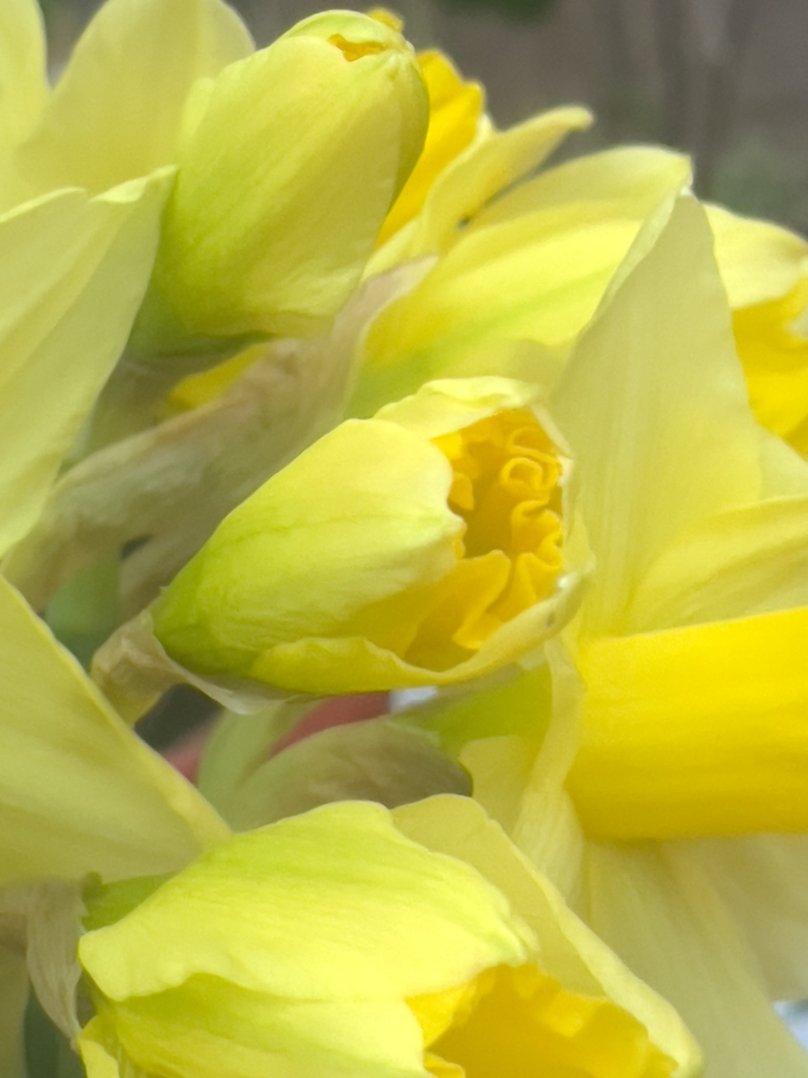
Daffodils
– Day 6
Robert
Herrick (1591-1674) wrote the following poem in 1648.
To Daffodils
Fair Daffodils, we
weep to see
You haste away so
soon;
As yet the
early-rising sun
Has not attain’d his
noon.
Stay, stay,
Until the hasting day
Has run
But to the even-song;
And, having pray’d
together, we
Will go with you
along.
We have short time to
stay, as you,
We have as short a
spring;
As quick a growth to
meet decay,
As you, or anything.
We die
As your hours do, and
dry
Away,
Like to the summer’s rain;
Or as the pearls of
morning’s dew,
Ne’er to be found
again.
In 1986
the daffodil was adopted by the Marie Curie charity as a symbol of strength,
resilience, hope, joy and new beginnings. Marie Curie is the UK’s leading end of
life charity. The annual Great Daffodil Appeal occurs in March and each
daffodil worn represents a donation to the charity.There are
several hospices across the country and Marie Curie nurses also attend
terminally ill patients in their own homes. My sister’s nurse made her last
days full of laughter and Beryl died with a smile on her lips.
The
American Cancer Society, the Cancer Society New Zealand the Canadian Cancer
Society, Cancer Council of Australia all use the yellow cheerfulness of the
daffodil to symbolise their campaigns.Maria
Salomea Skłodowska (1867-1934) was born in the Kingdom of Poland, then part of
the Russian Empire, in Warsaw. She studied at Warsaw University and then later
in Paris, where she subsequently conducted her scientific research. She married
the French physicist Pierre Curie and it is by the name Marie Curie that she is
remembered. In 1903, with her husband and the physicist, Henri Becquerel, she
shared the Nobel Prize for Physics for pioneering work in the development of
what she called the theory of ‘radioactivity. She and her husband were the
first married couple to win a Nobel Prize.In 19ll, Marie Curie won the Nobel Prize for Chemistry for her discovery of the elements
polonium and radium. She remains the only person to have won a Nobel Prize in
two sciences. During WWI she developed mobile radiography units for use in
field hospitals. It is probable that she died, in 1966, from the effects of
radiation exposure, the official diagnosis being aplastic anaemia.
Marie
Curie’s elder daughter, Irène, won the 1935 Nobel Prize for Chemistry with her
husband, Frédéric Joliot-Curie. Her younger daughter, Ève, became the director
of UNICEF and her husband was awarded the Nobel Peace Prize in 1965, as a
representative of UNICEF. It is quite remarkable for one family to have received
such acclaim.