Showing posts with label Somerset. Show all posts

Wednesday, 13 December 2023

Little Jack Horner


Little Jack Horner

Illustration by American illustrator W W Denslow (1856-1915) 

Image courtesy of Wikimedia Commons

Little Jack Horner

Sat in the corner

Eating his Christmas pie;

He put in his thumb

And pulled out a plum

And  said, ‘What a good boy am I.’

I always thought this was a strange rhyme and wondered whether it had any relevance to Christmas. The rhyme dates from the 18th century but appears to have its origins in the dissolution of the monasteries during the reign of Henry VIII in the 16th century.

Jack Horner was steward to the Abbot of Glastonbury, Richard Whiting. His responsibilities were to manage the church property and finances and to help the Abbot in administering the diocese.

 Glastonbury was the second richest monastery in England after Westminster by the end of the Middle Ages and was still affluent when Henry VIII came to the throne in 1509. In 1536 there were over 800 monasteries.

 Following the King’s separation from the Roman Catholic Church and the foundation of the Protestant Church of England, Henry ordered the dissolution of monasteries and other religious houses in England, Ireland and Wales, and appropriated their wealth. The dissolution was conducted for five years, from 1536 to 1541. The majority of the religious communities accepted their fate and the money and pensions they were given, but others, like the Abbot of Glastonbury, would not comply and were executed and their monasteries destroyed. Richard Whiting was hanged, drawn and quartered on Glastonbury Tor for his refusal to cooperate.

It is said that the Abbot of Glastonbury, in a bid to appease the King for his non-compliance, sent Jack Horner to London with a Christmas gift of a plum pie. Hidden under the pastry crust were the deeds to twelve manors. Jack opened the pie and removed the deeds to the village of Mells in Somerset.

Thus, the ‘plum’ of the pie was the manor of Mells. The rhyme was about greed and opportunism and has been used by satirists to illustrate the nefarious activities of politicians and others interested in improving their lot in life by devious means.


Illustration by American illustrator Blanche Fisher Wright (1887-1938) 

Image courtesy of Wikimedia Commons

The melody for the rhyme was first recorded by James William Elliott in  'National Nursery Rhymes and Nursery Songs


Thursday, 26 October 2023

Traditional pursuits in October – part 3


Traditional pursuits in October – part 3

St George's church, Hinton St George

In villages across Somerset the tradition of Punkie Night is upheld. One of the best-known, if not the best-known is at Hinton St George, a small village surrounded by farmland, woods and orchards. It has a population of about 450 but retains all the amenities a community requires – church, pub, primary school, shop, post office and village hall. On the last Thursday of October the village celebrates the Somerset tradition of Punkie Night.

Punkie is an old English name for a lantern which has been carved from a root vegetable like a swede or turnip or mangelwurzel. The Jack-o’-lantern has a lighted candle in it. Nowadays, a pumpkin is often used (and is easier to carve, I can attest!)

This year, 2023, Punkie Night falls on 26th October. Starting at the village hall at 6:00 pm children form a procession that sets off to travel through the streets of the village. They are led by the Punkie King and Queen and travel from house to house, swinging their punkies and maybe hoping for a treat or two.

As they go they sing traditional songs like the following:

It’s Punkie Night, tonight,

It’s Punkie Night, tonight,

Give us a candle, give us a light.

If you don’t you’ll get a fright.


It’s Punkie Night, tonight,

It’s Punkie Night, tonight,

Adam and Eve wouldn’t believe

It’s Punkie Night tonight.

Legend holds that in the Middle Ages, all the men of Hinton St George went to a fair. When it came to evening and they had not returned, the village women went to look for them, lighting their way with punkies. The punkies gave protection from evil as well as light. Farmers of old would put punkies on their gates to fend off evil spirits.

Punkie Night has echoes of Hallowe’en. The children often dress up, sometimes in something like mediaeval dress, but more likely these days in ‘spooky’ costumes. The procession stops along the way for Morris dancing and the singing of Punkie songs and finishes later at the Village Hall where the Punkies are hung up to be judged. There are first, second and third prizes for the best punkies in different age groups.


Saturday, 20 August 2011

Home alone with five dogs and a cat . . .


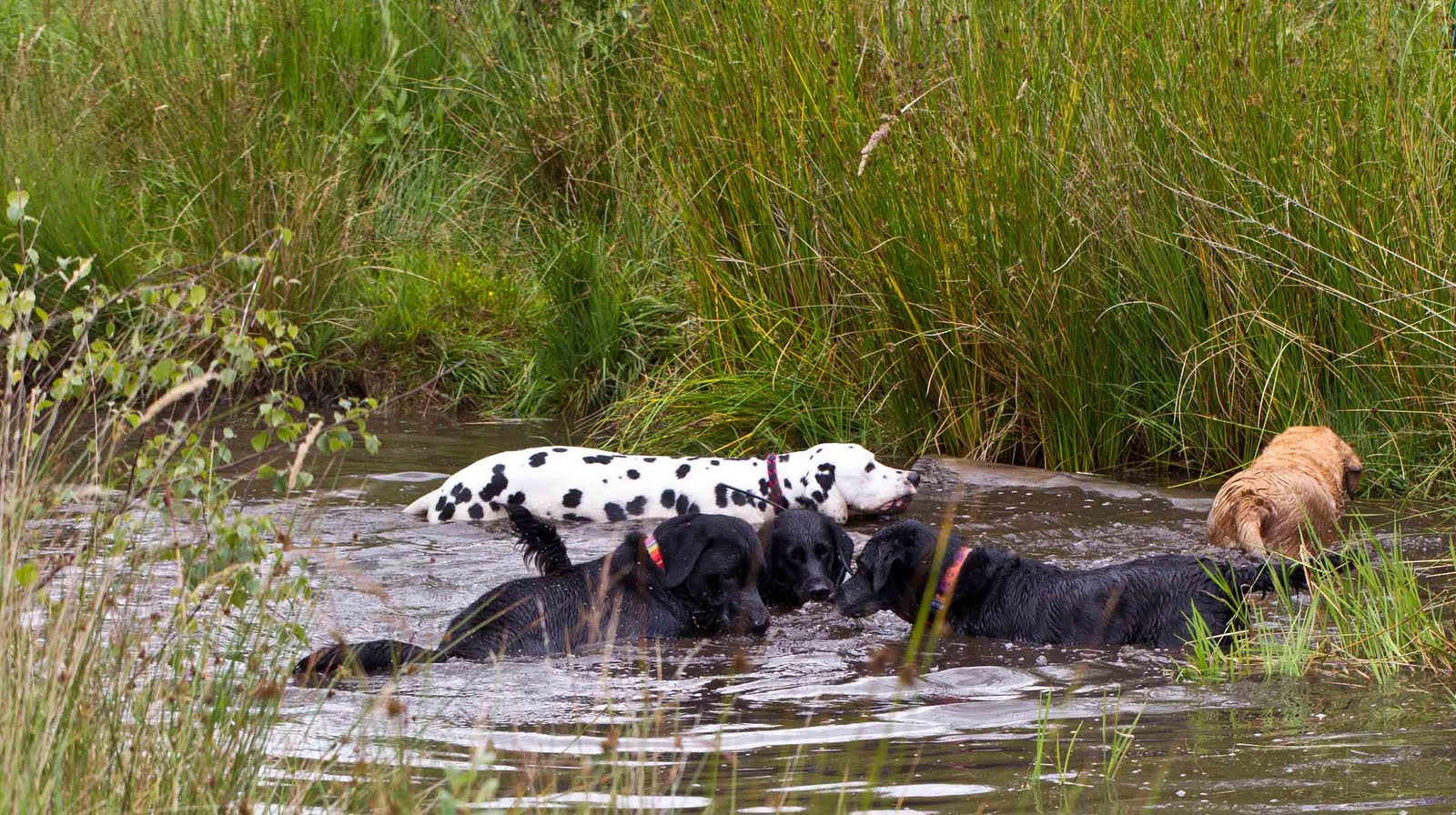
Bathing is one of Frodo's delights
Barry has been away this week, sailing with Gillian and two of her children. His leg is much better – he was bowled over by the very solid Gus when we were in Somerset which resulted in him having two wonky legs rather than just the usual one! Hours spent in A&E when we got home – after he insisted on driving, saying it was just weight-bearing that hurt! – proved that there was no lasting damage, and diclofenac and ibuprofen relieved the pain.

Meanwhile, I have been writing – or trying to – and looking after Gillian’s dogs as well as our own. They all sleep in our room, most of them on our bed, which is fine when Barry’s away as they occupy his half. Winston usually comes and curls up next to me as well, so I am never lonely. Tia and Foxy, Gillian’s dogs, think it is their duty to guard the house and bark at . . . nothing, apparently! Tia also grumbles constantly at Frodo. She is slightly older than him so perhaps she’s asserting her right to be top dog. He takes little notice.
Frodo has had four grand mal seizures this week. I hope that will be the end of the cluster this time round. With luck it will be several weeks before he is afflicted again. I’m accustomed to dealing with him when he’s seizing, talking to him and supporting his head so that it doesn’t bang against furniture or floor. He can’t hear me, of course – he’s unconscious - but perhaps it’s comforting to him in some way, particularly when he regains consciousness but is still disorientated.
Jenna takes no notice when he has a fit and Tia keeps away. Gus thinks he’s playing and wants to respond but Foxy looks more as though she might attack. She’s a very mild-mannered creature but even the quietest of dogs can misinterpret the odd signals given by a seizing animal as aggression and react accordingly. Thus, at 1:00 am on Thursday, I was keeping her away and simultaneously trying to cushion Frodo’s head when my right hand came within his champing jaws. The result was that he bit my thumb and index finger. It was quite painful.
The black Labradors seek the Kong. Frodo and Foxy don't!
Later, on Thursday evening, he had another fit. Foxy was very excited and trying to reach him and as I pushed her away my left arm was bitten. Isn’t fresh blood bright, like a swiftly blooming crimson flower?

So now I have a sore, bruised thumb which is much better than it was, and bruises and a plaster over the puncture wound on my arm which aches a bit but is otherwise fine. Worse things happen at sea! Poor Frodo is the gentlest dog and would be mortified if he knew! It is nearly seven years since he was diagnosed with idiopathic epilepsy and I’ve managed to keep bits of me away from the dangerous bits of him for all that time – until this week!

Ah me! Next week, the bites will come from tiny sharp puppy’s teeth.J 

Saturday, 13 August 2011

Camera Critters #175, Pet Pride

Some of my favourite people, two-leggers and four-leggers, met in Somerset last weekend.
Barry, the one who takes the really GOOD photographs on this blog. We celebrated our 44th wedding anniversary yesterday.
Never too big to play with little children's toys!
Left to right: Elliot, Callum, Kiri, Louis
Frodo and Gus - boys together
Eve makes a big fuss of Gus
Tia 
Louis chats to Jenna
Frodo, Gus, Foxy
Marnie takes a rest
The gang!

I'm linking to Camera Critters and Pet Pride. Click on the names to see more lovely photographs across the world.

Thursday, 11 August 2011

Friday, 7 August 2009

Invasion!

Great Britain has been invaded and can expect to remain occupied for at least six weeks. It's the Europeans again! Through the centuries we have suffered from assaults from Romans, Vikings, Normans – even the Germans declared intent to overcome but were repulsed before reaching these shores.
This time it is ladybirds that have marched or rather, flown into parts of Norfolk, on the East coast, and Somerset, in the South-West. The spotted hordes have swarmed in because of a glut of aphids that has resulted from the hot, wet weather. Cars, roads and buildings have been covered in layers of the brightly-coloured creatures – I didn't know aphids could be found in those locations – maybe the ladybirds know something the rest of us don't.
It is the most extreme invasion since 1976 though we always have some ladybirds flying across the Channel to holiday in these fair isles.
The name ladybird has been in use for centuries and was originally a reference to the Virgin Mary – Our Lady – because she was often portrayed wearing a red cloak.
The collective noun for ladybirds is a 'loveliness' and folk lore holds that they can predict the weather. If one falls off your hand that means it will rain but if it flies away the weather will be fine. Be careful, though, for they can nip. The intruder Harlequin ladybird has a more unpleasant bite that can cause mild skin irritation.
If a ladybird lands on your hand you may make a wish and then blow it away.
Unlike humans, who develop 'age spots' as they grow older, ladybird's spots fade as age. They live for just about a year but in that time will consume more than 5000 aphids, justifying their reputation as the gardener's friend. If plenty of food is available the female will lay more than 2000 small yellow eggs. These are laid in the same locations as their prey so that the developing larvae have a convenient source of food. However, they don't like cooler weather and will not fly if the temperature drops below 12.7c (55f)
The unfortunate human holidaymakers who have witnessed this influx may find themselves reciting the old nursery rhyme with some intensity:
Ladybird, ladybird, fly away home
Your house is on fire and your children are gone
All except one, and that's Little Anne
For she has crept under the warming pan.

Naturally, when I hunted in the garden there was not a single ladybird to be seen. I suppose they've all packed their bags and joined their friends and relations at the seaside
.Common Seven Spot ladybird (Coccinella septempunctata) Image from Wikipedia