Showing posts with label cheetah. Show all posts

Monday, 13 July 2026

Of cats’ claws


Of cats’ claws

When resting, a cat’s claws are sheathed in protective skin pouches. If a cat wants to climb or hunt, it flexes leg muscles to unsaddle or extend its claws.

Most cats, both domestic and wild, have retractable or sheathable claws. Hind paw claws are not always completely sheathed.

There are four exceptions to the retractability of cats’ claws. The first is the cheetah (Acinonyx jubatus), whose claws do not retract completely, giving it good traction when running.

The second is the endangered fishing cat (Prionailurus viverrinus) which has partially webbed feet and semi-retractable claws, allowing it to maintain its footing in muddy marshland. It is a strong swimmer and has been observed swimming underwater and catching waterfowl by the legs.

The third is the also endangered small Southeast Asian flat-headed cat  (Prionailurus planiceps). This cat lives mainly on fish it takes from rivers. It plunges its head into the water and uses its front paws to feel for prey in the shallows.

The last is the rare and critically endangered Iriomote cat (Prionailurus bengalensis iriomotensis) found only on the island of Iriomote, in Japan. It is closely related to the leopard cat.

Cats usually have eighteen claws, four on each hind paw and five, including dew claws, on the front paws. Some breeds, notably Maine Coons and Pixie-bobs, are polydactyl, meaning they have more toes than usual. Their ‘mitten paws’ may have any number from four to seven toes on each paw. Polydactyly usually occurs on the front paws, and it is rare for it to appear on all four limbs.

Sailors prized polydactyl cats, believing them to have superior balance, climbing, and mousing ability. They were thought to bring good luck. In the 1930s a ship’s captain gave Ernest Hemingway (1899-1961) a white cat with six toes. She was called Snow White and Hemingway was enchanted by her, and the litters of kittens she bore. Because of his great affection for polydactyl cats, they are frequently referred to as Hemingway cats.

 At the Ernest Hemingway Home and Museum in Key West, Florida, there is a colony of about sixty cats, many of whom are descended from Snow White. Hemingway started a tradition of naming the kittens after famous people, like Pablo Picasso, Audrey Hepburn, Clark Gable. The Museum continues the tradition today.

No matter how many claws a cat may have, it will shed the outer sheaths at regular intervals. The claws are made of keratin, like human hair and nails, and develop in layers from the inside out. Cats scratch to remove the outer layer every two to three months. Our stair carpet bears witness to this activity, and ‘ghost’ claws can be seen frequently.

Sunday, 24 November 2024

Purring


Purring

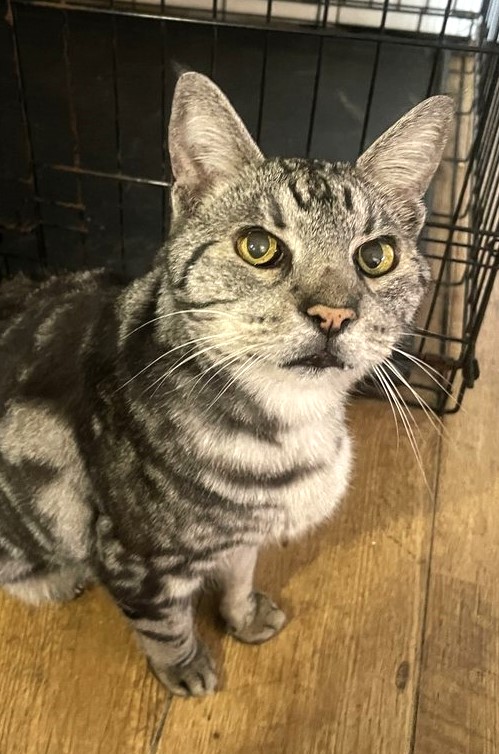
Herschel wraps his toes

A purring cat is a comforting, warming thing on a lap, not for everyone, of course. Domestic cats are unique in being able to purr while inhaling and exhaling. There are some who dislike cats for many reasons.

Herschel is quite choosy about laps, generally preferring to use them as stepping stones to more interesting locations, and saving his purring company for prone bodies in bed.


Here's looking at you.

We wondered, for the umpteenth time, if big cats purred. We seemed to remember that they didn’t but checked anyway. Big cats can roar but not purr, because of the anatomy of their throats.


You called?

In Felis, the domestic cats and the smaller wild cats, delicate bones, the hyoid bones, extend from the back of the tongue to the base of the skull. The cat vibrates its larynx which sets the hyoid bones thrumming. It is not clear why cats purr. One theory suggests that it is a way of masking the cries of young kittens, thus keeping them safe from predators. Another is that it is a means of communication between mother and offspring. The small kittens, being both blind and deaf at birth, sense the vibrations and move towards them. Kittens purr from the moment they’re born as a way of letting their mother know where they are.

The big cats or Panthera also have hyoid bones, but they are bigger and joined to the skull with thick cartilage. This allows the larynx the flexibility to produce loud roars, but not the delicacy of purring.

So, the cats are divided into two classes, the purring cats and the roaring cats. It is lions that roar most often, the other big cats restricting themselves to snarling and grunting, hissing and coughing.

The largest of the purring cats is the cougar. It is the only member of the Puma family and is not considered a ‘big cat.’ It is also known as the mountain lion, and the panther, not to be confused with the black panther, which is a black form of both the leopard and the jaguar.

The next largest of the purring cats is the cheetah. It is the only surviving member of its family, the Acinonyx. It differs from all other cats, big and small, in having claws that are not fully retractable.

Most people assume that a purring cat is a happy, relaxed cat. However, it may be feeling stressed. There will be other signs, like flattened ears, wide pupils and whiskers pointing forward, to tell an onlooker that a cat is uncomfortable or in pain.  Cats also purr to soothe themselves . . . The low frequency vibrations of a cat’s purr are suspected to promote bone and tissue growth and lessen pain and swelling.’

Stroking a cat’s silky fur is a pleasurable experience and purring seems like a sign of gratitude from a cat. Stroking is a form of stimulation and can become less a pleasure for the cat and more of a provocation if it becomes too intense. A cat may then react by nipping or grabbing the hand in its paws, sometimes all four at once, and kicking. As with all animals, including humans, it is wise to pay attention to body language.