Showing posts with label violets. Show all posts

Tuesday, 15 April 2025

Origins


Origins

I have little idea of the origins of some of the plants in our garden. For example, we have masses of violets and I’m quite sure I’ve never introduced them. Certainly, I have transplanted some over the years and I’m always delighted to see them. They self-seed so they’re popping up all over the place now, which pleases me no end.

I had noticed some green leaves in a flowerpot, but didn’t pay them much attention until I realised they were producing flower buds. This provoked me into closer inspection. 


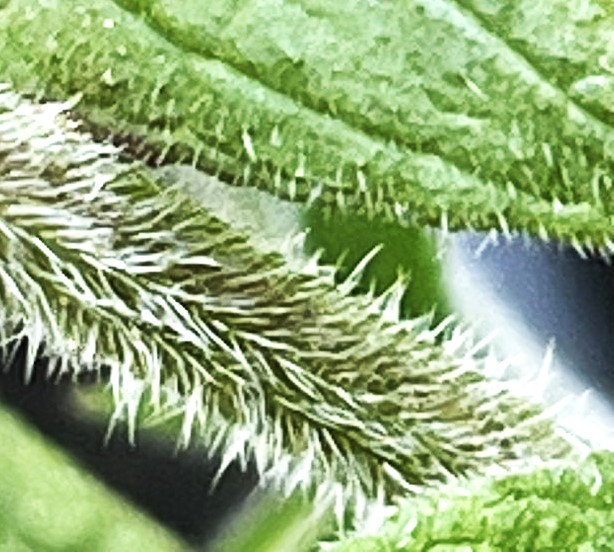
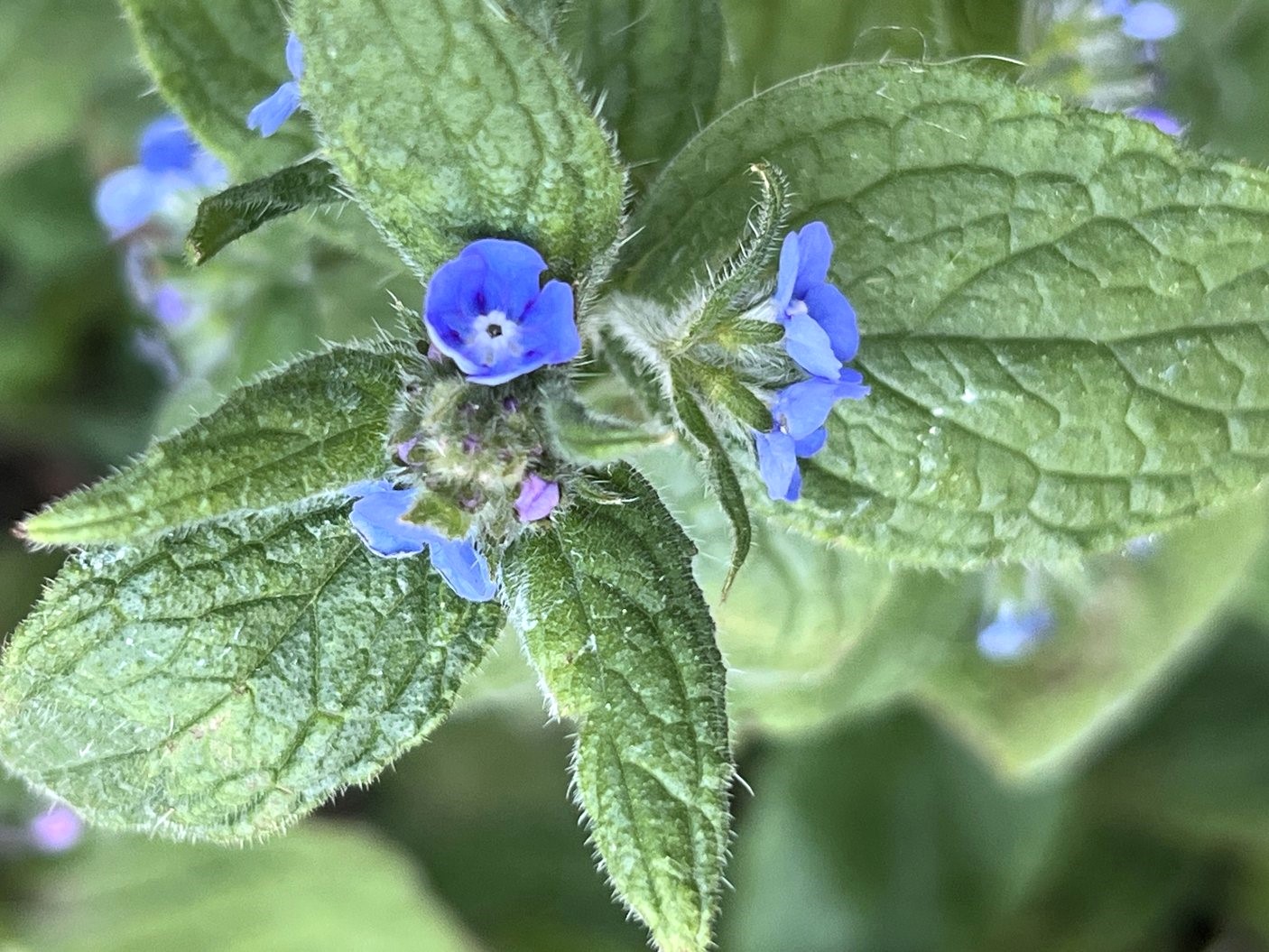
Using my iPhone app, ‘PictureThis,’ I discovered that the stranger was green alkanet (Pentaglottis sempervirens) a perennial which can sometimes become a nuisance, though it does provide good ground cover.  

The flowers are blue with white centres and are sometimes confused with forget-me-nots, though the plant stems are covered in bristly hairs and the leaves are also hairy, unlike forget-me-nots.

Green alkanet is a rich provider of pollen and nectar for bees, butterflies and hoverflies, flowering throughout the summer. Its leaves give food for the day-flying Scarlet tiger moth (Callimorpha dominula) and shelter for invertebrates at soil level.


                        Scarlet tiger moth (Callimorpha dominula)

Scarlet tiger moth images courtesy Wikimedia Commons

It used to be considered edible, although it did not taste very pleasant. Its pretty flowers were used as garnish for many dishes. However, latterly it has been discovered to contain carcinogens. In addition, the bristles can cause skin rashes, so it’s advisable to wear gloves when handling it.

Green alkanet is not native to Britain and has its origins in Spain, France, and Portugal. It was first brought to Britain around 1700, as an ornamental garden plant and was available for sale in plant nurseries. Inevitably, by 1724 it had escaped and quickly established itself in grass verges and hedgerows. It is common in southern England.

Tuesday, 26 April 2011

April A to Z blogging challenge Violets

This is an edited version for the A to Z blogging challenge of a story I wrote a few months ago.
My grandmother lived a short distance from our house and I visited her every day. She was a gracious old lady who had been an important part of my young life. Sometimes I stayed with her and slept in her guest bedroom, a pretty room decorated in lavender and white.

I enjoyed the bedtime ritual in her house. First I would have a bath in the claw-foot tub in her huge, chilly bathroom and then wrap myself in one of her large soft white towels and go through to her bedroom where she would brush my hair – one hundred strokes counted out in her soft voice as the bristles swept smoothly through my long straight locks. Then she would give me her box of talcum powder and I would dip the puff into the silky dust, loving the feel of the satin ribbon between my fingers. Sometimes she would dab a little of her perfume on my wrists – it matched the powder – then I would feel so grown up.

Whenever I stayed with her she gave me a sprigged nightgown to wear that had belonged to my mother when she was a child. It had a high neck and long sleeves and fell from a smocked yoke to my feet in gentle folds. There was plenty of room in it to tuck up my feet until they were warm enough to make contact with the cool bed linen.

Then we would go downstairs to the sitting room, a room full of curios and books and plants. The subdued light made the room welcoming and comfortable and though I must have stayed with my grandmother at different times of the year, it is the winter evenings that I recall most clearly, a log fire burning brightly in the grate and casting flickering shadows on the walls and ceiling. My face would grow hot as I leant forward to hold the long toasting fork ever closer to the glowing coals. Crumpets dripping with butter and honey – ‘As many as you like,’ she always said and I would hug myself with glee at the promise. At home such treats were strictly rationed and I always longed for more.

Strangely, at my grandmother’s house I never managed to eat more than the two I was given at home, but it was the thought that I could have more if I wanted that gave me a wonderful feeling of being indulged. Afterwards my grandmother would read to me as I sipped hot chocolate from a delicate china mug. When the story finished, always at the same moment that I drained the last sweetness, my grandmother would hold out her hand and together we would climb the stairs. She would tuck me in, pulling the sheet and blankets firmly round me so that I felt safe and contained. She would kiss me – ‘Night, night, sleep tight. Sweet dreams.’

I would turn on my side and draw up my knees and gaze around the room, lit by a night light – my grandmother knew I hated the dark. The pictures on the walls were of flowers that she had painted and framed - primroses, honeysuckle, bluebells. The curtains and bedspread were soft cotton patterned with tiny pink rosebuds entwining dainty violets. On the bedside table, next to the water carafe and glass, was a small charmingly decorated tin of Parma violets more treasured for their scent than their taste. They smelt like my grandmother – or should it be that she smelt like them?

The next morning I would go home, happy to join my family once more and knowing that I would see my grandmother the next day. I thought I would see her every day for the rest of my life.

My granddaughter lives nearby and visits me most days. Sometimes she stays overnight. Yesterday she burst in excitedly. ‘Look, Grandma, look at these. Aren’t they lovely? Mummy put them in a special box for me. She said you’d like them.’ She thrust a tissue wrapped parcel into my hand and hopped from foot to foot, impatient for me to open it.

The first thing I saw was the lid with its painted flowers and I knew, before I removed it, what was inside. Slowly I took off the top and there, nestled in shreds of lavender paper, were Parma violets. The released scent filled the air. I offered one to my granddaughter. She smelt it then put it in her mouth. ‘Ugh!’ she said and I smiled. I don’t like the taste, either, but the smell reminds me of my grandmother – it was the cologne she always wore. 

Thursday, 22 April 2010

April is the cruellest month

April is the cruellest month, breeding
Lilacs out of the dead land, mixing
Memory and desire, stirring
Dull roots with spring rain.
Winter kept us warm, covering
Earth in forgetful snow, feeding
A little life with dried tubers.
From 'The Waste Land' 1: The Burial of the Dead T S Eliot (1888 - 1965)
I cannot agree with Eliot's sombre reflection.Certainly April is changeable, perverse and unpredictable in her habits,but when the sun shines and birds sing and buds unfurl into fresh green leaves and scented blossoms and delicate flowers it is a month to be lauded and applauded.
April violets - Viola - in the garden
We have never planted these in our garden but they appear each year and are spreading, to our great delight!
 
Dog violets - Viola riviniana -  in the forest today
(Pity they weren't Viola labradorica!!)
For me April is a soft and gentle month of new life and optimism, of a promise fulfilled and a pledge renewed that more is to come.
April's colours are subtle; there is not the extravagance of the summer flowers that bloom to excess, each brighter and showier than its neighbours to attract the butterflies and bees. Roses are overblown - forget-me-nots never!  
Forget-me-nots - Myosotis - appear every year, mostly blue, occasionally pink or white, they are pretty, unassuming little plants.
The last few days in my corner of the globe have been wonderful - warm, bright, breezy and loud with bird song. Already there are many butterflies and bees busily following their instincts and each day brings new delights as more almost forgotten beauties reveal themselves.
Exochorda - the Pearl Bush
Always at this time of year, almost unbidden, the choral piece 'All in the April evening' comes to my mind. I sang it as a girl at school and have always loved it. In this video it is sung by the  Glasgow Orpheus Choir.


Lily of the Valley - Convallaria majalis - comes twirling its way to the surface.
Honesty - Lunaria rediviva - is a biennial plant. Its flowers are usually purple, sometimes white and attract, bees, butterflies, moths and flies which pollinate them. Some of its popular names are Silver dollar, Penny flower, Moonwort. Flower arrangers like to use its papery silver seed heads in their displays.
April sun gladdens the heart and makes the spirit dance. The sap is rising and, as Alfred Lord Tennyson  (1809 - 1892) so aptly wrote, 'In the spring a young man's fancy lightly turns to thoughts of love.'
More than 200 years earlier William Shakespeare (1564 -1616)  wrote 'verses' that appeared in 'As You Like It'. It has been suggested that the banality of the rhymes and lyrics was a deliberate ploy by the bard to show his playful side. The words have been set to music by a number of different composers. In the following video the work is sung to Thomas Morley's music. He was a contemporary of Shakespeare so perhaps his rendering is the most appropriate!
.