A to Z challenge 2023 – Y is for . . .
My
theme for this challenge is Nature in all much of her wonderful
diversity. My posts will reflect the fact that I am resident in the south of
England.
All
photographs in this post are the property of the writer.
Yellow
archangel (Lamium galeobdolon)
Other
names for this essentially wild perennial include artillery plant, cobbler’s
bench or, my favourite, yellow weasel-snout. It grows throughout the UK but is
most common in England and Wales and is a good source of nectar for bees. It
prefers to grow in well-drained soil in full sun but will tolerate less
favourable conditions.
Its
leaves bear a similarity to those of the stinging nettle, but it is unrelated
and is known as a dead-nettle. It may have evolved to look like stinging
nettles as a defence against predators. It actually belongs in the mint family
and its shoots and flowers are edible, either cooked or raw.
The name
‘archangel’ arises because it comes into flower around the time of St Michael’s
Day on 27th April.
St Michael is an archangel in Judaism,
Christianity, Islam and the Bahai’i faith and is one of the lower angels. The
higher orders of angels have more authority over their subordinates and look
different. They may also have more wings or faces.
In Christianity the three highest ranks are Seraphim,
Cherubim and Thrones, followed by the middle orders of Dominions, Virtues and
Powers. The lowest ranks are Principalities, Archangels and Angels.
There is
no such distinction among the dead-nettles.
The Celts
believed that dead-nettles would protect them from evil spirits and guard their
cattle from ‘elf-shot’. They thought that ‘elf-shot’ or ‘elf-stroke’ was a
paralysis caused by arrows fired at the cattle’s heads by elves at the behest
of witches.
Dead–nettles
have been used for centuries in folk medicine, as a cure for kidney problems
and bladder infections. They were also used to treat gout, sciatica and
arthritis.
They are
still used by herbalists today and there is some scientific evidence of the efficacy
of them in treating common ailments.
Dead-nettles
present in several different colours as white dead-nettle, red or purple
dead-nettle and henbit dead-nettle as well as yellow archangel. Dead-nettles
flower from the end of spring to early summer.
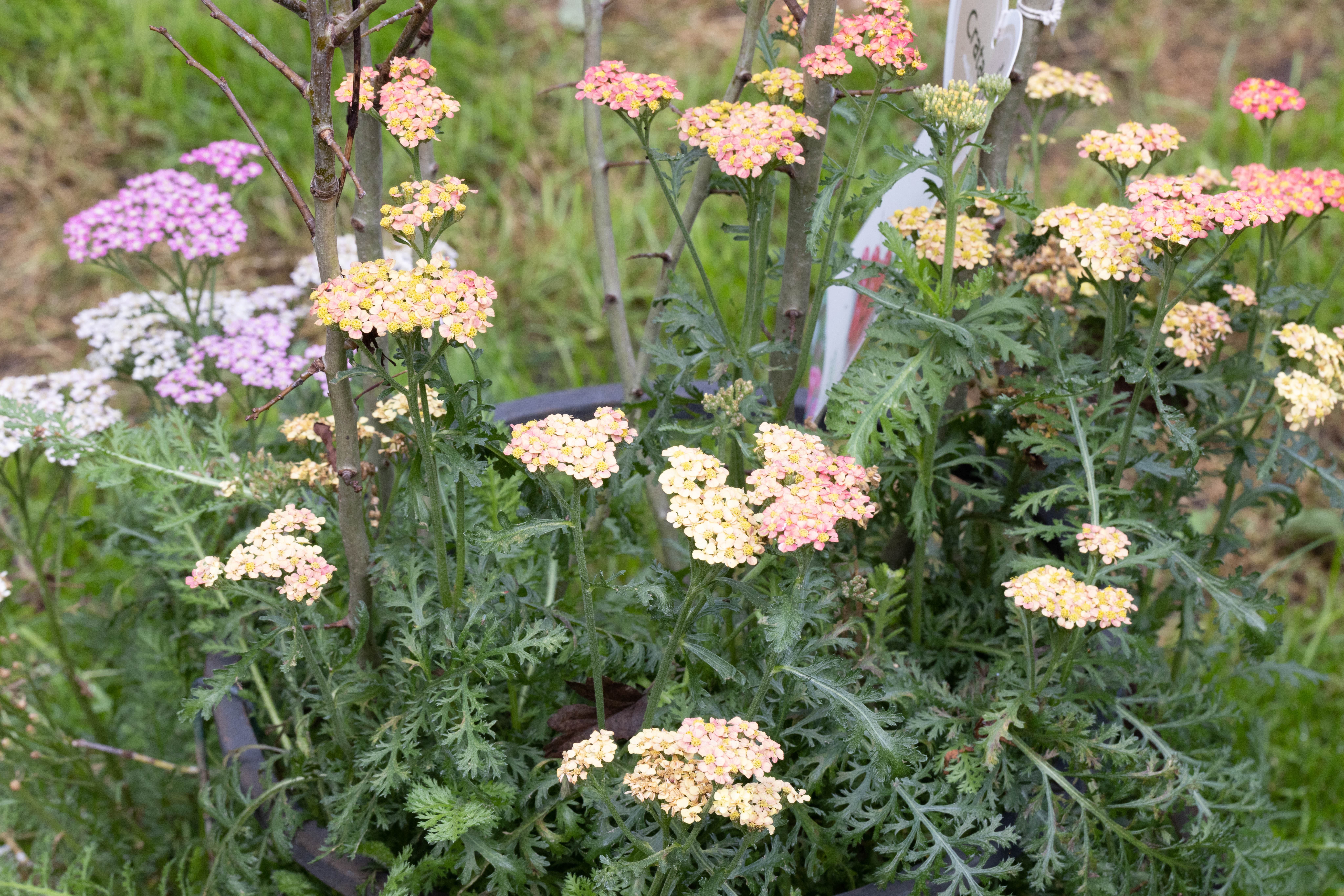
Yarrow (Achillea millefolium)
Yarrow is
a widespread native perennial with a strong sweet scent. It attracts many
insects when it flowers between June and November. The flat-topped flowering
clusters are composed of many tiny flowers and come in white, pink, and shades
of red, yellow and purple. It grows to a height of about 50 cms, forming
clumps, and is reputed to be as attractive to butterflies as buddleja.
Yarrow
has been used agriculturally to help restore arable land to grassland when sown
with other native plants. It has also been introduced as a feed stuff for
livestock in Australia and New Zealand.
Yarrow
used to be considered a charm against bad luck and illness. Medically, it was
used to stop wounds bleeding but conversely it was thought to cause nosebleeds
if put up the nose. It is an anti-inflammatory and is an effective topical
treatment for bruises and sprains. It is also anti-bacterial and anti-fungal,
so good for cuts and stings. Some birds,
including the starling, line their nests with yarrow, perhaps as an inhibitor
of parasites.
It is a
member of the aster or daisy family.
Other
popular names include old man’s pepper, devil’s nettle, milfoil and soldier’s
woundwort. In Sweden it is called field hops and has been used to make beer.
‘Achillea’
in the plant’s name refers to the mythological Greek hero, Achilles. According
to one legend, Achilles was held by his ankle and bathed in the River Styx. A
different version says that he was dipped in water infused with yarrow and that
the plant imbued him with its own protective powers. He used the plant to heal
his wounded soldiers.
Achilles was
killed by an arrow that hit the only weak point in his body, the part that had
not been touched by the water, from which arose the expression ‘Achilles heel’,
meaning weakness.




.jpg)
.jpg)
.jpg)