It is November, isn’t it?

Spotted in the garden this foggy November morning were bright raspberries.

I know the seasons are more than usually muddled in the UK this year, but this is remarkable.

It is November, isn’t it?
Spotted in the garden this foggy November morning were bright raspberries.
I know the seasons are more than usually muddled in the UK this year, but this is remarkable.
Gardening in early June

We hacked down our very tall climbing rose and it’s desperate to reach the heavens again, but we shall keep it short. It has a bud on it, which will produce a pink rose. I don’t know the name of it, but call it 'Jack and the Beanstalk.'
I worked around, removing flowers growing in the wrong place – weeds to the uninitiated! – and pulling out the last straggling forget-me-nots. Raspberries and strawberries are ripening, but there’s no colour on the blueberries. The cherries have been collected, the plums and apples, apricots and damsons are promising, while the poor pears struggle along but rarely deliver.
I admired the tiny white flowers on the goosegrass (Galium aparine) as I pulled it up. It tries so hard, and spreads everywhere. It is also known as cleavers, sticky willy, catchweed, sweetheart, bedstraw, and robin-run-the-hedge. I’ve always known it as goosegrass or cleavers. It’s a favoured food for geese and chickens, hence its common name of goosegrass.
The plant, which belongs in the same family as coffee, is more interesting than it first appears. It can be cooked as a vegetable before the fruits ripen, but is not so appetising if eaten raw, because of the little hooks that cover the leaves and stems. The burrs which follow the flowers hold two or three seeds. They also have hooks which attach to passing animals or humans, thus being easily distributed. The fruits have often been used as a coffee substitute and contain less caffeine than coffee beans. The leaves can be dried and used to make tea, and the roots produce a red dye.
As a bedstraw, it was used to stuff mattresses.
In Ancient Greece shepherds made sieves from the stems of cleavers to strain milk, a practice that was also followed in Sweden.
Having plucked out much of the plant, and knowing there will be more later, I left the garden, but not before looking at some more roses. Somehow, they’ve all managed to hide away.

‘Warm Welcome’ is a semi-evergreen climbing rose. It’s sweetly scented and a vibrant orange-red.

Growing near it is a deep pink old Bourbon rose, 'Zéphirine Drouhin’, which has a rich, intoxicating scent and very few thorns.


Image courtesy Wikimedia Commons
The final one is a pink David Austin climbing rose called ‘The Generous Gardener’, which has a strong, sweet fragrance. It was named to mark the 75th anniversary of the National Garden Scheme.
The National Garden Scheme was founded in 1927 to make private gardens accessible to the public. For the privilege of visiting a splendid garden, visitors pay an entrance fee which goes to a variety of charities, including Macmillan Cancer Support, Hospice UK and Parkinsons UK. In 2025, donations amounted to nearly £3.9 million.
Anyone can open their garden for charity, and the gardens may be anything from a community allotment to a cottage garden, from rolling acres to wildlife havens, from seaside to town.
I know someone who opens her garden for one or two days each year. It’s a lot of work, but so worthwhile. It is not something I shall ever do, however.
The Dorset Family

On Tuesday evening I had a call from my eldest daughter, asking if it would be all right for her to visit the following day. She had been intending to descend on us without warning, but her elder daughter said, ‘Mum, haven’t you read Janice’s blog? She said that it's lovely to see people, but a little advance notice would be helpful.’
I was surprised at that. I didn’t know that Marnie read my blog. Anyway, Gillian took the advice to heart. On Wednesday, Gillian, her daughters, one son-in-law and all six of her grandchildren arrived. Their dogs remained in Dorset.
Five-month-old Hailey was passed to me and sat happily on my knee watching her cousins. The other three girls, Marnie’s daughter, Isla, who is twelve, Kiri’s daughter, Ariella, four, and Callum’s daughter Melia, two and a half, did what girls usually do. They settled down on the floor with paper and coloured pencils, then gravitated to construction toys with gears and cogs. It’s clear that they spend a lot of time together, giving, taking, and working cooperatively.
Fergus, who is nearly eleven, concentrated on playing with the dogs, particularly Gilbert. He is very much at ease with animals.
Luca was busy pressing buttons and investigating the contents of cupboards and
drawers. He will be three in October and is ‘into everything’ as the saying
goes. He needs a dedicated full-time adult to monitor his actions, and prevent them
if necessary possible. He found the cat litter tray especially interesting.
The texture of the granules was pleasing as it poured through his fingers. Naturally,
the more he was dissuaded from investigating it, the greater was the
fascination. Fortunately, the tray only contained unused litter! The cats were
prowling around, quite unaffected by the sudden influx of people, particularly
small ones.
Gilbert
and Arthur were intrigued by the baby and gently licked her toes, which she
seemed to enjoy. Roxy, of course, is an old hand paw with little humans,
and knew which ones to attend, principally Luca, who was waving his food around
in a tantalising manner.
Barry took Marnie and Dean into the garden, to pick apples and plums, of which there are an abundance. All the children, apart from Hailey, had a turn around the garden – such a Regency phrase!
Our garden is no longer a children’s space, in the sense that they cannot play football, cricket, or tennis in it, or ride their bikes, but it is full of interest. We have tried to divide it into ‘rooms’ with a winding path and arches which support a variety of climbing plants. Actually, it’s more the case that the plants support the arches now.
Marnie was in seventh heaven. Her ambition is to have a self-sufficient garden. She already grows a few vegetables, but has plans for much more when she and Dean can acquire a house with a bigger garden.
She came back into the house laden with fruit, a branch (!) of bay leaves to dry, thyme, oregano, a number of different mint plants, which she can root on, and a great quantity of cobnuts. She and Paul, her father, have been engaged in creating chutneys and pies. The crab apples are not ripe, so she will have to make a return journey to pick those for crab apple jelly. I haven’t made that for some years now as somehow everything in sight gets covered in stickiness.
They had to leave early as Fergus had a football match near Blandford. He’s a tall boy and plays goalkeeper, like his sister, Isla, and just as his mother used to.
All too soon, the house was relatively empty again and peace descended. The dogs and cats slept well, Gilbert retiring to (our) bed shortly after his supper at 6:30.
Tonight, there will be more upheaval for Arthur when Susannah returns. He will be so excited. He’s a lovely little dog, very faithful and affectionate and we shall miss him when he returns to London with Susannah and her cats.


Jellicoe surveys

It has rained so much recently, that one thinks the skies must surely be empty by now, but no, the drops continue to drip or pour or lash down with depressing regularity. When there is an occasional lull in the downpour and even a hint of blue sky and sunshine, the cats like to stroll into the garden to check out their territory, sniff the flowers and indulge in a little ornithology.
Jellicoe was surprised to see the new structure and naturally had to examine it more closely. With three bounds he reached the top, stayed a short while to survey the world from his elevated position, then, curiosity satisfied, descended.

It will be more interesting when it is covered with flowers and foliage and their attendant world of insects, beetles and spiders large and small. Then he, and Herschel, will be able to practise their catch and kill skills.

Eventually – such a useful, all-encompassing word! – eventually, there will be two further arches, to replace the tatterdemalion edifices being supported by plants, rather than the more usual way round.
‘Eventually’ refers to a circumstance that may be achieved at an indefinable point in the future, rather like our proposed replacement front door, about which discussions have been ongoing for some several years now.

The site from which the new arch was sourced has been visited – online, of course! – but the arch bought from there is now no longer available. It won’t matter, once they’re clothed in vines!
Underneath the Arches

We have three arches along a winding path in the garden, now entering their third iteration. The first ones were metal and lasted a few years. Their replacements were wooden and lasted a few years more. When they started to sag, being supported by rather than supporting honeysuckle, clematis and jasmine, they were strengthened with spars, which kept them going a little longer.


Elsewhere in the garden . . .


The garden in late August




Coenosia tigrina on yarrow
Little fly with a big name on yarrow


Rose

Buddleja

Saururus cernuus in the pond
Commonly called 'lizard's tail', this aquatic plant disappears completely in winter.

Pears have been disappointing. Lots of pear rust and only three or four pears from the trees.

Apples have been very productive - a large basketful every day.


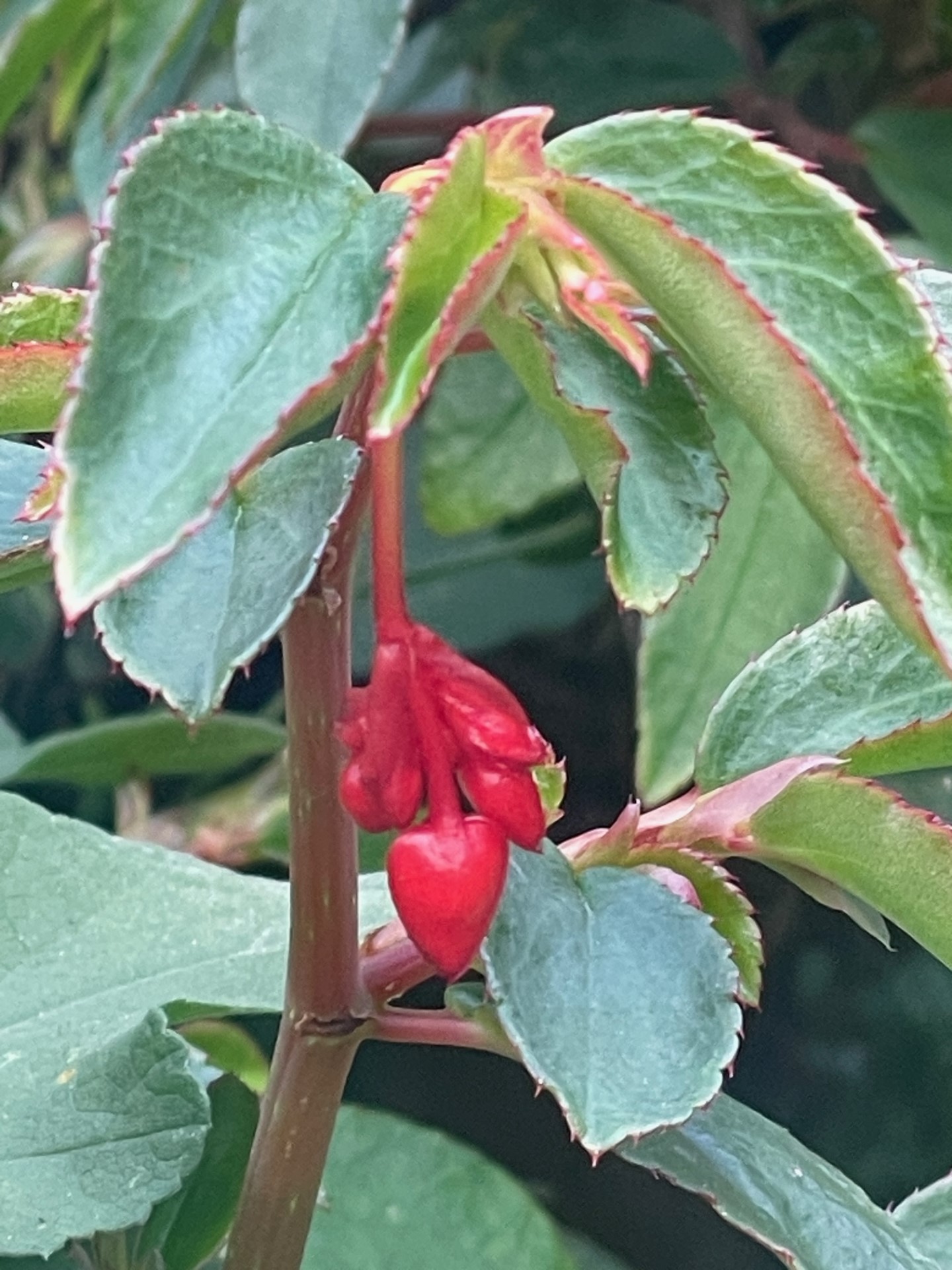

This is another of the house plants enjoying a summer holiday outside. This is Pachira aquatica, known as the Guiana chestnut or Money tree.
