Showing posts with label Gatekeeper butterfly. Show all posts

Monday, 6 August 2012

Early August in the forest


Early August in the forest
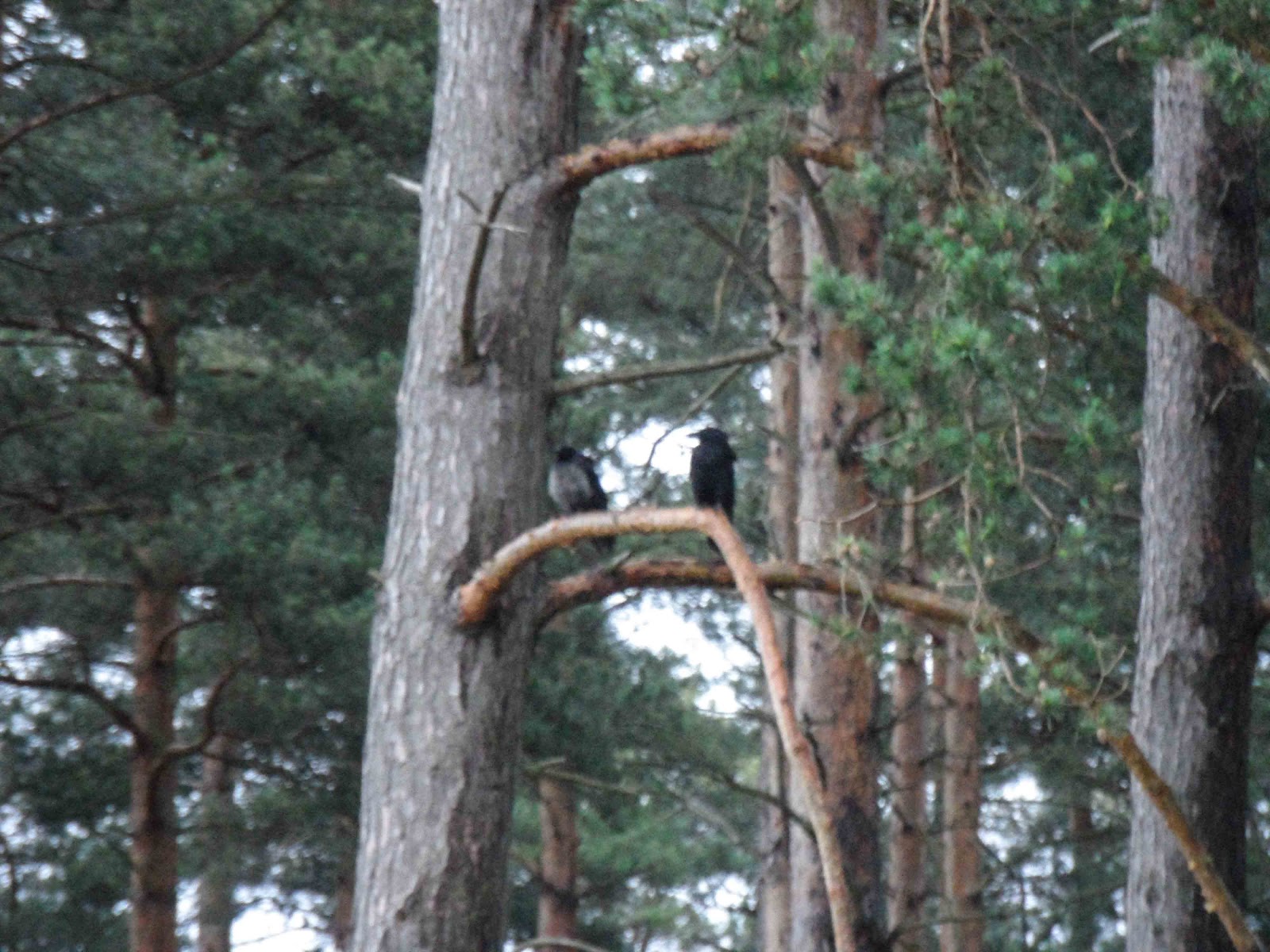
Bill junior is lighter in colour than his father
Bill and Beatrice Crow daily demand their biscuits. Bill is still the more confident bird and comes down from the tree immediately he spots that a biscuit has been thrown for him. The two young have been reduced to one, a very noisy and insistent bird that follows Bill to the ground, not to pick up the food but to squawk to be fed. Bill flies off and the youngster follows.
Frodo, Buster, Tia, Foxy, Janice, Gus, Bertie, Jenna
We decided to visit some of the ponds we’ve seen from a distance. Since the fire of May 2011 that destroyed so many trees the Forestry Commission has worked hard to clear and replant, helped by local volunteers. 
Buster, Bertie, Gus
New ponds have been dug and are full at the moment, a magnet for water-loving dogs.
In the distance you can see the Tuley tubes, protective tree sleeves to defend young saplings from foraging herbivores. They also accelerate growth because they act as a miniature greenhouse and channel growth into the main stem and roots. 60000 trees have been planted and are growing strongly.
Gatekeeper or Hedge Brown (Pyronia tithonus)
On our way back from our walk yesterday Barry spotted this butterfly. It is a Gatekeeper (Pyronia tithonus) or Hedge Brown and flies from mid-July to the end of August. It is common and widespread in the southern half of Britain and is gradually increasing its range northwards. This is a female – the male has a dark patch on his forewing that marks an area of scales (androconia) that produce scent to attract females.
It is known as the Gatekeeper because it is often found among flowers and grasses near field gates. Its alternative name indicates that it frequents hedges and the edges of fields.

Wednesday, 19 August 2009

Yet another butterfly

Yesterday, while hanging out the washing I saw a pretty butterfly ( . . . now haven't I said all this before on another occasion??) Anyway, it seemed to be taking its ease on a windowsill so I went indoors to fetch my camera and was delighted to find it was still posing helpfully so I took a photograph - well, I would have done but I'd forgotten to replace the memory chip after downloading to my laptop :-{. Needless to say the butterfly fluttered off before I could do the necessary. Muttering to myself I continued with the chores. (What chores? Gin and tonic please. . . . tada! . . . groan)Later on, Barry was walking the estate, camera at the ready, and took photos of a very pretty butterfly supping on the Candytuft - and it was the very same one I had seen in the morning, or at least a very close relative. I had no idea what it was so referred to 'Britain's Butterflies' by David Tomlinson which is illustrated beautifully with photographs, maps and drawings by Rob Still.
It is a Gatekeeper (Pyronia tithonus) a butterfly that is very successful in the southern half of England. In recent years it has been gradually extending its range northwards. It is sometimes called the Hedge Brown because it favours shrubs and hedgerows. It lives in colonies of variable size and doesn't stray far from its community. It likes to rest with wings outspread in the sun.

Gatekeepers start to fly in mid-July with a peak of butterflies at the beginning of August. The flight period ends with the end of the month.

This particular individual is a female, already looking a little ragged on the hind wings. Males have a dark band of scales on the forewing - this is called the 'sex brand'. Although they are common and widespread they are vulnerable to intensive agricultural practices and removal of hedgerows.

Candytuft (Iberis umbellata) is a member of the Brassicaceae family, related to mustard. The name derives from Candia, the former name of Iraklion in Crete.