A to Z challenge 2023 – G is for . . .
My
theme for this challenge is Nature in all much of her wonderful
diversity. My posts will reflect the fact that I am resident in the south of
England.
All
photographs in this post are the property of the writer, with the exception of the one about Shel Silverstein
Great
spotted woodpecker (Dendrocopos major)
Of all
the birds that visit my garden, the great spotted woodpecker is one of my
favourites and I am always elated to see, or more likely hear one. They are
native to the UK and are common in England and Wales. They are not found in the
far north of Scotland and there are only a few pairs nesting in Ireland, though
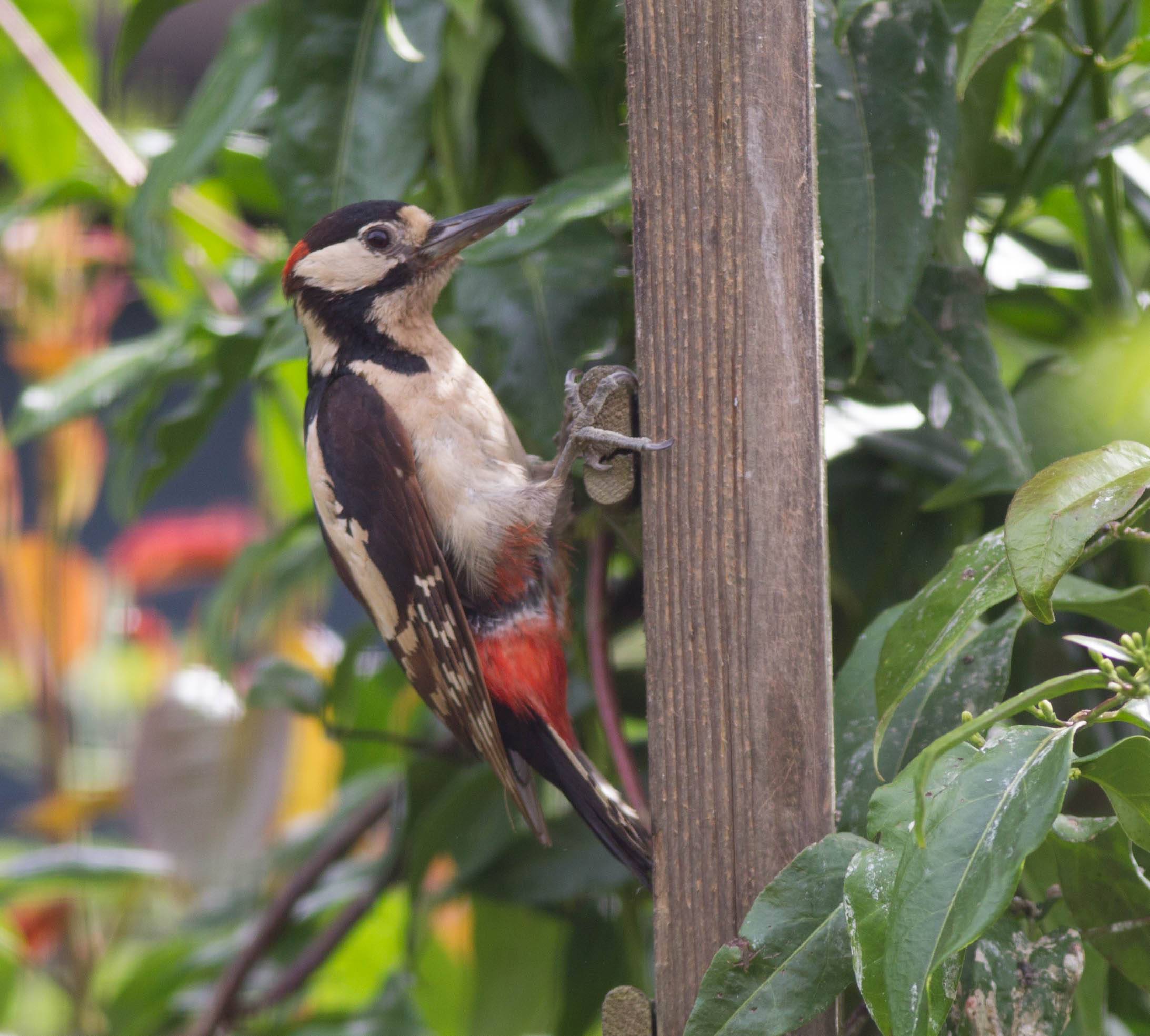
numbers are increasing.This photograph show a juvenile with its red cap. The cap disappears in adults, with the male developing a scarlet flash and red being absent from the female's headSpring is
the time of year when the loud drumming of this bird can be heard. Both males
and females make their presence known and defend their territory by rapidly hammering
their bills against dead tree trunks. The sound can be heard over long
distances and is effectively their song, although they do also have an
unremarkable call of a screech and a falling whistling note.
The male
has a scarlet flash on the back of its head and juveniles have red caps. Males
and females both have red rumps. It is a striking bird – in more senses than
one! – and is about 22 to 23 cms in length, so slightly smaller than a blackbird.The birds
feed on insects, worms, snails, tree seeds, eggs and young birds and are also
regular visitors to garden bird feeders.
Scientists
have studied the shock-absorbing skulls of these birds in an endeavour to
develop more effective protective headgear for humans.
A Polish
legend explains how the woodpecker got the scarlet flash on his head.
God and
the devil had a competition to plough their fields. God had a woodpecker and
the devil used a horse, which was much more effective. God secretly borrowed
the horse overnight and ploughed his entire field. The next day, the devil saw
the field and was persuaded that the woodpecker had done it, so he asked God to
swap the horse and the bird. He soon discovered that the woodpecker could not
plough and in his anger at being tricked, he hit the woodpecker’s head, which
bled, leaving a red mark.
Emily
Dickinson (1830-1886) wrote a short
verse about the woodpecker.
‘His
bill an auger is,
His
head, a cap and frill.
He
laboreth at every tree,-
A
worm his utmost goal’
Shel
Silverstein (1930 – 1999) took a more
light-hearted approach. ‘Peckin’’ comes from his book, ‘A light in the Attic’,
which was dedicated to his daughter, who died of a cerebral aneurysm when she
was 11.)
Green
woodpecker (Picus viridis)
The Green
woodpecker is also one of my favourite birds and is the UK’s largest
woodpecker. Called the Yaffle, after its chuckling flight call, the Green
woodpecker is very much shyer than the Great spotted woodpecker and is more
often heard than seen. It has a short-tailed green body, a brilliant yellow
rump and a bright red crown.
Green
woodpeckers spend most of their time feeding on the ground, probing the soil
for ants. They live and breed in all areas of the UK, apart from Ireland and
the far north and west of Scotland. (Ireland
and the north of Scotland seem to miss out quite a lot, really!)
This image has been cropped from a much larger photograph of a green woodpecker in a very tall oak tree
Other
folk names for the Yaffle include laughing Betsey, yaffingale, and nicker pecker. It’s also
known as the rain-bird, weather cock or wet bird, because it is thought to have
the ability to summon rain, or maybe it just
foretells it, along with seaweed.
Both
woodpeckers have extremely long tongues, which they use to catch insects. The green woodpecker’s tongue is about 10 cms long,
one third of its body length, another fact to ponder.
(Suppose
humans had tongues of comparable ratio? Garrulous people would be tripping over
their tongues all the time, even stepping on them. Would biting one’s own
tongue be more or less painful if there were yards of it? And how would the
taste buds be distributed? So many questions, too few answers.)
When the woodpecker’s tongue is not is use it is
coiled around its skull, wrapped around its brain. (That thought makes me feel quite queasy.)
In the
great spotted woodpecker’s case, the coiled tongue provides a buffer to protect
the brain against concussion during the speedy pecking required for drumming. The
Green woodpecker doesn’t drum with the same ferocity or frequency as the Great
spotted woodpecker.
My second
G is for Gossamer.
Orb web spun by common garden or cross spider
Gossamer
is the fine silk produced by spiders. All spiders produce silk but the silk can
be used in many different ways. Most spiders vary the viscosity of their silk
according to how it is to be used. Same use it in orb webs to capture prey,
while others wrap their victims in the fine filaments, often having first immobilised
them with venom. Some male spiders produce sperm webs in which the eggs are
covered in silken cocoons.
Spiderlings almost ready to sail away on a gentle breezeOn a
sunny day in summer spiderlings can be seen floating through the warm air on
strands of gossamer, being dispersed far and wide. This is known as ‘ballooning’
or ‘kiting’.
For some
spiders, the webs of others are a source of sustenance. Parasitic spiders live
on the webs of orb spinners and feed on the insects captured there. Some spiders
build webs daily and consume the damaged remains at the end of the day.
Others
use a single skein of silk as an emergency line when they fall, or as a trail
to find their way home again.
Charlotte
Smith (1749-1806) was an English poet
and novelist. While incarcerated in Debtor’s Prison in 1783, she wrote ’Elegiac Sonnets’.
Sonnet LXIII is called ‘The Gossamer’.
‘O’er
faded heath-flowers spun, or thorny furze,
The
filmy Gossamer is lightly spread;
Waving
in every sighing air that stirs,
As
Fairy fingers had entwined the thread:
A
thousand trembling orbs of lucid dew
Spangle
the texture of the fairy loom,
As
if soft Sylphs, lamenting as they flew,
Had
wept departed Summer’s transient bloom:
But
the wind rises, and the turf receives
The
glittering web:- So, evanescent, fade
Bright
views that Youth with sanguine heart believes:
So
vanish schemes of bliss, by Fancy made;
Which,
fragile as the fleeting dews of morn,
Leave
but the wither’d heath, and barren thorn!
The best
time of day to see gossamer is early morning before the world is awake.

G is also
for Goldfinch (Carduelis carduelis)
another little bird to bring joy in its wake, and a bird that uses spider silk
to help bind its nest.
It is native
to the British Isles, except in the most mountainous parts of Scotland, and has
been introduced to other countries, including Australia and New Zealand.Carduelis
is the Latin word for goldfinch. The English word was used by Geoffrey Chaucer
in the 14th century in his unfinished ‘The Cook’s Tale’
‘Gaillard
he was as goldfynch in the shawe’
(Gaily
dressed he was as is a goldfinch in the woods)
Although
I dislike clowns, Goldfinches always remind me of them, with their
brightly-coloured heads, but the less alarming, less grotesque clowns. They gather
together in small flocks, called a charm, although in the cold of winter they
may gather in flocks of around 100, and some may migrate to Spain to avoid the worst
of the weather.The
goldfinch has a slender pointed beak well adapted to extricate seed from
thistles and teasels, although they feed their young on insects in the spring
and summer.
Historically,
goldfinches were kept as caged songbirds and are often represented in Italian
Renaissance paintings of the Madonna and Child.
.jpg)