Showing posts with label Great Spotted Woodpecker. Show all posts

Saturday, 8 April 2023

A to Z challenge 22023 - G is for . . .


A to Z challenge 2023 – G is for . . .

My theme for this challenge is Nature in all much of her wonderful diversity. My posts will reflect the fact that I am resident in the south of England.

All photographs in this post are the property of the writer, with the exception of the one about Shel Silverstein

 Great spotted woodpecker (Dendrocopos major)

Of all the birds that visit my garden, the great spotted woodpecker is one of my favourites and I am always elated to see, or more likely hear one. They are native to the UK and are common in England and Wales. They are not found in the far north of Scotland and there are only a few pairs nesting in Ireland, though numbers are increasing.

This photograph show a juvenile with its red cap. The cap disappears in adults, with the male developing a scarlet flash and red being absent from the female's head

Spring is the time of year when the loud drumming of this bird can be heard. Both males and females make their presence known and defend their territory by rapidly hammering their bills against dead tree trunks. The sound can be heard over long distances and is effectively their song, although they do also have an unremarkable call of a screech and a falling whistling note.
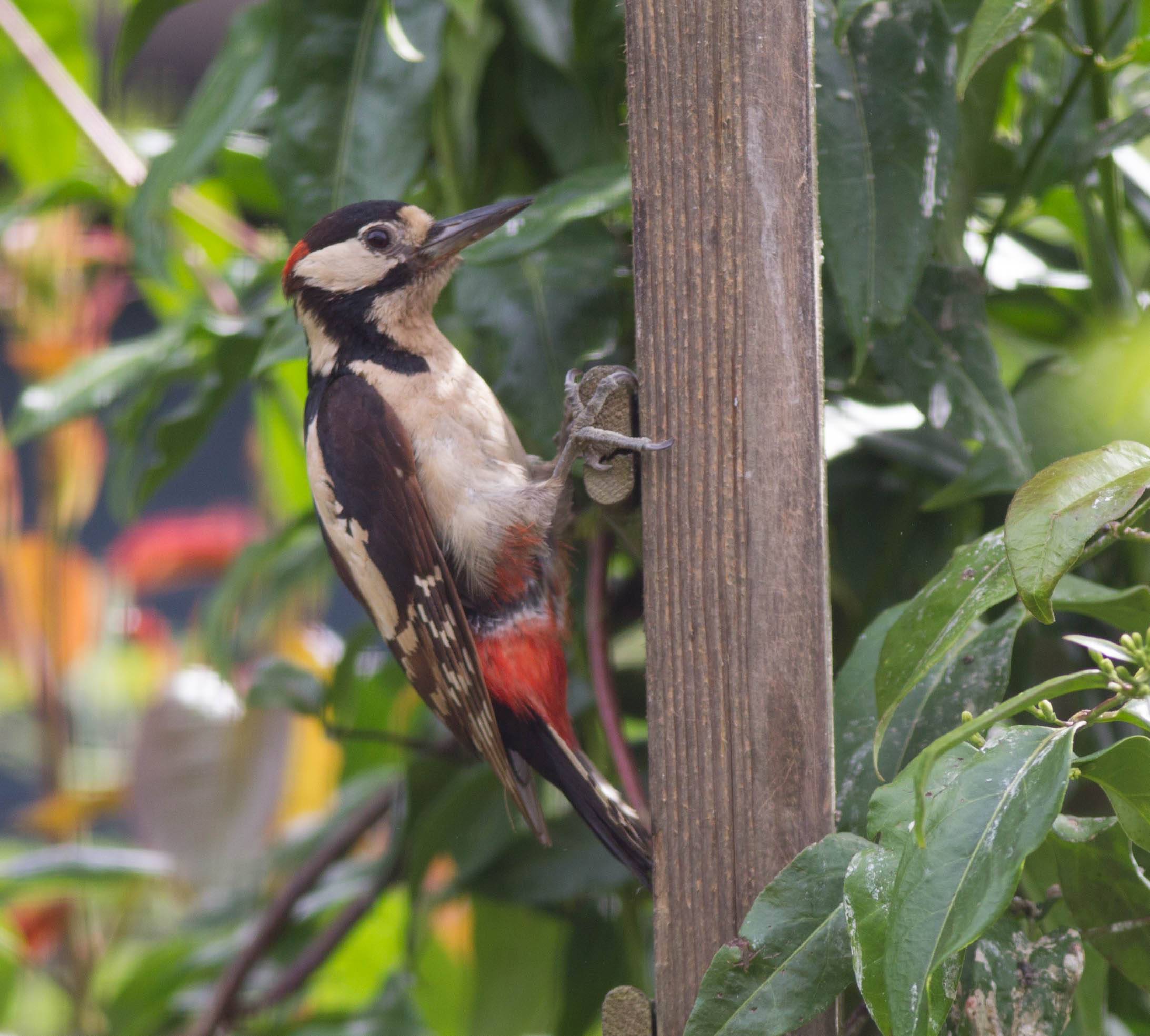
The male has a scarlet flash on the back of its head and juveniles have red caps. Males and females both have red rumps. It is a striking bird – in more senses than one! – and is about 22 to 23 cms in length, so slightly smaller than a blackbird.

The birds feed on insects, worms, snails, tree seeds, eggs and young birds and are also regular visitors to garden bird feeders.

Scientists have studied the shock-absorbing skulls of these birds in an endeavour to develop more effective protective headgear for humans.

A Polish legend explains how the woodpecker got the scarlet flash on his head.

God and the devil had a competition to plough their fields. God had a woodpecker and the devil used a horse, which was much more effective. God secretly borrowed the horse overnight and ploughed his entire field. The next day, the devil saw the field and was persuaded that the woodpecker had done it, so he asked God to swap the horse and the bird. He soon discovered that the woodpecker could not plough and in his anger at being tricked, he hit the woodpecker’s head, which bled, leaving a red mark.


Emily Dickinson (1830-1886) wrote a short verse about the woodpecker.

‘His bill an auger is,

His head, a cap and frill.

He laboreth at every tree,-

A worm his utmost goal’


Shel Silverstein (1930 – 1999) took a more light-hearted approach. ‘Peckin’’ comes from his book, ‘A light in the Attic’, which was dedicated to his daughter, who died of a cerebral aneurysm when she was 11.)


Green woodpecker (Picus viridis)

The Green woodpecker is also one of my favourite birds and is the UK’s largest woodpecker. Called the Yaffle, after its chuckling flight call, the Green woodpecker is very much shyer than the Great spotted woodpecker and is more often heard than seen. It has a short-tailed green body, a brilliant yellow rump and a bright red crown.

Green woodpeckers spend most of their time feeding on the ground, probing the soil for ants. They live and breed in all areas of the UK, apart from Ireland and the far north and west of Scotland. (Ireland and the north of Scotland seem to miss out quite a lot, really!)

This image has been cropped from a much larger photograph of a green woodpecker in a very tall oak tree

Other folk names for the Yaffle include laughing Betsey, yaffingale, and nicker pecker. It’s also known as the rain-bird, weather cock or wet bird, because it is thought to have the ability to summon rain, or maybe it just foretells it, along with seaweed.

Both woodpeckers have extremely long tongues, which they use to catch insects. The green woodpecker’s tongue is about 10 cms long, one third of its body length, another fact to ponder.

(Suppose humans had tongues of comparable ratio? Garrulous people would be tripping over their tongues all the time, even stepping on them. Would biting one’s own tongue be more or less painful if there were yards of it? And how would the taste buds be distributed? So many questions, too few answers.)

  When the woodpecker’s tongue is not is use it is coiled around its skull, wrapped around its brain. (That thought makes me feel quite queasy.)

In the great spotted woodpecker’s case, the coiled tongue provides a buffer to protect the brain against concussion during the speedy pecking required for drumming. The Green woodpecker doesn’t drum with the same ferocity or frequency as the Great spotted woodpecker.


My second G is for Gossamer.

Orb web spun by common garden  or cross spider

Gossamer is the fine silk produced by spiders. All spiders produce silk but the silk can be used in many different ways. Most spiders vary the viscosity of their silk according to how it is to be used. Same use it in orb webs to capture prey, while others wrap their victims in the fine filaments, often having first immobilised them with venom. Some male spiders produce sperm webs in which the eggs are covered in silken cocoons.

                Spiderlings almost ready to sail away on a gentle breeze

On a sunny day in summer spiderlings can be seen floating through the warm air on strands of gossamer, being dispersed far and wide. This is known as ‘ballooning’ or ‘kiting’.

For some spiders, the webs of others are a source of sustenance. Parasitic spiders live on the webs of orb spinners and feed on the insects captured there. Some spiders build webs daily and consume the damaged remains at the end of the day.

Others use a single skein of silk as an emergency line when they fall, or as a trail to find their way home again.

Charlotte Smith (1749-1806) was an English poet and novelist. While incarcerated in Debtor’s Prison in 1783, she wrote ’Elegiac Sonnets’.


 Sonnet LXIII is called ‘The Gossamer’.

‘O’er faded heath-flowers spun, or thorny furze,

The filmy Gossamer is lightly spread;

Waving in every sighing air that stirs,

As Fairy fingers had entwined the thread:

A thousand trembling orbs of lucid dew

Spangle the texture of the fairy loom,

As if soft Sylphs, lamenting as they flew,

Had wept departed Summer’s transient bloom:

But the wind rises, and the turf receives

The glittering web:- So, evanescent, fade

Bright views that Youth with sanguine heart believes:

So vanish schemes of bliss, by Fancy made;

Which, fragile as the fleeting dews of morn,

Leave but the wither’d heath, and barren thorn!


The best time of day to see gossamer is early morning before the world is awake.


G is also for Goldfinch (Carduelis carduelis) another little bird to bring joy in its wake, and a bird that uses spider silk to help bind its nest.

It is native to the British Isles, except in the most mountainous parts of Scotland, and has been introduced to other countries, including Australia and New Zealand.

Carduelis is the Latin word for goldfinch. The English word was used by Geoffrey Chaucer in the 14th century in his unfinished ‘The Cook’s Tale’

‘Gaillard he was as goldfynch in the shawe’

(Gaily dressed he was as is a goldfinch in the woods)

Although I dislike clowns, Goldfinches always remind me of them, with their brightly-coloured heads, but the less alarming, less grotesque clowns. They gather together in small flocks, called a charm, although in the cold of winter they may gather in flocks of around 100, and some may migrate to Spain to avoid the worst of the weather.


The goldfinch has a slender pointed beak well adapted to extricate seed from thistles and teasels, although they feed their young on insects in the spring and summer.

Historically, goldfinches were kept as caged songbirds and are often represented in Italian Renaissance paintings of the Madonna and Child.

Sunday, 29 January 2012

I saw a mouse - where? Not on the stair . . .


Mice - by Rose Fyleman 

I think mice
are rather nice.
Their tails are long,
Their faces small,
They haven't any
Chins at all.

Their ears are pink,
Their teeth are white.
They run around
The house at night.

They nibble things
They shouldn't touch
And no one seems
To like them much.

But I think mice
are nice.

I agree with Rose Fyleman that mice are nice though I prefer them out of the house rather than in it. 

Yesterday Barry was in the conservatory photographing birds and making short videos of them. As I watched the on-going display a movement caught the corner of my eye and there it was – a field mouse. 
We were pleased to see it because rats kill mice and its presence means that there are probably no rats in the vicinity (they’ve all travelled to London to visit Bethan and Robert)

It moved very quickly – speed is of the essence when you’re a tiny being, around 18 centimetres long from tip of nose to end of tail. The hose pipe gives some perspective. We think it was a Yellow-necked mouse (Apodemus flavicollis) but cannot be absolutely sure since it didn’t stand on its hind legs and display its chest. It didn’t stay long for its photo shoot and we were lucky to see it at all as it is largely nocturnal, the prey of owls and cats.

Meanwhile the birds carried on feeding, oblivious to the tiny mammal beneath them dining on the crumbs of fat cast off by their probing beaks. 


Most of the birds wanted to display their nether regions, the newly repainted plumage glowing to attract a mate.

Some, like this starling, with his winter spots giving way to the glorious iridescence of spring finery . . . 
 . . . appeared to spot the little mouse and wonder what it was up to. 
The female blackbird feasted on holly berries while her would-be mate gorged pyracantha.

Coal tit watched warily from the Nectarine – often chased away by blue tits, his chance would come.
 Long-tailed tits swooped and dipped their way to the feeders . . .
. . . and a great spotted woodpecker, fresh from the beauty salon, displayed her scarlet underside but forbore to show her face.

Friday, 23 December 2011

ABC Wednesday W is for . . .


‘Warm Welcome’

Rosa ‘Warm Welcome’ is a semi-evergreen climbing rose that flowers profusely in summer and autumn. The clusters of flowers are sweetly scented and a vibrant orange-red, a welcome splash of brightness on our often less than sunny summer days.

White starling
Starlings (Sturnus vulgaris) are on the RSPB Red list. This means that they are globally threatened. They are abundant in Berkshire and frequent our bird feeders with noisy enthusiasm. A few years ago I spotted a pure white starling. Not quite believing my eyes I took some hasty photographs and though I watched and waited for several days I never saw it again.
Woodpecker – of the three UK woodpeckers, two can be seen in gardens. The Great Spotted Woodpecker (Dendrocopos major) is the commoner visitor to our garden. It is a striking bird and vies with the starlings for a place at the table. It eats insects and fruit.
The Green Woodpecker (Picus viridis) is the largest of the woodpeckers that breed in Britain. It eats insects and has a particular liking for ants. It is popularly called the Yaffle because of its laughing call. It is on the RSPB Amber list, meaning that its status is causing concern.
The bird at the front is a juvenile. The white neck patches will develop later.
The Wood pigeon (Columba palumbus) is Britain’s largest pigeon. It is the major agricultural pest and a favourite species for sport shooting. However, I am not a farmer and am always pleased to see these heavyweights in the garden. Their repetitive soft cooing call is a reassuring sound that all is well in the bird kingdom.
The Wren (Troglodytes troglodytes) is the UK’s commonest breeding bird. Like other small birds it suffers a decline in numbers in cold weather. It is often to be seen creeping mouse-like round plant pots, seeking the insects and spiders that form its diet.

To see other Ws please click here.

Saturday, 22 January 2011

Shadow Shot Sunday #140

Three days ago we saw the sun shining brightly in a flawless blue sky and casting shadows among the branches of the trees.
Here is a Great Spotted Woodpecker in an oak tree. There must be insects and larvae around and she's making sure they don't damage the developing buds. Actually, she's not in the least altruistic - there's a feast to be had and she's having it!
Thank you to Tracy at 'Hey Harriet' who organises this weekly meme. Click here to see more shadows and perhaps join in.

Wednesday, 6 January 2010

ABC Wednesday Y


Y is for Yachts and Yachting


Yaffle is an old country name for the Green Woodpecker(Picus viridis) Yaffles sometimes visit our garden but it is more common to see Great Spotted Woodpeckers (Dendrocopus major) on our feeders.

Yellow is the colour commonly used in safety clothing.

Yellow pansies in summer

Fragrant yellow honeysuckle attracts insects.
Thank you to the ABC team for organising and hosting this entertaining meme. To see what others have chosen please click here.

Sunday, 7 June 2009

Camera Critters - Woodpecker sees off Starling

Great Spotted Woodpeckers are frequently hugely outnumbered by flocks of Starlings and cannot compete in the clamorous feeding frenzy. No sooner have they seen off two or three Starlings than another six join in the fracas so they usually fly away and return when it's quieter. Occasionally and not often for long there may be just one or two Starlings on the feeder and then the Woodpecker can hold his own. Here a Woodpecker has pecked at a young Starling, removing a downy feather. The juvenile has decided that discretion is the better part of valour and is departing the scene.

Left in peace the Woodpecker drops the feather in order to feed.


Click here to see more 'Critters' . . .
Thank you to Misty Dawn for organising this meme.