Mushroom
or Fungus?
All
mushrooms are fungi but not all fungi are mushrooms. Fungi include moulds,
yeasts and rusts. All fungi differ from plants and animals in the way they
obtain their sustenance. They cannot ingest food like animals or photosynthesise
like plants. They ‘feed’ by absorbing nutrients from the environment, decomposing
organic matter, which becomes compost.
The fungi
commonly called mushrooms grow all year round but are most noticeable in late
summer and early autumn.
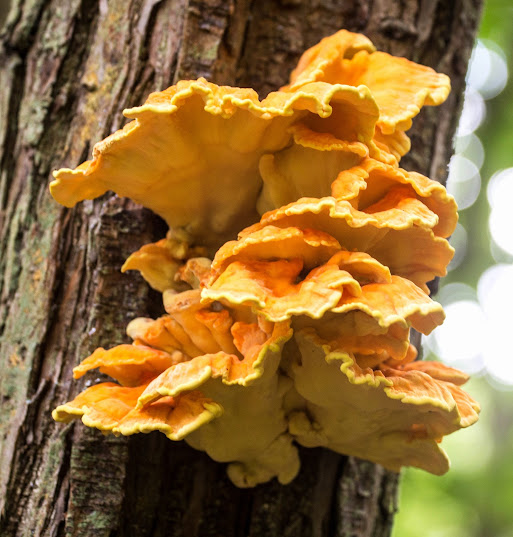
Not all
mushrooms grow low down. Chicken of the Woods (Laetiporus sulphureus) grows on tree trunks, notably oak trees and
can be seen from late spring to autumn. It is valuable for wildlife. Some beetles
only feed on bracket fungi like this one. Deer eat it, too.
Humans can
eat Chicken of the Woods but it can cause dizziness and stomach upsets in some
people. It is poisonous if growing on yew. It is said to have a texture similar
to chicken when cooked, so is an acceptable substitute for meat in vegetarian
meals.
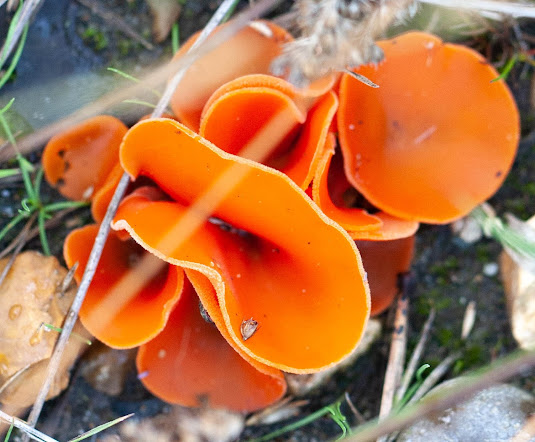
Orange
Peel Fungus (Aleuria (Peziza) aurantia)
This edible fungus grows on open ground in woods and is very common in autumn. It
starts as very small cups, looking flat, but grows to 3-4" across.
From
August to November walking with the dogs in the woodlands takes on a new
aspect. Silent figures in ones or twos may be seen, causing warning barks or
excited approaches, depending on the character of the dogs. The objects of
their interest walk quietly among the trees, eyes cast down, frequently
stooping to gather something from the rich soil.
They may emerge suddenly from
the cover of the woods, holding plastic bags weighed down with their booty.
Occasionally, they carry shallow baskets. These folk are the mushroom seekers,
the amateur but very knowledgeable mycologists, for at this time of year the
earth gives up an abundance of mushrooms.
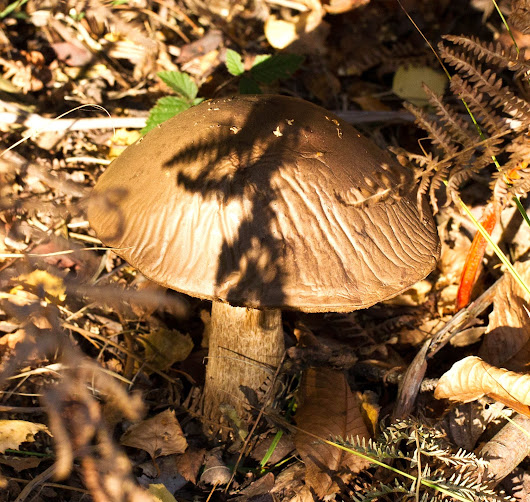
I think this
is Brown Birch Boletus (Boletus scaber) - but I could be
wrong!!
It is quite common in summer and autumn in woods around birch trees.
The caps are edible and good to eat but the stalks are rather tough.
English people have little folklore
about mushrooms and many of the tests to decide which ones are edible and which
poisonous are not to be trusted. They may well grow in grass or not blacken a
silver spoon but these are dangerously ill-informed methods for testing the
toxicity or otherwise of them.
In Europe the knowledge is deeply
ingrained, with France having perhaps the greatest interest and understanding.
Until the Second World War Englishmen were very suspicious of wild mushrooms
but learnt much from immigrant Poles and other Europeans who taught them that
some toadstools can be delicious. Others, though edible, are so bland as to be
not worth eating.
The most prized fungi of all, the
truffles, do not generally grow in UK, but when they do they are mostly found
under beech trees. In France they usually grow under evergreen oaks. Specially
trained pigs or dogs are used to sniff out the wondrous treats that develop
underground, often at a depth of a foot or more.
Since the end of the Second World War,
interest in the UK in collecting mushrooms has grown and is causing some
concern, because mushrooms are very important in
maintaining moisture in the soil and providing a source of water for trees. In
times of extended periods of dry weather such water caches are invaluable.
This is one of my favourite books. The glorious illustrations are by Beatrix Potter
Fly agaric (Amanita muscaria) is a striking mushroom often seen in children's books. In Alice in Wonderland Alice is given fly agaric to eat. For more than 4,000 years it was used in religious ceremonies in Asia. It is hallucinogenic.
Just as scavenging birds and beasts keep the
world largely free of decaying carcases, so fungi perform a similarly
significant service. Indeed, they have been described as ‘the great scavengers
of the vegetable kingdom.' (‘Wayside and Woodland Fungi’, W.P.K.
Findlay D.Sc., F.I.Biol., F.I.W.Sc)
Trametes (formerly Coriolus) versicolor, commonly called Turkey Tail in USA
This is very common on fallen branches and trunks. It is a medicinal
mushroom in China and used in China and Japan as an immunoadjuvant therapy in
the treatment of cancer.
Together with bacteria mushrooms break
down organic detritus. Without them the world would be cluttered with dead
trees, fallen branches and deep, deep leaf drifts. The enzymes they produce
liquefy the wood of trees and the soft tissues of leaves and fruits to provide
nourishment for the fungi. Anything that is not consumed forms rich humus on
the forest floor and acts as a sponge to retain moisture. Some fungi are
adapted to decomposing hoof and hair remains of animals.
Fungi are a source of food, drugs,
poisons and diseases. They cause most of the serious plant ailments and some
that are troublesome to man and animal, like ringworm. Every gardener who
maintains a compost heap owes its success in part to moulds as well as bacteria
and worms.
If you should feel inclined to eat
wild fungi please don’t rely on identification through illustrations. Toxic and
non-toxic mushrooms can look remarkably similar and a simple mistake can lead
at best to several hours’ discomfort and at worst to an agonising death. Take
advice from a knowledgeable mycologist and if in doubt, DON’T!


