Showing posts with label roe deer. Show all posts

Friday, 25 October 2024

Dear deer


Dear deer

Red deer stags, Glen Torridon, Scotland

Image courtesy Wikimedia Commons

There are two native species of deer in the UK, the Red and the Roe, though Fallow deer are now so well-established as to be considered native. The Normans introduced them to England around the 11th century.

Other non-native deer, like Muntjac deer from China and Chinese Water deer, and Sika deer from Japan, are seen in increasing numbers. All the male deer grow antlers, apart from the Chinese Water deer, which instead have large canine teeth, called tusks. Sometimes, these deer are called ‘vampire deer.’

Red deer are the largest species. The iconic baying stag is strongly associated with Scotland, though it is also found in numbers in other parts of England and Wales.

A stag starts growing his antlers in the spring. They grow rapidly, at the rate of 2½ cm (1”) a day and are fully developed by September, in time for the mating season, or rut. They are covered in velvet, which supplies the growing bone with oxygen and nutrients, until just before the rut. Then the velvet is rubbed off, against tree bark in the summer, and the bone dies. The antlers are shed in early spring and are grown again from early summer.

The size and extent of antlers may indicate a stag’s age, but teeth are a more accurate pointer. Stags with twelve points are called Royals, but the points must be equally distributed. A beast with five on one side and seven on the other will not be classified as a Royal. 

'The Monarch of the Glen' by Sir Edwin Henry Landseer (1802-1873)
Image courtesy Wikimedia Commons

Stags with fourteen points used to be informally known as Imperials and those with sixteen as Monarchs. However, Sir Edwin Henry Landseer’s famous painting, ‘The Monarch of the Glen,’ clearly shows a stag with twelve points.

The much smaller roe deer also grow antlers, but they never exceed three points. They were the original inspiration for the book ‘Bambi.’ I wrote about roe deer a number of years ago.

Wednesday, 5 April 2023

A to Z challenge 2023 - D is for . . .


A to Z challenge 2023 – D is for . . .

My theme for this challenge is Nature in all much of her wonderful diversity. My posts will reflect the fact that I am resident in the south of England.

All photographs in this post are the property of the writer

Daffodils

The Latin name for daffodil is Narcissus. Narcissus was a beautiful young man. When he caught sight of his reflection in a pool of water, he became so bewitched by his own beauty that he fell in love with his image. He could not tear his gaze away and faded away into death. He was then turned into a flower, the daffodil we know today in its many forms.

The daffodil is one of the first perennials to flower in Spring and as such is a symbol of rebirth and hope. Daffodils were introduced to England by the Romans who thought that the sap had healing powers.

In England, it is known as the Lent or Lenten lily, because it blooms between Ash Wednesday and Easter. It is also the symbol of the Marie Curie cancer charity and is worn throughout March as a sign of support.

It is the national flower of Wales, and is proudly worn at public events, along with the leek, which predates it by thousands of years!

Victorians called daffodils the flower of respect and friendship and they are a traditional gift for tenth wedding anniversaries. Florists often add them to bouquets as a symbol of faith and happiness. Once upon a time, however, giving someone a single daffodil was seen as bad luck, and a drooping daffodil signalled death. (Not much hope in my garden, then, as the dogs gallop around, ‘bending’ many a bloom!)


D is also for Dunnock (Prunella modularis)

Dunnocks are small, unobtrusive grey and brown birds. The name dunnock comes from the English ‘dun’ meaning dingy brown or dark-coloured and ‘ock’ meaning small.

They are often seen alone or with one other on the ground near hedges and low-growing shrubs, unlike house sparrows, which live in flocks. They are known as Hedge sparrows because of a passing resemblance to female house sparrows, but their bills are quite distinct, the sparrow’s beak being broader, for cracking seeds, and the dunnock’s thin and pointed and more suited to plucking insects from leaves and twigs.
They are very common throughout the UK in areas of plentiful vegetation. They have a characteristic habit of flicking their wings, particularly in territorial disputes, and for this reason are commonly called ‘shufflewings’. Numbers have dropped by almost a third in the last fifty years and the birds are now on the amber list of conservation concern.

They eat insects, spiders, worms and some seeds.

Dunnocks can copulate more than 100 times a day. The female dunnock will mate with several males, meaning that chicks within the same brood may have different fathers. Sometimes two males she has mated with will work together to protect a territory against rivals and help her to raise her young.

Chicks may be raised by a single female, or by many females with the help of a male, or by many females and males together. Although males are not thought to discriminate between the chicks in a brood, they invest more time in feeding the young if they have had access to the female and may therefore have impregnated her.

Their nests are built low down in a bush or conifer and are constructed of twigs and moss and lined with feathers or other soft material. The eggs, laid in clutches of three to five, are blue.

The nests are often targeted by cuckoos.


Although they appear quite plain, a closer inspection reveals intricate feather patterns. It is always a pleasure to see these little birds at home in my garden.


My final D is for Deer.

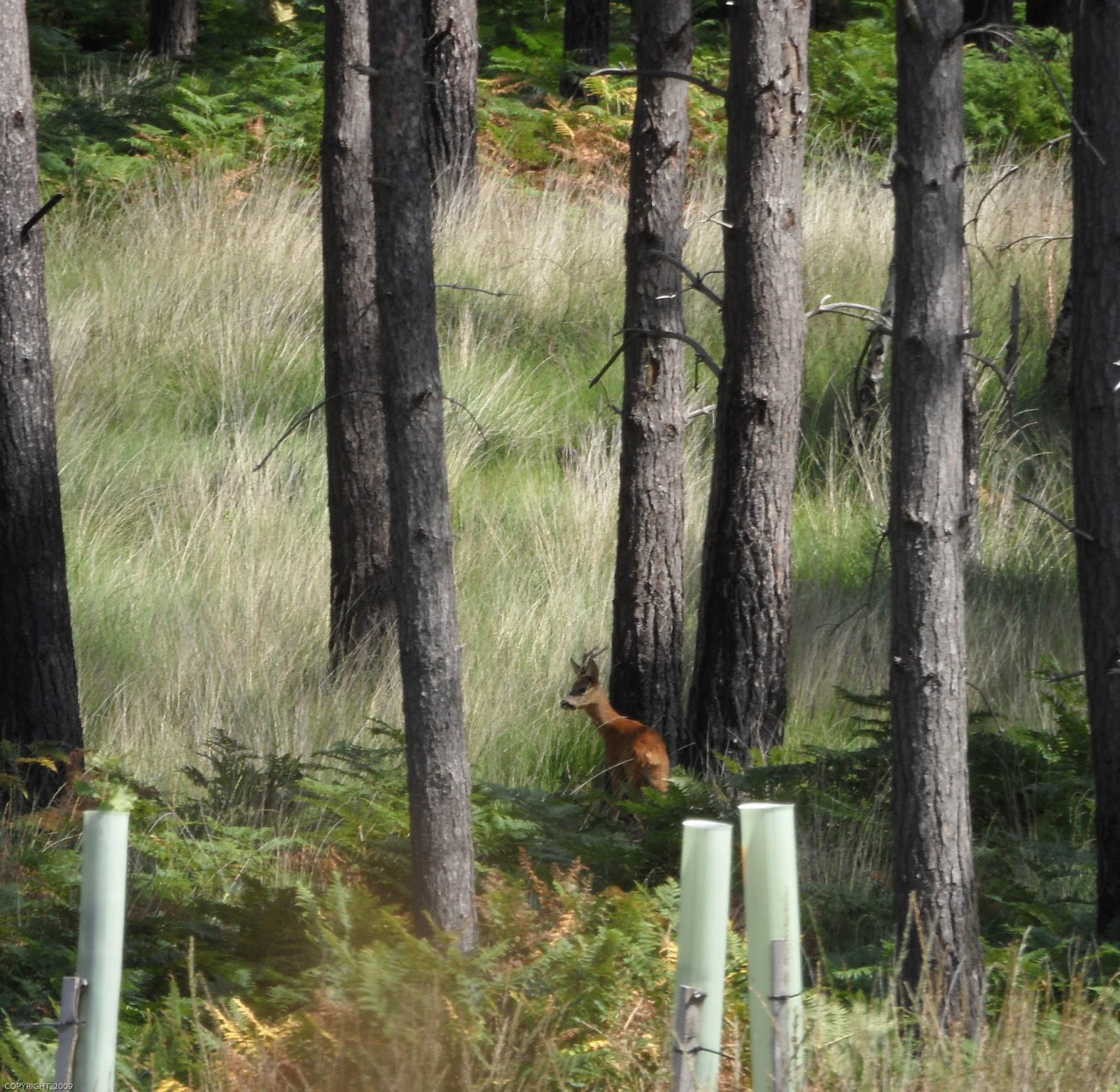
The deer in our local woodlands are Roe deer (Capreolus capreolus). They are one of the two truly native deer of the British Isles, though they are not found in Ireland. The other native deer are the red deer.

Their colouring enables them to blend into the environment. There are two in this photograph.

‘Bambi’, Felix Salten’s book (1928), was originally about the life of a roe deer.

Roe deer are about 75 cm tall at the shoulder and weigh up to 25 kg. Their natural lifespan in the wild averages 10 years. 
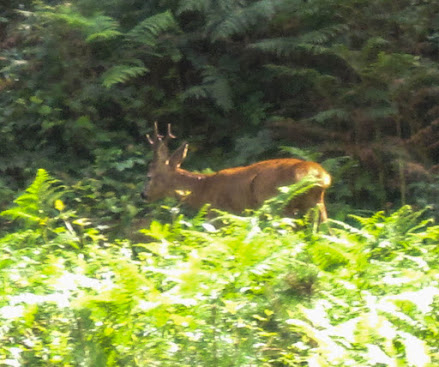
Their coat colour varies from rusty red in the summer to slate grey in the winter and both doe and buck have a white rump. The doe’s white rump is heart-shaped and the buck’s is shaped like a kidney. 

Young buck

Roebucks have three-pointed antlers when they are fully adult and unlike other deer, begin to regrow them almost immediately after shedding them. Their main diet is grass, leaves, berries and the shoots of young trees.

The breeding season or ‘rut’ is from mid-July to August, when bucks battle for the right to mate with a receptive doe. Roe deer delay the implantation of a fertilised egg until January to avoid giving birth in harsh winter conditions when food is scarce, so although gestation is 9 months, the first four months see no growth followed by five months of developing embryo. The does give birth to two or three kids in May or June, but many perish shortly after birth, often due to predation, or during the cold of their first winter.


They are wary and ready to flee at the slightest hint of danger

The best times to see them are around dawn and dusk when they are feeding. Daytime is spent hidden from view, ruminating.

Most ruminants have stomachs with four chambers. These allow the animals to digest food without completely chewing it first. Some is brought back up to be chewed again and this is called chewing the cud, commonly observed in cattle.

They are graceful creatures, able to bound effortlessly over fences and hedges. It is incredible to see them apparently ‘melt’ into the landscape.


Monday, 3 February 2014

Our weekend walks

We had a couple of dry fine days at the weekend. On Saturday there was a cold wind gusting every now and then, causing me to hang on to my hat.

We saw three roe deer – the first we’ve seen for a few weeks. I guess they’ve been sheltering deeper in the forest, trying to avoid the relentless rain. Saturday’s sun enticed them into the open, along with a number of dog walkers, cyclists, runners and young children.
Sunday was beautiful, not as windy or as cold.

Bill and Beatrice Crow joined us. 


Friday, 23 August 2013

Fun in the Forest

'Let me help you'
Buster doesn't need any help but Bertie is quite possessive over his AquaKong.
Sometimes Buster helps his brother Bertie!
An old(er) lady flanked by two young chaps.
Tia is accompanied by Bertie and Buster
Flotilla.
All eyes on the Kong . . . well, most of them. Frodo is not a retriever, except of biscuits.
Dear deer!
Up periscope . . . 
. . . when the signal is stationary we are informed that Jenna has 'treed a quarry'. . .
. . . as if!!
A cooling dip for Frodo . . .
. . . and a gentle swim for Foxy, always hoping for (but not receiving) biscuits.
Kersplash!
Can you see me? I can see you!
Tug of war . . . Bertie always wins.
At one of the 'new' ponds.
Left to right: Frodo, Bertie, Buster, Tia, Janice, Foxy, Jenna, Gus
Buster sits and waits for the Kong to be thrown.

Saturday, 15 September 2012

Roe deer


The doe is watching the dogs pass by
The deer in our local forest are roe deer, the most numerous of Britain’s native deer, and at this time of the year their coats have changed from the dark grey or brown of winter to a rich russet. It is quite usual for us to see one or two roe deer when we take the dogs walking, particularly towards evening. The deer are watchful but not easily startled, only taking flight if one of the dogs gets within twenty yards. Then they bound away and melt into the trees. 
Here she's watching Barry, trying to understand what he's doing
 We have often seen deer lying down in patches of sunlight. This gives them an opportunity to chew the cud. Usually they lie where they have been feeding only if they feel secure. One of the places we have seen them is about a hundred yards from the path we follow.
It's difficult to get buck and doe together in one frame!
In the last three weeks, since late August, we have regularly seen a young buck and doe. They are keeping company because this is the breeding season. The rut takes place from July to September. Does usually bear twins which are born the following spring, between April and June. In exceptionally good conditions a doe may have triplets. 
He looks as though he's saying, 'What are you looking at?'
Roe deer are the only deer that delay implantation so that the young are born when conditions are favourable, in that the weather is more clement and there is sufficient food and fresh plant growth. Others among the one hundred or so mammals that delay implantation (embryonic diapause) include stoats, badgers and rodents.
Spotting them is sometimes difficult . . . 
Can you see him now?
Here he is lying down 
Moving away unhurriedly
 I found a useful site that shows how to calculate the age of a buck by its antlers and I think ‘our’ buck is a two-year-old.

The antlers are shed each year and unusually for British deer, the roe buck casts and regrows them in the winter when good food is not readily available.

I am linking to Camera Critters.


Saturday, 25 July 2009

Camera Critters #68

When we take the dogs walking I usually take my camera (Canon Ixus 980) It's small enough to go in a pocket or to carry in my free hand ready for action. In the other hand I carry the ball-flinger to keep Jenna-the-Labrador entertained. As Gillian and Paul's dogs are staying with us at the moment it keeps them busy too.
Last Thursday we were strolling along, Barry hauling Dominie, Buddy and Frodo catching up on pee-mails, the Labradors hurling themselves into every puddle and pond they came to and me scanning for activitiy. Then I saw a roe deer; she was in an area where we often see deer. I tried to photograph her but she was some distance away and wary. We would eventually pass the other side of this small area and I was hopeful of seeing her again.
At one of the new ponds, excavated earlier this year when tree harvesting was being carried out, Frodo and the Labradors swam and drank and paddled and played. When Dominie was independent she loved to swim and so Barry lets her roll gently into the pond where she can enjoy the sensation of water on her body, drink some of it and revisit earlier times for a little while. When she's had enough she lies in the sun to rest and lick herself while Buddy and Frodo pace about, sniffing here and there and the Labradors chase the ball.

Barry guides Dominie into the water as Buddy watches. Jenna has collected the ball on this occasion.


Now Tia has the ball. As usual Jenna is wearing her transmitter collar so that we know which direction to worry in when she disappears!
Foxy, Gillian and Paul's fox-red Labrador, learnt long ago that treats were far more satisfying to retrieve than a slobbery ball so stopped trying to keep up with Tia and Jenna. I don't often take titbits out with me now but she still looks hopefully at me, my hands, my pockets. She is slowly realising that she is a retriever and she can sometimes get to the ball before the others, so long as she has a headstart - that is, if I fool the others into going in the wrong direction first. They can never quite believe she has found it and will go on looking until they realise she has it, then Jenna takes it from her! Foxy never objects - she really is a very sweet-tempered dog.

Foxy has the ball. Jenna and Tia haven't realised where I've thrown it and are quartering the ground beyond the pond.
Dominie's pleasures in life include meeting new people and dogs. Most people stop to enquire about the reason for her wheels.Some dogs are spooked by the unfamiliar silhouette she presents but usually the dog greetings follow the routine and etiquette they always have. She particularly likes little dogs and on Thursday she met two out with their humans. One of them was a rescue dog - we meet quite a few of these in our perambulations, from small cross-breeds to retired racing Greyhounds to working breeds that have proved too much for their original owners or breeders. The sky was ever-changing and threatening rain - indeed wehad a torrential downpour later in the evening - so we proceeded on our way. Sure enough, when we reached the opposite side of the stretch where I had spotted the doe, there she was again. Now she was accompanied by a young buck who appeared to have only one antler. Barry took over ball-flinging duties - we knew if Jenna caught sight, sound or scent of the deer she would have been off!
The deer are beyond the pond between the two groups of small trees. Frodo is paddling and slaking his thirst.
Frodo, my velcro dog, accompanied me as I slowly approached the pair, happily paddling and keeping an eye on me. The doe and buck were aware of me but seemed unfazed, looking at me now and again and then resuming their grazing.
He looks at me while she looks in the other direction.Deer slot
Eventually, after I had been watching and photographing and moving closer for about seven minutes, the doe went into cover where she continued to watch me for a while before vanishing.
The buck looked long and hard at me. I wonder what happened to his right antler? Finally he decided that discretion was the better part of valour and left the scene . . . but unhurriedly, at his leisure.
I don't think I'll ever get over my excitement at seeing deer - they are truly beautiful elegant creatures and their ability to melt into the shrubs and trees is amazing.

Next time we'll take Barry's Canon 40D with a telephoto lens and hopefully the photographs will be much better quality. Of course, the mere act of taking it with us will probably guarantee we shan't see any wild animals!
Thank you to Misty Dawn for creating this meme and to Misty and Tammy for hosting it.