Showing posts with label dunnock. Show all posts

Wednesday, 5 April 2023

A to Z challenge 2023 - D is for . . .


A to Z challenge 2023 – D is for . . .

My theme for this challenge is Nature in all much of her wonderful diversity. My posts will reflect the fact that I am resident in the south of England.

All photographs in this post are the property of the writer

Daffodils

The Latin name for daffodil is Narcissus. Narcissus was a beautiful young man. When he caught sight of his reflection in a pool of water, he became so bewitched by his own beauty that he fell in love with his image. He could not tear his gaze away and faded away into death. He was then turned into a flower, the daffodil we know today in its many forms.

The daffodil is one of the first perennials to flower in Spring and as such is a symbol of rebirth and hope. Daffodils were introduced to England by the Romans who thought that the sap had healing powers.

In England, it is known as the Lent or Lenten lily, because it blooms between Ash Wednesday and Easter. It is also the symbol of the Marie Curie cancer charity and is worn throughout March as a sign of support.

It is the national flower of Wales, and is proudly worn at public events, along with the leek, which predates it by thousands of years!

Victorians called daffodils the flower of respect and friendship and they are a traditional gift for tenth wedding anniversaries. Florists often add them to bouquets as a symbol of faith and happiness. Once upon a time, however, giving someone a single daffodil was seen as bad luck, and a drooping daffodil signalled death. (Not much hope in my garden, then, as the dogs gallop around, ‘bending’ many a bloom!)


D is also for Dunnock (Prunella modularis)

Dunnocks are small, unobtrusive grey and brown birds. The name dunnock comes from the English ‘dun’ meaning dingy brown or dark-coloured and ‘ock’ meaning small.

They are often seen alone or with one other on the ground near hedges and low-growing shrubs, unlike house sparrows, which live in flocks. They are known as Hedge sparrows because of a passing resemblance to female house sparrows, but their bills are quite distinct, the sparrow’s beak being broader, for cracking seeds, and the dunnock’s thin and pointed and more suited to plucking insects from leaves and twigs.
They are very common throughout the UK in areas of plentiful vegetation. They have a characteristic habit of flicking their wings, particularly in territorial disputes, and for this reason are commonly called ‘shufflewings’. Numbers have dropped by almost a third in the last fifty years and the birds are now on the amber list of conservation concern.

They eat insects, spiders, worms and some seeds.

Dunnocks can copulate more than 100 times a day. The female dunnock will mate with several males, meaning that chicks within the same brood may have different fathers. Sometimes two males she has mated with will work together to protect a territory against rivals and help her to raise her young.

Chicks may be raised by a single female, or by many females with the help of a male, or by many females and males together. Although males are not thought to discriminate between the chicks in a brood, they invest more time in feeding the young if they have had access to the female and may therefore have impregnated her.

Their nests are built low down in a bush or conifer and are constructed of twigs and moss and lined with feathers or other soft material. The eggs, laid in clutches of three to five, are blue.

The nests are often targeted by cuckoos.


Although they appear quite plain, a closer inspection reveals intricate feather patterns. It is always a pleasure to see these little birds at home in my garden.


My final D is for Deer.

The deer in our local woodlands are Roe deer (Capreolus capreolus). They are one of the two truly native deer of the British Isles, though they are not found in Ireland. The other native deer are the red deer.

Their colouring enables them to blend into the environment. There are two in this photograph.

‘Bambi’, Felix Salten’s book (1928), was originally about the life of a roe deer.

Roe deer are about 75 cm tall at the shoulder and weigh up to 25 kg. Their natural lifespan in the wild averages 10 years. 

Their coat colour varies from rusty red in the summer to slate grey in the winter and both doe and buck have a white rump. The doe’s white rump is heart-shaped and the buck’s is shaped like a kidney. 

Young buck

Roebucks have three-pointed antlers when they are fully adult and unlike other deer, begin to regrow them almost immediately after shedding them. Their main diet is grass, leaves, berries and the shoots of young trees.

The breeding season or ‘rut’ is from mid-July to August, when bucks battle for the right to mate with a receptive doe. Roe deer delay the implantation of a fertilised egg until January to avoid giving birth in harsh winter conditions when food is scarce, so although gestation is 9 months, the first four months see no growth followed by five months of developing embryo. The does give birth to two or three kids in May or June, but many perish shortly after birth, often due to predation, or during the cold of their first winter.


They are wary and ready to flee at the slightest hint of danger

The best times to see them are around dawn and dusk when they are feeding. Daytime is spent hidden from view, ruminating.

Most ruminants have stomachs with four chambers. These allow the animals to digest food without completely chewing it first. Some is brought back up to be chewed again and this is called chewing the cud, commonly observed in cattle.

They are graceful creatures, able to bound effortlessly over fences and hedges. It is incredible to see them apparently ‘melt’ into the landscape.


Saturday, 29 April 2017

A lovely morning surprise!

  Herschel snoozes
   It was early Saturday morning and we were enjoying a leisurely lie-in, idly watching rugby and occasionally dozing off. Susannah had taken Frankie to his swimming lesson and then carried on to her gym class.
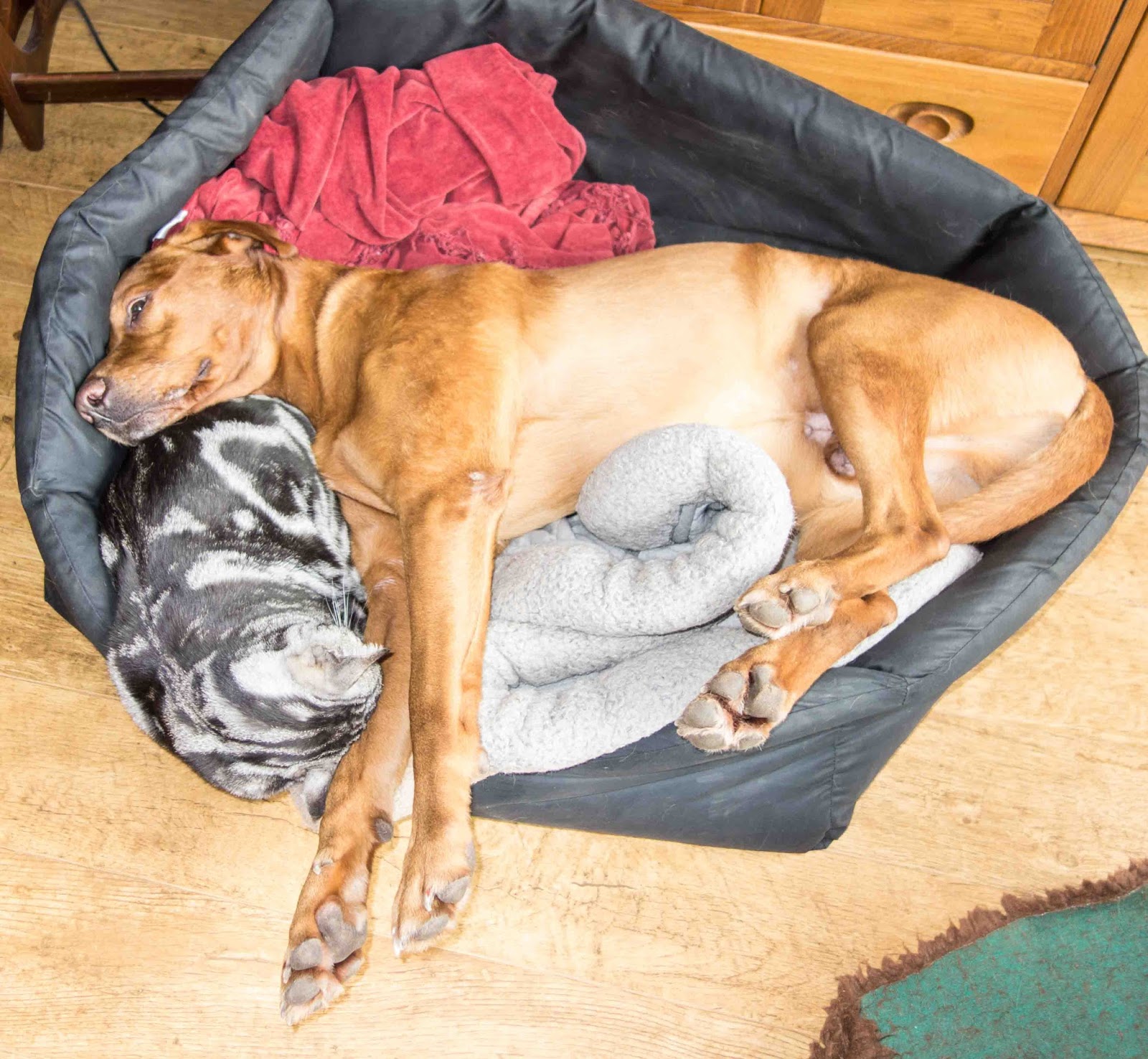
Bertie  and Jellicoe share a bed. He couldn't be a hunter, could he?
Bertie and Roxy were stretched out on our bed, joined from time to time by Herschel and Jellicoe. Isambard was lying on my legs so naturally I couldn’t get up – it’s very bad manners to disturb a cat. Jenna and Gus were snoozing in their beds.

We could hear sounds of cats playing. At least Solomon and Lenny weren’t screaming at each other so all was peaceful and there was no urgency for us to get up and proceed with the day. Susannah returned and there was an exclamation of disbelief and horror as she realised she had trodden on a dead but still pliant wood pigeon.

‘You’ve got to see this,’ she said so we duly arose. The hall was a mass of feathers surrounding a defunct avian. The scene in the garden of the capture and possibly the execution  was clearly demarcated by a sufficient number of feathers to make us believe there might have been more than one casualty. How can one bird have so many feathers? Still, as the old tongue twister has it, 'There are forty thousand feathers on a thrush' so there must be at least that number on a wood pigeon. I can understand why Labradors dislike picking up pigeons – all those feathers coming loose.
Not quite the remains of the day  . . .
After clearing up (We now have a clear idea of the colour of a pigeon blood ruby) we set about using our deductive skills to determine the culprit. We thought about Susannah’s cats. Solomon is little and likes catching dragonflies. 
Solomon
Could it have been Lenny? Possibly. He may have lain on the poor bird. Lenny is ‘plump’ and lazy and limits his hunting exploits to moths.
Lenny
It could not have been Isambard as he was pinning down my legs and in any case is not keen on leaving the company either of us or the dogs. 
Isambard watching the fish
Herschel caught a squirrel not long after he was given the freedom of the garden but is not given to excessive hunting. We concluded it was probably Jellicoe. He watches the birds more than the others and so far this year he has killed a rat, a field mouse, a dunnock and a wood pigeon. He also caught a blackbird but it escaped. So, he’s not the most prolific of killers but he does his best, sadly.
What is this?'
Our garden used to be busy with birds, particularly at this time of year when adults are feeding their young, but word seems to have got around in the bird fraternity that it is a no-go area. While we miss seeing them we are glad they no longer frequent our feeders. It is a small price to pay for the joy of seeing our elegant felines prowling through the shrubs, watching the fish in the pond or sunning themselves.

Fish shall safely swim . . .

Wednesday, 10 August 2011

ABC Wednesday D is for Dunnock


The Dunnock is not a showy bird and, like so many small brown birds, seems quite insignificant, not worthy of close attention.
In fact the gradations of colour in its plumage are subtle. It is not merely brown, though from a distance it looks so. It is grey and buff, brown and black and sometimes the grey looks tinged with blue. It has a grey head with a grey eye-stripe and underparts. Its back is brown with black streaks and it has brown to buff flanks.
The Dunnock used to be called the Hedge Sparrow – in earlier centuries all small birds were referred to as sparrows. However, although it eats seeds for much of the year, it has the thin, sharp beak of an insect eater and forages for insects.  Sparrows have thicker, seed cracking bills.
It has two to three broods a year, usually laying four blue eggs. In the south of England it is targeted by the Common Cuckoo which lays one egg in the nest; the egg hatches into a huge baby bird that pushes the resident babies out of the nest and endlessly demands food. Cuckoos normally parasitise the nests of birds that lay eggs of a similar colour but there have been only one or two cases of cuckoos laying blue eggs.
At the onset of the breeding season there is a flurry of activity in the Dunnock community. The females occupy their territory and invite males to join them. Sometimes a monogamous partnership follows. More often, in two thirds of the population, more complicated arrangements are made. A male may be polygamous, a female may be polyandrous – they may be polygynandrous, all parties relying on each other to raise the resulting young, which may all have different fathers!
Click here for more Ds