Showing posts with label squirrel. Show all posts

Saturday, 29 April 2017

A lovely morning surprise!

  Herschel snoozes
   It was early Saturday morning and we were enjoying a leisurely lie-in, idly watching rugby and occasionally dozing off. Susannah had taken Frankie to his swimming lesson and then carried on to her gym class.
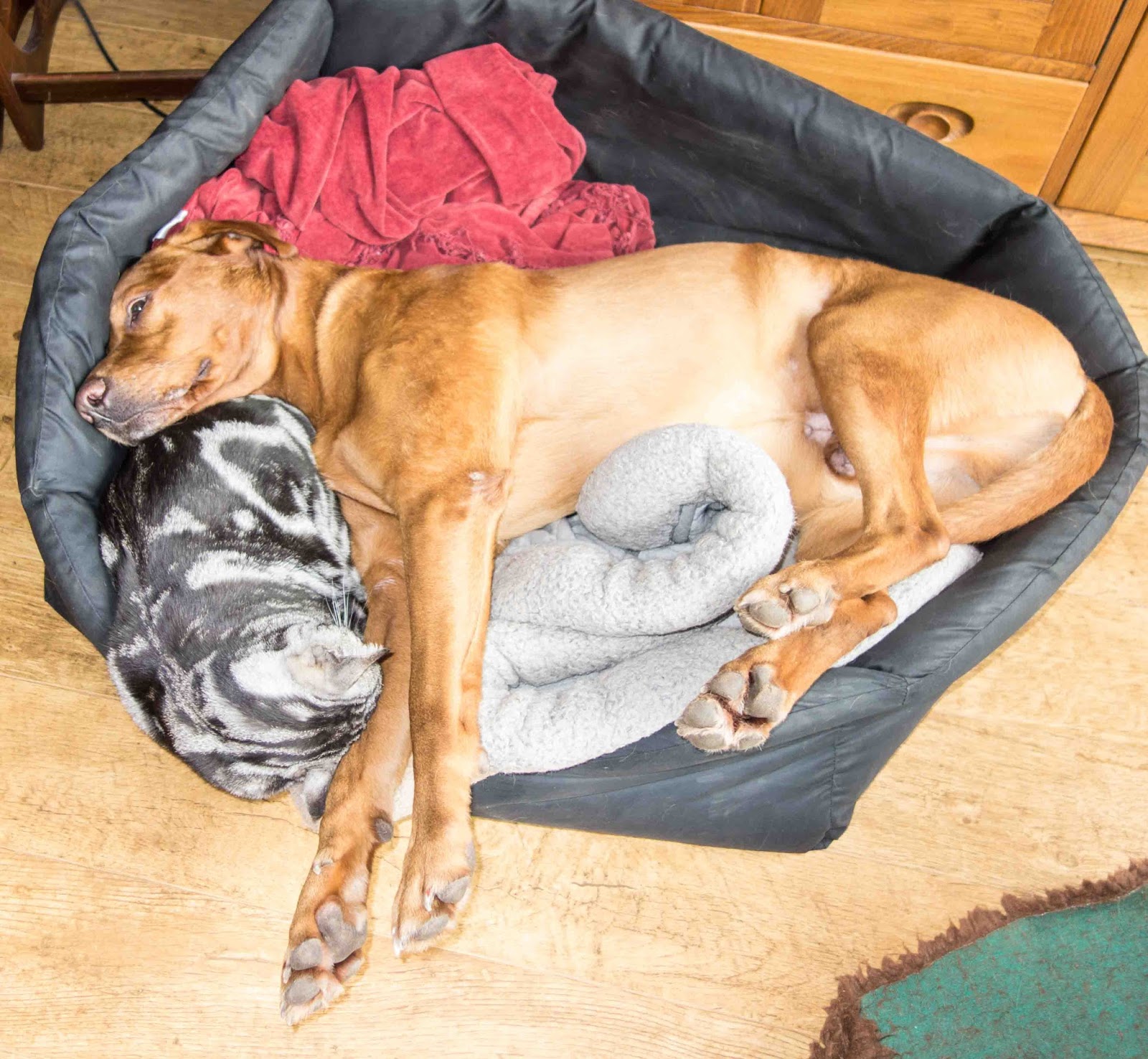
Bertie  and Jellicoe share a bed. He couldn't be a hunter, could he?
Bertie and Roxy were stretched out on our bed, joined from time to time by Herschel and Jellicoe. Isambard was lying on my legs so naturally I couldn’t get up – it’s very bad manners to disturb a cat. Jenna and Gus were snoozing in their beds.

We could hear sounds of cats playing. At least Solomon and Lenny weren’t screaming at each other so all was peaceful and there was no urgency for us to get up and proceed with the day. Susannah returned and there was an exclamation of disbelief and horror as she realised she had trodden on a dead but still pliant wood pigeon.

‘You’ve got to see this,’ she said so we duly arose. The hall was a mass of feathers surrounding a defunct avian. The scene in the garden of the capture and possibly the execution  was clearly demarcated by a sufficient number of feathers to make us believe there might have been more than one casualty. How can one bird have so many feathers? Still, as the old tongue twister has it, 'There are forty thousand feathers on a thrush' so there must be at least that number on a wood pigeon. I can understand why Labradors dislike picking up pigeons – all those feathers coming loose.
Not quite the remains of the day  . . .
After clearing up (We now have a clear idea of the colour of a pigeon blood ruby) we set about using our deductive skills to determine the culprit. We thought about Susannah’s cats. Solomon is little and likes catching dragonflies. 
Solomon
Could it have been Lenny? Possibly. He may have lain on the poor bird. Lenny is ‘plump’ and lazy and limits his hunting exploits to moths.
Lenny
It could not have been Isambard as he was pinning down my legs and in any case is not keen on leaving the company either of us or the dogs. 
Isambard watching the fish
Herschel caught a squirrel not long after he was given the freedom of the garden but is not given to excessive hunting. We concluded it was probably Jellicoe. He watches the birds more than the others and so far this year he has killed a rat, a field mouse, a dunnock and a wood pigeon. He also caught a blackbird but it escaped. So, he’s not the most prolific of killers but he does his best, sadly.
What is this?'
Our garden used to be busy with birds, particularly at this time of year when adults are feeding their young, but word seems to have got around in the bird fraternity that it is a no-go area. While we miss seeing them we are glad they no longer frequent our feeders. It is a small price to pay for the joy of seeing our elegant felines prowling through the shrubs, watching the fish in the pond or sunning themselves.

Fish shall safely swim . . .

Wednesday, 7 September 2016

The Pleasures of Cats

It is now almost a month since the cats were first granted the freedom of the garden.  Barry and I have been savouring the pleasure of seeing our cats enjoying the Great Outdoors.

‘Like tigers in the savannah,’ we say happily to each other as we watch them prowling through the undergrowth or leaping gracefully to a vantage point to gaze down upon the fish busily spawning in the pond.

Birds have been noticeably absent, if that is not an oxymoron, and though I know they are quieter in August because they are moulting, it is now September. Crows and magpies, collared doves and wood pigeons and an occasional spotted woodpecker have all been spotted and the tawny owls continue to call at night, but the noisy squadrons of starlings are staying away in droves. Have our handsome cats been noticed by our feathered hitherto friends?

If that is the case then they are wiser than a young squirrel today which managed to negotiate the cat fence to climb in but was not fortunate enough to find a way out. Herschel was sitting on the grandfather clock in the sitting room, quietly surveying the garden, when something caught his eye and he leapt off and raced down the path. By the time I had reached the patio door he was back, carrying a live squirrel. I managed to shut the door before he brought his prize into the house and then turned the hose on him to ‘encourage’ him to release it. He didn’t. Two minutes later he was back at the patio door and, dropping his bedraggled and now sadly dead trophy on the step, he retreated to the wooden bridge over the pond to lick himself dry.

Naturally, the dogs and all the other cats wanted to inspect the ‘gift’ so thoughtfully presented by their friend and relation. We like our animals to eat raw meat but prefer it to be safe and as I didn’t fancy popping the body into the animal food freezer for a week to kill all bacteria the little corpse has been safely disposed of. (I didn’t fancy skinning and gutting it, either.)

It would be foolish to imagine that the cats will suppress their hunting instincts to avoid alarming their squeamish servants but they are only allowed in the garden when we are here to supervise them so that, hopefully, we will be able to reduce the number of captures, live or otherwise, that are brought in for our delectation. However, I did discover a half-eaten dragonfly in the conservatory.


In case you’re wondering, Herschel, or Herschel the Hunter as he will henceforth be known, and I are still on speaking terms and as I write he is sleeping on the sofa next to Bertie, his favourite dog. Doubtless he is dreaming of squirrel pie. 

Tuesday, 8 November 2011

ABC Wednesday Q is for Quercus and Quince

There was a flowering Quince (Chaenomeles) already in the garden when we bought this house, more than thirty years ago. It has survived rather than thrived, usually producing a few red flowers and three or four yellow fruits. I have never attempted to do anything with them since I don’t think it’s worth the effort to produce probably less than one egg cupful of quince jelly. The fruits are impossibly bitter, difficult to peel and take a long time to cook but aficionados declare them a rare treat. They can also be pickled.
View of oaks from our garden
There is an abundance of Quercus in this area. They are mostly English oaks (Quercus robur or Quercus pedunculata) producing acorns which nestle in cups at the ends of long stems. The pedunculate oak is a long-lived tree native to most of Europe. It commonly measures its life in centuries, the oldest two in UK, in the New Forest of Hampshire and in Lincolnshire, being around 1000 years old.
Fresh leaves in April
Oak supports more than 400 species of insects, more than any other British plant and is an important food source, in the form or acorns, for many small mammals and birds. 
Jays (Garrulus glandarius) were the principal propagators of this oak before the development of commercial planting. It is a hardwood tree grown for its long-lasting heartwood which is much in demand for interiors and furniture.
We often see squirrels racing round the trunks or leaping from branch to branch
The English oak is a national emblem, its importance originating in the oak tree in which the future Charles II hid during the English Civil War. From that time it was known as the Royal Oak. May 29th is Oak Apple Day or Royal Oak Day and was so named by Act of Parliament more than 350 years ago. You can read more about it here.
Two of our oaks being cut down on a very cold January day
‘The Royal Oak’ is one of the most popular names for English public houses and eight Royal Navy warships have been commissioned with the name Royal Oak. In Tudor times oak was the main construction material for warships and the Royal Navy’s official quick march is ‘Heart of Oak.’


Come, cheer up, my lads, 'tis to glory we steer,
To add something more to this wonderful year;
To honour we call you, as freemen not slaves,
For who are so free as the sons of the waves?


(Chorus)


Heart of oak are our ships, jolly tars are our men,
we always are ready; Steady, boys, steady!
We'll fight and we'll conquer again and again


The oak is the commonest woodland tree in England but must grow for 70 to 80 years before it produces its first acorns.


Click here for more Qs

Thursday, 14 October 2010

Yesterday’s walk - Gus grows up and a small tragedy


Gus carries the Air Kong
Gus is 13½ months old now and growing into quite a big boy. He learns very quickly and is a wonderful retriever, always keeping his eye on the ball or the Air Kong. He is as fast over ground as Jenna and nearly as speedy as her in the water but there is one area in which he has taken time to mature. All our other dogs cocked their legs the day they turned six months old but Gus was content to continue discreetly squatting, like Jenna, until yesterday, when he cocked his leg for the very first time. We felt that our little boy had come of age!
Two dogs, one Kong and Jenna, on the right, wins the prize.
Gus is intent on taking part in the 2012 Olympics and has been practising hard for the Long Jump event. So far he has only practised over water and still has to perfect his landing. At the moment his tail ruins any chance of breaking a record, I’m afraid.
Like all good athletes Gus mentally rehearses his jump
 Like a tightly coiled spring he is ready to leap forward
 
Uncoiled and almost airborne
 Flying!
Preparing for touchdown - the tail is going to spoil the jump!
As we returned from the practice arena, otherwise known as the forest, we noticed a sad little corpse. It was not there when we set out and we could see no cause of death. 
We are sure this adult had only recently met its death as the scavengers had not yet started their grisly work.
Normally we only see dead squirrels  on the roads – we have never found one in the garden and it’s rare to see a corpse in the forest. The last time we saw one was  a few years ago when Frodo was quite young. In fact, he found it and gently picked it up and brought it to me. He didn’t notice this one.

Sunday, 23 May 2010

Camera Critters #111, Shadow Shot Sunday #105


This 'very berry' fat cake, as CJ Wildbird Foods' markets it, is attractive to blackbirds and song thrushes among others. It also attracts grey squirrels! As the song has it, 'All God's creatures  got a place in the choir!

Chorus: All God's creatures got a place in the choir,
Some sing low, some sing higher;
Some sing loud on the telephone wire,
Some just clap their hands, their paws or anything they got now!
Listen to the bass it's the one on the bottom,
Where the bullfrog croaks and the hippopotamus
Moans and groans with a big to-toot,
And the old cow just goes moo.
The dogs and cats they take up the middle,
Where the honey bee hums and the crickets fiddle,
The donkey brays and the pony neighs,
And the old gray badger sighs.
Chorus:
Listen to the top where the little birds singing,
All the melodies and the high notes swinging;
And the hoot owl cries over everything,
And the blackbird disagrees.
Singing in the night time singing in the day,
The little duck quacks and he's on his way;
The otter hasn't got much to say,
And the porcupine talks to himself.
Chorus:
It's a simple song of living sung everywhere,
By the ox and the fox and the grizzly bear,
Grumpy alligator and the hog above,
The sly old weasel and the turtle dove.
Chorus:
Whoa!
All God's creatures got a place in the choir,
Some sing low, some sing higher;
Some sing loud on the telephone wire,
Some just clap their hands, their paws or anything they got now!

Thank you to Tracy from 'Hey Harriet' for organising Shadow Shot Sunday, and to Misty Dawn for 'Camera Critters.'
To see more please click on the appropriate label.