Showing posts with label Dalmatian. Show all posts

Monday, 15 September 2025

Dogs and puppies


Dogs and puppies

Roxy with her ball, Gilbert waiting.

Roxy and Gilbert met a puppy the other day, a yellow Labrador called Max, thirteen weeks old, and very new to the experience of walking in the Great Outdoors. Well brought-up puppies know that they should be submissive to their elders and so they roll onto their backs, exposing the most vulnerable part of their anatomies to the seniors. Frequently, an inadvertent release of a small amount of puppy pee will occur, to further placate the adults.

When the older dogs sniff the puppy, it will squirm with delight, sometimes squeaking. Some dogs remain submissive all their lives. Our senior Jack Russell, Biddy, had an endearing habit of submitting to people in her ‘pack’ all her life.

Roxy is never happier than when she is carrying a ball, and if she can manage to fit two in her mouth, she is even more delighted. She will not relinquish her prize to another dog, only to a human. While Gilbert may sometimes be distracted from the task of retrieval, Roxy is fully engaged and always knows where a flung ball has landed, often pointing it out to Gilbert.

However, when she met Max, she dropped her ball and allowed him to play with it. Well-bred, properly-socialised adult dogs recognise and understand the needs of puppies. We have been fortunate to have had a number of puppies, and it is heart-warming to see an adult dog gently playing with a young puppy.

Gus playing with puppy Bertie.

To the inexperienced it may look and sound dangerous. There is a lot of play growling and mouthing, huge adult jaws enveloping tiny snouts, the puppy being allowed liberties no adult dog could enjoy.

Frodo playing with puppy Jenna.

Should the puppy become too boisterous, the adult will discipline it, firmly and so quickly that a human may miss the reprimand. Nonetheless, just as humans need a break and a rest from the insistent demands of toddlers, so should dogs be respected and the puppy removed to a safe place for a nap after a period of play.

Bertie sleeping with his big friend, Gus.
Young puppies miss the warmth and security of their litter-mates. Adult dogs don’t often sleep together, but will tolerate a puppy snuggling up to them.

Puppy Gilbert with Roxy and Herschel on his first night in his new home.

Sunday, 14 September 2025

Tinea


Tinea

Tinea, perhaps more commonly known as Athlete’s foot, is an intensely itchy condition which is hard to eradicate. It is frequently acquired in communal changing rooms.

Barry suffered with tinea during his running years. He travelled the world on business, and went running in every country he was sent to. It was a wonderful way to explore different landscapes.

He tried many remedies for Athlete’s foot, and consulted doctors who recommended different treatments, but nothing seemed to work.

One day, our Dalmatian, Cariadd, began to lick his feet. Once he had overcome the ticklishness of her attention, he relaxed and enjoyed it. To his surprise, within a few days, the tinea had cleared completely. It may have been coincidental, and maybe it would have disappeared on its own eventually, but Cariadd was credited with almost magical properties. She only ever licked his feet when tinea recurred and passed on her ‘knowledge’ to the younger dogs.

People sometimes shudder when they think about a dog licking their feet, but it’s actually incredibly soothing.

Thursday, 5 June 2025

Mantra


Mantra


We have long been advocates of mantras, not for religious reasons, but to help us feel we are a little more in control.

The morning mantra used to be, ‘Keys, wallet, briefcase, ‘phone,’ as the man of the house left for work. The woman of the house didn’t need a mantra. It was her job to make sure that each child left the house properly dressed, thoroughly fed and on time, before closing the door securely and making her own way to work. After she had repeated, ‘Have you got. . . ? Have you remembered . . .?’ umpteen times, there was little chance of her forgetting what she needed for the day ahead.

Now, in the peaceful days of our non-working lives, the mantra has changed. As we prepare to leave the house with dogs in tow, for a hearty jaunt in the woods, the chant is, ‘Keys, hat, sunglasses, camera, walking poles, leads, remote control.’

Remote control?

Our dogs are smartly dressed in orange tracker collars, which they wear alongside the collars with their identity tags. 

                                                Coming out?

The remote control is not intended to control the dogs, but to identify where they are, should they decide to follow a path of their own choosing. It is possible to monitor thirty dogs with the device, so is more than sufficient for our two. We have only ever walked seven dogs at a time, four of ours and three of our daughter’s, but that was a long time ago, when there were fewer people out walking dogs.

    Gilbert models his collars. On this occasion, he and Roxy are wearing the blue collars decorated with bees.

We know how far each dog has travelled, and also the distance the humans have covered. They cover approximately twice the distance of the people. Satellite imagery presents a clear map to show the terrain and to help plan a route, if required.

It’s interesting to use the tracker, but also comforting. In all our decades of having dogs, we’ve lost three. One, a little Jack Russell, found her way home late at night. Her brother, on another occasion, was knocked down but died after a few days with the vet. He was a strong dog, but the shock was too much for him. The third one, my Velcro dog, emerged from the carcase of a deer, in which he had been feasting. He had become a black, white and red Dalmatian.

So, we have the trackers for our peace of mind (or piece of mind!!) It’s about time children were fitted with trackers, too, though I gather iPhones can be tracked. I know I wouldn’t have liked to have been so easily traced, but maybe things are different now. 

Given the opportunity, I would have hidden inside my children’s heads to understand them. As it was, I had to rely on the information they gave me to know where they were and with whom. We all survived, and it’s been interesting watching them navigate the perilous waters of parenthood. Parenting at one or two removes is so much more relaxing!

Monday, 5 May 2025

Agility Course


Agility Course

Watching dogs speed around an agility course is pure delight, particularly if they make the course their own, and run under obstacles instead of over them, or miss them out completely. Some dogs are natural comedians and respond to laughter, and they are the ones who steal the hearts of an audience.

We had a liver and white Dalmatian called Buddy, who was actually rather good at agility. He had brains and beauty, and wanted always to please his young owner, our youngest daughter, Bethan. She had spent a great deal of time building agility courses in our not very large garden, for Cariadd, our first Dalmatian. Bethan was three years old when we brought the small, warm puppy home, so Cariadd was around six when she started training her in agility. Cariadd was very obliging, but it wasn’t really her favourite occupation. She preferred cross country running.

 Buddy was a different prospect. He would do anything for Bethan and did well in his classes. However, he was just too big to compete with the dainty little dogs that normally excel at agility and eventually the lessons ceased, and he reverted to being a proper Dalmatian, running miles every day with Barry, Cariadd and Dominie.

We have an agility course in our house. The objective is not to discover how fast we can complete the course, but to see if we can complete it without breaking our necks.

The first obstacles are the slow-moving, indolent cats, who weave their way slightly ahead of us, miaouing if we dare to suggest they could move a little faster, please. Every move towards the kitchen indicates to them that meals might soon be served. They have been heavily influenced by the dogs, whose major loves in life are us, followed swiftly by food. The rule is, ‘If the humans move, we move, too.’

Having negotiated a track past the cats, the major obstacle presents itself. This is Roxy, who prostrates herself before us like a living sacrifice. It is imperative that she is never more than twelve inches away from one of us. I fear that she suffers from the reverse ostrich syndrome; that is, if we cannot see her, we might deny her existence.

Preparing meals, filling the kettle, emptying the dishwasher/washing machine/tumble dryer, packing the groceries away in fridge, freezer or cupboard, Roxy is always there, at our feet. I don’t know how we don’t trip over her.

Gilbert is also part of the course, but his function is to help. He moves around us, bringing us toys if he thinks we need some encouragement in our pursuits.

When we have completed whatever footling task we embarked on, we retreat from the kitchen, but now the agility course has been altered. The recumbent Roxy has miraculously and silently blocked our way out of the kitchen. It would not be advisable to step over her, because she has been known to rise up, mid-step-over, and that is quite hazardous. Slowly, we navigate our path back, accompanied by our four-footed friends.

Nothing can be accomplished at speed in our house unless we shut the animals away. Hence, we have baby gates at strategic doorways, behind which dogs can be contained. They don’t work for the cats – they slither under or leap over. The gates mean that the dogs can still be in contact, but not as closely as they might desire.

It's not so vastly different to having toddlers and at least the animals don’t have tantrums.

Thursday, 3 April 2025

Looking back


Looking back

Frodo the Faller

Dalmatians have short, white eyelashes to match their short white (and black or liver) coats. Frodo had a somewhat piratical look. Strangely, there was another Dalmatian in our road at the time who was called Pirate and who had an even more pronounced eye patch. 

Dalmatians are pure white at birth. The spots develop in the first six to eighteen months. Some Dalmatians are born with coloured patches. The fur on such patches is coarser than the rest of the silky coat. At one time, decades ago, such puppies were destroyed at birth, but now it is realised that they are perfectly normal and make very good pets. They can never be show dogs, that's all.

I wondered what had been happening in this domain ten years ago. Why ten years? I don’t really know. It doesn’t seem possible that ten years have passed. Sometimes it seems like yesterday, while at other times it feels like another lifetime.

So, here is the link to Frodo the Faller – he really was a trooper and a great favourite with all who knew him, including many vets.

Tuesday, 11 February 2025

Sticks!


Sticks!

It is a fact universally acknowledged that dogs enjoy sticks or things that resemble sticks. They like to chase and retrieve them, or chew them, or guard them, or play tug of war with them, or simply lie on them and go to sleep.

Many dogs will seek out a stick as soon as their paws touch the forest floor, and the bigger it is, the better. Roxy Labrador picks up a stick the minute she gets out of the car.

Dogs will navigate gateways and narrow paths with sticks that are much longer than it would be thought possible to manoeuvre. Cariadd Dalmatian used to carry sticks that looked more like telegraph poles.

Some dogs are possessive about their sticks and will not relinquish them. Arthur Cocker Spaniel loves to play the ‘Is that my . . . ?’ game. He will not give up his stick or toy until he is ready. He makes lots of noise, but he is the sweetest little dog.

 Sam Jack Russell insisted on taking his sticks into the back of the car and would not release them until he reached home. He and his sister, Daisy, played sticks with their mother, Biddy. The three of them ran along, two going forwards, one backwards. Biddy was also an accomplished tree climber.

Sticks and water go together. Labradors are persistent retrievers and bob their heads under water, looking and smelling for sticks that have sunk. Atavistic behaviour deep in the retriever memory from their origins, perhaps, from hauling in fishing nets in the chilly Newfoundland waters.

We always make sure that sticks are thick and long enough not to stick in the dogs’ mouths and throats. Mostly, we encourage our dogs to play with Kongs and balls, but sometimes, only a stick will do! 

Wednesday, 30 August 2023

Gilbert the Good - a Monty Don dog


 Gilbert the Good – a Monty Don dog

I told you a while age that my humans call me a Monty Don dog. Monty Don presents a television programme called Gardeners’ World and there are two dogs that help him, a Golden Retriever and a Yorkshire Terrier. I’m more the size of a retriever – well, I am a Labrador Retriever, so that makes sense.

Anyway, I think I could offer my services to Monty Don if he ever needs a stand-in, say if his dogs are on holiday or something. I like helping in the garden. I even bring things indoors sometimes – the odd branch, perhaps, or I particularly like flower pots and I don’t mind if they’re full or empty.

               I like to stick my nose in when Janice is weeding. Some of the things she pulls up look quite appetising. She pulled up a lot of mint the other day as it was growing everywhere, even in the pond. I like mint. It smells wonderful.

.Barry has been pruning trees and then he does something called ‘graunching’ which is very noisy. I stand well back. I don’t like loud noises.  He uses a big machine and wears things on his ears and over his eyes – I don’t know how he can see what he’s doing! Then he puts all the graunched bits back on the garden. He says the graunched bits are now called ‘mulch’. There’s a lot I don’t understand but I’m willing to learn. I could graunch some branches for him if it would help. He wouldn’t even have to take them off the trees.

I like smelling the flowers. My humans told me that Buddy Liver Spots liked to stand among the plants in the conservatory. He hated getting wet, so never went swimming, and always walked round puddles if he could, but loved to run through long wet grass. He was a Dalmatian, though, and I’m a Labrador, so we are quite different.  My long-ago relatives used to help the fishermen haul in the nets in Newfoundland and I’m sure my distant cousins still do. All Labradors have partially webbed feet so we’re all good swimmers.

I don’t like going into the garden when it’s raining and neither does Roxy, but we love to go walking when it’s wet. Bertie, who came before me, didn’t like going out in the rain when he was a puppy. If he needed a pee he used the cats’ litter tray. I haven’t done that and I’m too big now, anyway. I’m a good boy – I know that because my humans keep telling me I am.

Anyway, back to being a Monty Don dog. I think  I’d enjoy being on television. Lights! Camera! Action!


TTFN

Gilbert

Tuesday, 7 March 2023

For all the dogs of our lives


For all the dogs of our lives

Frodo the Faller

When the American playwright, Eugene O’Neill, and his third wife lived in Paris in the 1930s, they had a Dalmatian called Blemie (Silverdene Emblem) He travelled to the USA with them, eventually dying on 17th December, 1940. His headstone reads, ‘Sleep in peace, faithful friend.’ 

O’Neill wrote ‘The Last Will and Testament of an Extremely Distinguished Dog’ a few days later and his words will resonate with anyone who has ever loved and lost a dog. The following extracts contain the essence of the whole document.

‘There is nothing of value I have to bequeath except my love and my faith. These I leave to all those who have loved me. I ask my Master and Mistress to remember me always, but not to grieve for me too long. 

One last request I earnestly make. Now I ask, for love of me, to have another. It would be a poor tribute to my memory never to have a dog again.’

The will in its entirety can be found here.

Gus, Bertie and Jenna
Jenna

Frodo the Faller
Fetch! (and try not to fall over)

Monday, 27 February 2023

Splooting


Splooting

Roxy splooting 
Most of our dogs have adopted the hearth rug position, limbs stretched out fore and aft, from little Jack Russell, Busy Biddy to big Dalmatian, Frodo the Faller. Watching Roxy relaxing today and demonstrating her hearth rug technique, I dimly recalled hearing or reading something to the effect that this pose was not good for dogs, could damage their hips, or some such thinking. I felt this could not be right, as so many of our dogs have done it with no lasting damage, or, indeed, any damage at all.
Puppy Bertie splooting 
There is potential for damage, if passing humans are not looking where they’re going. A dog is a trip hazard at the best of times. For the dog, being mistaken for an actual hearth rug could be perilous!

I looked it up and discovered there is a name for ‘hearth rug dog’. Apparently, ‘splooting’ has long been associated with Welsh Corgis, but many other breeds also do it, as do cats, rabbits and other four-legged animals, like squirrels and lizards.

One explanation suggests that animals sploot to stretch their joints. Another thought is that they do it to cool down when the weather is very hot. Dogs can only sweat through their pads and so stretch out to expose as much as possible of their skin to cool surfaces.

Anyway, splooting is my new word of the day, but there will be limited opportunities to use it.

Wednesday, 8 February 2023

A Life Full of Animals - part two


A Life Full of Animals – part two


Dominie and Jenna. Jenna could barely step over the threshold!

We have always been available to look after our adult children’s dogs. Taking care of Foxy, Gillian’s fox-red working Labrador puppy, made us realise how much we liked and missed Labradors, and so Jenna came into our lives from Shropshire. We asked for the biggest black bitch in the litter, as she would be living with Dalmatians, which are quite big dogs. Well, she had big paws and that’s as far as it went. She remained a little dog with big paws throughout her sixteen years.
 Playtime with Frodo

We didn’t know there were pheasant in the forest where we walk, until Jenna flushed them. She also chased deer and would disappear into the distance, so we put a cow bell on her, to hear when she was near and an electronic tracker, so that we could discover where she’d been. We think it was because she had Dalmatian companions, who don’t generally retrieve, although they can, and are built for long distance running, which she wasn’t. Once she had Labrador friends and relations she never disappeared again.


 Jenna with tracker 
Jenna was a very sociable dog. Whenever we were out walking and saw people in the distance she would always go to greet them, even if she had never seen them before. Once she had done that, she would be content to come back to us. She maintained that endearing habit almost to the end of her life.
Jenna and Gus
Her half-brother, Gus, four years her junior, pointed out to us the difference between dogs and bitches. We had always assumed that bitches were easier, even though we had had dogs as well as bitches. They are smaller than dogs, generally, Dominie being something of an exception. The Jack Russell and Dalmatian bitches were biddable and faithful, but Jenna, our first Labrador for nearly forty years, reminded us that this particular breed is different.
Gus
We had forgotten how independent they are. Jenna was friendly and loyal but inclined to follow her own path, which was actually never far from ours. Gus stayed close to heel and like Buddy Liver-Spots before him, spent much time and energy trying to keep his pack together. His most worrying times came when we had an extended family walk with several dogs. As the line of people lengthened, so he rushed back and forth from end to end, trying, so we thought, to chivvy the laggards to increase their pace, and the leaders to slow down.
Buster, left, and Bertie 
An exception to this rule was Buster, Bertie’s brother, who went to live with Gillian and her family in Dorset. They were beautiful fox-red working Labradors. While Bertie was a sensible, sober dog who never wanted to be found wanting in the behaviour stakes, or anywhere else, Buster was capricious. He enjoyed charging off in all directions. Bertie enjoyed greeting other dogs, but once introductions had been made, he was happy to return to us. He was a perfect gentleman with a wonderful smile. Gus’s smile showed just his front teeth but Bertie’s was full and wide and accompanied by snorts of pleasure.
Roxy 
Three days after Frodo died, Roxy was born in Shropshire, (all our Labradors have come from the same kennels in Shropshire, where the dogs are bred for temperament first and foremost) and it’s fanciful to think that some of his spirit was reborn in her, mainly because she is a counter-surfer, the only Labrador we’ve known to do this, although Gilbert is showing signs of following in her paw-steps. In every other respect, she’s her own dog, friend to all, human, canine or feline.

Jenna, Gus and Bertie all died within eleven months, which was heart-breaking. Gus and Bertie died in August and October last year so Roxy rapidly went from being the youngest to the only dog and she was really depressed. She had never known life without another dog and although the cats were company it wasn’t the same. So, in January this year, Gilbert came to live with us.
Gilbert soon after he arrived. He was smaller - that is, shorter than the cats
Now he is thirteen weeks old and growing apace. Herschel is gaining the ascendant, as cats do
At the time of writing, both cats have taken refuge from Gilbert inside the fire guard and are about to start taking lumps out of each other. A stern ‘No squabbling’ from me usually stops them in their tracks. Although they’re litter brothers, they are very different. Herschel is a standard Ocicat, spotted and striped and a third bigger than Jellicoe. Jellicoe is a classic tabby-patterned Ocicat, now known, bizarrely to my ears, as an Aztec. They are extremely affectionate and always in our company. Their brother, Isambard, died when he was seven.
Isambard, Jellicoe and Herschel
Our first two Ocicats, Winston and Monty, also died young. Monty was only three and Winston was six. Our vets did their best, but were puzzled. As one set of medications sorted out one problem it revealed another and it became a roundabout of symptoms and decline. They were stunning animals.
Winston and Monty  
We then had a couple of years without any cats until one day we were startled by a house mouse. I like mice, the pet variety, but didn’t want to encourage wild mice, so we did our research and acquired the three brothers ten years ago. Barry says they were his best ever birthday present.

Herschel

Cat in a basket - Jellicoe
We haven’t had house mice since and Herschel regularly patrols the integral garage. I don’t think they’ve ever caught anything indoors but have certainly captured rats and mice in the garden. A foolhardy young squirrel met its end from Herschel and Jellicoe has killed a wood pigeon, which he dragged through the cat flap and deposited at the foot of the stairs. Happily, birds do not figure largely in the death statistics and, unlike the Burmese, they don’t trap frogs. They are not avid hunters and prefer to spend their time in the garden lounging in high places and looking beautiful.

Tuesday, 31 January 2023

A Life Full of Animals - part one


A Life Full of Animals - part one

I have never known a time in my life without animals, apart from the three years I was at college.

My earliest memory is of Bob the Collie, for whom my father laid a place at the table. There followed Sombre the Smooth-coated Collie, Ginger the cat, Punch the Springer and Judy the kitten.

The first dog Barry and I had was a yellow Labrador called Whisky. She was three years old and she was my birthday present from Barry when I was in my final year. I couldn’t keep her at college so Barry kept her in the officers’ mess at RMCS Shrivenham, where she led a very convivial life. She was a patient and very friendly dog, and eventually a great companion to and protector of our young children. 
Whisky with Gareth
We thought her not to be a natural guard dog, barking only at buses and ladders, until one night in Northern Ireland when Barry came home very late, she barked menacingly at him before she realised who he was and was then abjectly apologetic. She was not averse to helping herself to choice morsels from other people’s shopping baskets, when the opportunity presented itself, and enjoyed ‘picking’ blackberries, too.

Biddy with Gillian

As she aged and our children grew, we decided to get another dog, to ease the pain of Whisky’s passing, when the time came. Thus we acquired Biddy, a 7-month-old smooth-coated Jack Russell terrier, (JR) the long-legged variety now known as Parson Jack Russell. She had already been cubbing and never lost her penchant for searching underground, once disappearing for several hours and emerging mostly brown, rather than her usual tan and white. She was enormous fun, always seeking to ingratiate herself by sliding round on one shoulder in front of one of us and submitting. She was very much Barry’s dog, loving to huddle inside his jacket. When he wasn’t around, Biddy’s preferred companion was Gareth, particularly in the forest. She was expert at climbing trees.

Biddy and Gareth

After Whisky died, Biddy was lonely, missing her old companion and so we got Leo, a rough-coated, short-legged Jack Russell. He had been a stud dog and in our innocence we thought we would have no problem keeping him and Biddy apart when she came into season. How wrong we were! Biddy had five adorable puppies, and we kept Daisy and Sam. Daisy was a very pretty broken-coated girl and liked sleeping in the cat beds we suspended from the radiators, for by now, we had a cat, a beautiful brown Burmese.

Leo

Susannah, Gillian and Gareth with Biddy and her five puppies


Daisy
Daisy, Sam and Biddy at the seaside
This came about because Susannah had wanted a rabbit. We had experienced heart-ache with Gillian’s previous rabbits and so persuaded Susannah that a cat would be preferable. We called her Alicat and we were encouraged to breed from her. JRs are reputed to be cat killers but when we brought Alicat home, Daisy jumped on my lap, watched by the other three, and we never had a problem. Of course, each of our then three children had a different favourite kitten and soon our menagerie grew, until by the time Bethan, our fourth child, arrived, we had four JRs and nine Burmese. We also had guinea pigs and pet mice and gerbils, all of which reproduced at will.
Sam with Susannah and Bethan

Bethan with Barry, Sam and Daisy

Sam was also broken-coated and immensely strong for his size. He loved collecting logs, the bigger the better. He really was a big dog in a little dog’s body. He and Leo did not get on once he grew up, so Leo went to live with my parents. Sam’s life was short and sweet. Out running with Barry one day, he ran off and was knocked down by a car. He died unexpectedly after surviving a few days with the vet. He was six years old. Biddy had spent much time licking his ears and little Daisy was somewhat overlooked. Clearly, Sam was his mother’s favourite and she pined for him.  We commenced our search for our next dog. 

I had long wanted a Dalmatian and soon Cariadd joined our family from Wales. She was smaller than the JRs when she first arrived, but soon outstripped them and proved to be a good problem-solver.

Biddy and Cariadd

Cariadd. Bethan, Biddy and Daisy

Barry holding one of Cariadd's longer 'sticks', watched by Bethan

She specialised in carrying long branches, more like young trees, through small gaps and was the perfect running mate for Barry. She also had a terrific smile, which worried people who were not familiar with dog smiles. We were sometimes told, ‘Your dog’s snarling at me.’

Many breeds of dog smile, or snark, some with closed lips, others with varying degrees of tooth display and nose wrinkling. I must admit it can look quite alarming!

I believe that once you have two or more dogs you can never go back to just one. Dogs need dogs and the one that’s left alone becomes depressed. A ‘new’ dog, whether baby puppy or older dog, rejuvenates the survivor and rekindles his or her energy and enthusiasm.

When our last JR, Daisy, died, we had to find a companion for Cariadd, and this came in the form of Dalmatian Dominie, from Devon, four months old and a really big puppy. She was as soft as butter, a little dog in a big dog’s disguise. Cariadd, not noted for her maternal instinct, allowed the youngster to chew her neck and never grumbled at her. Dominie was not well coordinated as a puppy and fell in our pond every day for a week as she thundered over the bridge, but she grew into an athletic dog who could turn on a sixpence, giving any chasing dog a great work out.

Dominie with our eldest grandson, Callum (now 25 and an expectant father)

We were very taken with our Dalmatians, delighting in their elegance and intelligence, and it was good to have not one, but two big dogs to which we could reach down a hand to be nuzzled. As Cariadd aged, and, sadly, dogs age too quickly, we decided to look for a third Dalmatian. Bethan had enjoyed building obstacle courses for Cariadd and was keen to try showing a dog. Dominie, beautiful though she was, was simply too big and Cariadd had never been keen on the show ring.

We thought it would be fun to have a liver Dalmatian, so green-eyed Buddy left his home in Cornwall to live with us. His eyes didn’t remain green. He was a handsome boy, devoted to Bethan. When we brought him home, Dominie’s expression was one of pure joy. We could almost hear her saying, ‘My puppy, oh, my puppy.’

Dominie with baby Buddy

Labradors are renowned for being greedy, but Dalmatians can match, if not outpace them. Ours all learnt very quickly that food was freely available on work tops and we had to find places they could not reach. Naturally, they didn’t attempt to thieve while we watched. We were careful about not allowing them ‘dangerous’ foods, like grapes or macadamia nuts, but even so Buddy demolished a chocolate cake and lived to tell the tale. Our grandchildren still laugh about that.

Buddy does the leg work while Dominie waits

In the meantime, the cats were ruling the roost, and attempting to find a way into the fish tank for a tasty fresh snack. When they had a spat, as cats do, they would find a dog to curl up with. The cats never attacked the dogs, just each other. Sometimes, a dog would stand between two arguing cats, to calm them down.

Cariadd and 6 Burmese

After Buddy came seven-month–old Frodo, from Lincolnshire, a dog bred primarily for looks rather than temperament. He was always gentle and loving with everyone in our household, particularly Buddy, but reactive with unfamiliar dogs, not a good trait in a show dog. He became my Velcro dog and remained so until his death seven years ago.
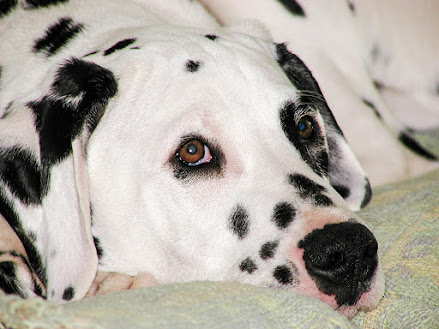
 

Frodo the Faller