Showing posts with label Redwing. Show all posts

Sunday, 9 April 2023

A to Z challenge 2023 – I is for . . .


A to Zchallenge 2023 – I is for . . .

My theme for this challenge is Nature in all much of her wonderful diversity. My posts will reflect the fact that I am resident in the south of England.

All photographs in this post are the property of the writer.


I is for Ilex (holly)

Holly flower buds

Ilex ‘Golden King’ is an evergreen tree with variegated spiny leaves of green and bright gold. Occasionally it produces all gold leaves.

New leaf growth is red 

It is one of the best variegated holly varieties and will thrive in shade, although the leaf colour is better in full sun.

Immature berries
We have always asked a lot of the plants we choose for our garden, colour, scent and beauty for most of the year, but above all, we want them to attract insects and birds. Obviously, we don’t always get it right. Hakuro Nishiki is a case in point – it is the dumb blonde of the UK plant world.
Berries ripe and ready to eat
 In spring ‘Golden King’, which, despite its name, is a female tree, has small white flowers which provide nectar and pollen for bees and other pollinators. The flowers are followed by crimson berries in the autumn.
Blue tits and other small birds seek out insects
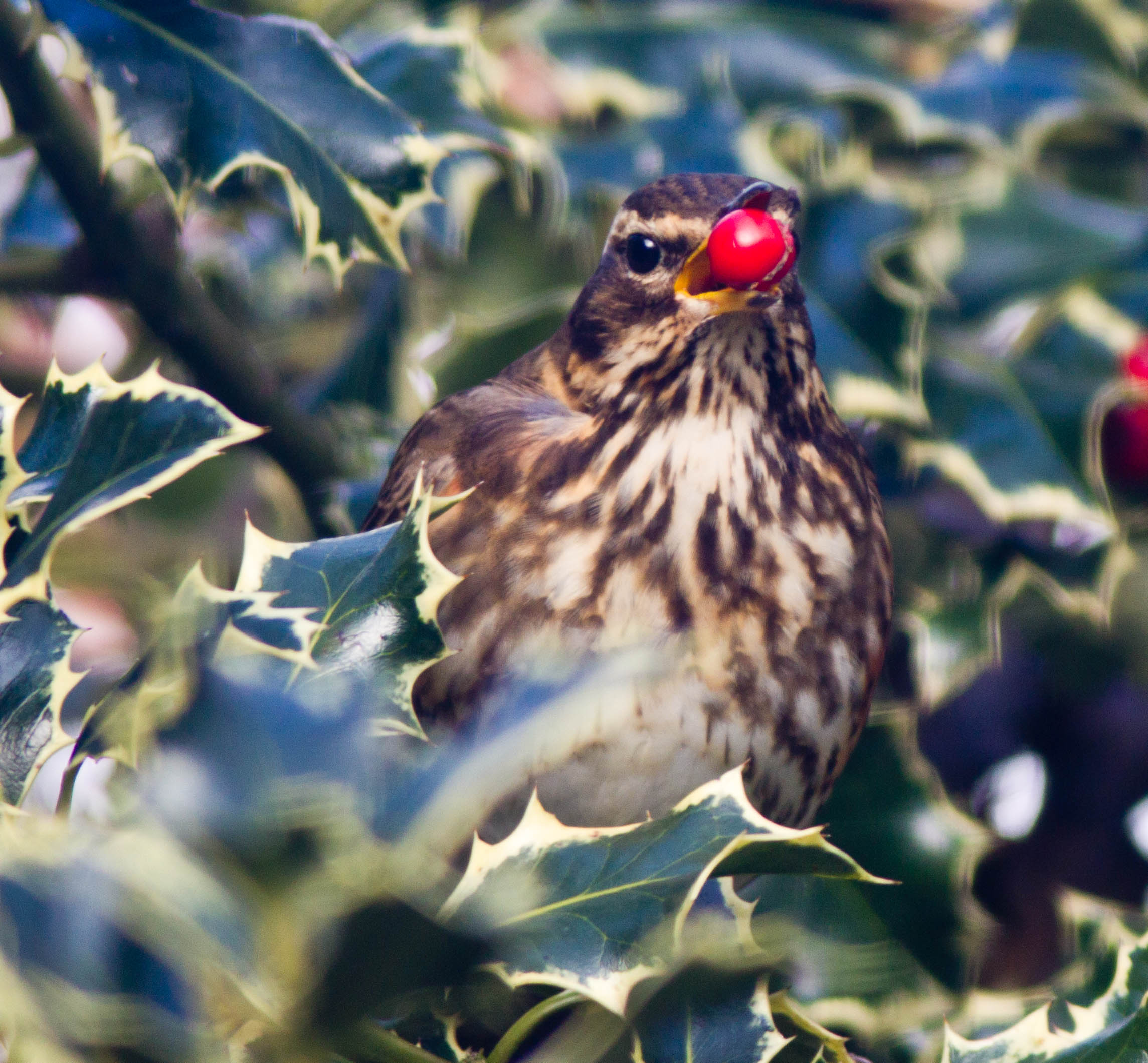
Holly berries are a good food source for thrushes and blackbirds. In cold winters they often attract redwings, Britain’s smallest thrush. Redwings (Turdus iliacus) start arriving in the UK from September with the majority reaching these shores in October and November and leaving again in March and April.
Blackbird, ready to feast
Flocks of redwings, ranging in number from 10 to 200 and often accompanying fieldfares, travel across the country looking for food, usually only visiting gardens when it is very cold. Then they fly in and consume vast quantities of berries, often taking command of a food source and denying
the local residents a chance to feast.

A casual observer can mistake redwings for thrushes, but the orange-red patch below each wing and creamy stripe above the eye distinguishes them from our native thrushes.

Redwings migrate during night hours from Iceland, Russia, the Faroes and Scandinavia.

Going . . .

. . . going . . .

 . . . gone!

There is a small resident breeding population of between 50 and 100 pairs in the Scottish highlands. 


Ichneumon wasp

Hiding in ivy

One sunny October day we noticed an insect we’d never seen before, so we photographed it and proceeded to try and identify it. It was about 1” (2.5 cms) long and we discovered that it was an Ichneumon wasp.

It may look a fearsome beast and you could be forgiven for thinking that it had a mighty sting, but, in fact, the Ichneumon wasp does not present any threat to humans.

It is widespread in the UK and is seen from April to November in a variety of habitats from hedges and woods to parks and gardens. The female uses her long ovipositor, which looks just like a stinger, to lay eggs in other insects and spiders. When the eggs hatch, the larvae feed on the host, eventually killing it.

This little wasp seeks shelter in hollow trees or under rocks, or anywhere that gives protection from threats and also allows them easy access to food. The one we saw was making use of brickwork near our front door.

It is a parasitic wasp and more than 20,000 species have been identified worldwide, mostly in temperate climates. It is closely related to bees and ants but, unlike them, lives a solitary life of about ten months.

As a parasitic predator it feeds on other insects and their larvae. It uses its long proboscis to reach the internal organs of organisms. It also has strong mandibles, which it uses to pierce the outer carapaces of its victims. It may also feed on pollen, nectar and aphid secretions.

After mating, the male dies and the female spends several weeks laying hundreds of eggs. Thereafter, she also dies.

It sounds exhausting! 

Sunday, 11 December 2022

Reflections on Christmases past


The holly . . . but no ivy
In the post-war years of the mid to late forties, and even into the fifties, the UK was struggling to recover from years of devastation and hardship. Food was still rationed and people thought carefully about how they used their allowances. Christmas was a time to enjoy something a little different, a treat.

'Rationing remained in effect until the early 1950s. Meat was the last item to be derationed and rationing ended completely in 1954, nine years after the war ended. The UK was the last country involved in the war to stop rationing food.'

In our house we children would wake to the exciting heaviness of a Christmas stocking at our feet. Although we would try to stay awake on Christmas Eve, we never saw the person who delivered the stockings and so could be deceived into half-believing that Father Christmas really existed. Packed inside would be all manner of small inexpensive gifts and in the toe of the stocking we would find a tangerine and a handful of nuts.

I recall my mother drawing and plucking a chicken for our Christmas dinner. I wonder how many ordinary people would do that now? Certainly, I have never done it. I wonder, too, how many children, today, accustomed to seeing 'oven-ready chickens' never make the connection to the feathered, living birds they might see on a school trip to a farm. Having said that, my soon-to-be son-in-law's nine-year-old son recently presented us with a pheasant he had drawn and plucked himself. I was very impressed!

Chicken was a rare luxury and we had one at Christmas and perhaps another at Easter. Dinner was roast chicken 'with all the trimmings' which allowed the meat to go a little further. My mother cooked roast potatoes, parsnips, Brussels sprouts, carrots, giblet gravy and bread sauce. To follow there were mince pies and Christmas pudding with brandy butter with the hopeful anticipation of finding a silver sixpence in your helping. Christmas crackers were fun and we liked the silly hats and trinkets inside and the groaning jokes.

In the afternoon we would unwrap presents. Each child would take it in turn to pick a parcel from beneath the tree and give it to the named recipient. The (real) Christmas tree, delightfully pine-smelling, was decorated with glass baubles and tinsel and real candles. Lighting the tiny candles must have taken a long time and there was obviously a real fire risk, but I don't recall any disasters. Cutting one's hand on a broken glass bauble was a more likely event.

We would all enjoy the pleasure of the unwrapping and the final display of the gift. Often it would be an item of clothing which would have to be tried on and modelled for our delight. When that present had been thoroughly appreciated by everyone the next parcel would be picked. So an enjoyable afternoon would be spent giving, receiving and thanking.

Christmas robin

I remember how shocked I was to discover that the 7 and 8 year-olds I worked with in the seventies and eighties, knew in advance what they were getting for Christmas. Not only that, they knew exactly how much it would cost. Where was the fun in that?

Tea followed – Christmas cake with silver ball decorations and a Father Christmas standing on the white icing 'snow'. After that, before bed-time, we would play board games or cards or read. It was a warm, relaxed time in front of a crackling fire. Thinking back now I wonder just how relaxed my mother felt by the end of the day!

On Boxing Day we would have soup, cold meat and bubble and squeak. My parents tried to make the special feeling of Christmas last a while longer by holding back a few little gifts which were always said to be 'from the tree.' Around the room were small boxes of chocolates, dates, nuts, figs and bowls of fresh fruit. We enjoyed them for their rarity and because it would be another year before such a feast was spread again.

Shopping for food in the late forties and fifties entailed visiting many specialist shops – bread from the baker, dry goods like tea, flour and sugar from the grocer, meat from the butcher, fruit and vegetables from the greengrocer, fish from the fishmonger, confectionery from the sweet shop.

The shopping list would follow the route to be taken, starting with the greengrocer at the far end of town. Shops were open for a matter of hours, from 8:00 or 9:00 a.m. until 5:30 or 6:00 p.m. for five or five and a half days. They shut at close of business on Christmas Eve and opened again on the first working day after Boxing Day. If someone had forgotten to buy something they needed they would have to go without it until the shops re-opened. Provided all the necessities were in the larder, there was a tremendous feeling of relief once there was no possibility of shopping again until after the holiday.

Now everything is available throughout the year. The seasonal foods no longer hold sway since whatever is desired may be purchased at any time, fresh, frozen, dried, produced locally or thousands of miles away. In the western world we live in a bubble of self-indulgence, able to satisfy our every whim and fancy at any time of day or night. If the local shop is closed there's always an all-night garage or a twenty-four-hour store if we really cannot wait.  Nonetheless, a siege mentality persists and supermarket aisles are thronged with stressed shoppers pushing laden trollies of goods to see them through the 24 hours or so that the shops will be shut.

During the last thirty years or so Christmas increasingly has developed into a festival of greed and commercialism. From August the Christmas catalogues start arriving, each charity begging expenditure on often tawdry items. Later 'Good causes' encourage us to support them and in December, Salvation Army and silver bands pluck at our heart and purse strings with their brassy renditions of carols, many of which will be unfamiliar to young school-children. The carols most young children sing at school will be unfamiliar to all apart from their teachers and parents.

The supermarkets blare out endless repetitions of ghastly versions of seasonal songs old and new and worse still, shoppers find themselves singing along. Television and radio do their best to plug any gaps, so that it is nigh impossible to pass a day without an assault on the eardrums, unless those devices are out of service.

Houses sprout unlikely decorations – blinking, twinkling, nerve-rending flashing lights in all colours, while jolly Santas stride across roof-tops, and inflatable reindeer prance behind them. Is it because our winters are so drear that we embrace these gaudy decorations? Sunlight may be scarce but we can make our own brightness – and it all looks so sad when Christmas is over. There's a brief renewal in the lead-up to New Year's Eve, a final flash of brightness of fireworks as the Old Year dies and finally we face cold, dull January and wonder if there will ever be dazzling days again.

Where is the true meaning of Christmas now? Is our anticipation always to be disappointed because we have so much all the time, and salve our consciences for those who have nothing by dropping coins in a collection tin? Where is the joy? 

For me it is in the faces of my family in the moments when they are laughing or day-dreaming or simply enjoying each other's company, in the wonderment of small children as they see something they have never seen before, in the quiet moments when walking alone or waking in the night when everyone else sleeps. These times are present throughout the year but take on special significance at Christmas. 

There is a tingle of magic about Christmas, a vision beyond the everyday, a hope of better things to come.

Redwing enjoying a meal of holly berries

Whatever your beliefs or lack of them, this annual holiday affords a time for reflection. Take a moment from the rushing crowds or the press of visitors and look up, maybe (probably!) through the rain at the vastness of the sky and consider your place in the universe. We are insignificant organisms struggling towards the light. We came from stardust and to stardust we will return.

'For dust thou art, and unto dust shalt thou return' Genesis 3:19

Saturday, 11 May 2013

Of Cats and Butterflies and Trees


Of Cats and Butterflies and Trees

Our kittens are growing fast. Still lanky of leg and long of body they are extremely lively and very vocal. Each kitten has adopted a different member of the family though they are all very affectionate and demand a lot of attention from whoever happens to be available for a good purring. Isambard’s favourite person is Barry and Jellicoe favours me. Herschel’s chosen companion is Bertie. Actually, they all like Bertie.

The morning ritual involves the kittens calling as soon as they hear our voices. They do not, as yet, sleep in our bedroom – the dogs deserve a place of sanctuary!

Barry emerges to ecstatic miaous and purrs and then he calls Bertie out. Immediately the kittens flock to our golden boy and rub all round him, curling their tails about his body and pushing their faces against his and Bertie loves it.

Recently we have had weather warm enough to encourage us to open the patio door. Across it there is a mesh screen to allow fresh air in and prevent kittens going out. Soon we shall erect a fence within the garden to enable the little boys access to the Great Outdoors. 

The Purr…fect Cat Fence has been delivered from the States and awaits our endeavours to assemble it. First, though, shrubs and trees in the garden have had to be lopped and trimmed so that adventurous felines do not find a way to escape into the even Greater Outdoors. 
The most drastic operation has involved the slaughter pruning of our holly tree. 
No longer can the starlings and blue tits, blackbirds and thrushes rely on its prickly cover to protect them from the attentions of the sparrowhawk.

In the course of all this woodwork gardening Barry discovered that our garden shredder was not up to the job of reducing the extraneous limbs and branches to mulch and spent several happy hours researching the best machine for the job.  We were surprised when it was delivered to see how big – and heavy – it was. ‘It’s a big bugger, innit?’ we said to each other in our best Mummerset accents. 

Naturally the box it came in had to be explored . . . 

 . . . as did the shredder basket.

It is very efficient and reasonably quiet. We haven’t quite got to the stage of looking for things to cut down so that we can use it but that time is not far off, I suspect.
We shan't see any of these this year! 
I noticed a solitary holly blue butterfly disconsolately circling the remains of the tree, wondering where she was now going to lay her eggs. I hope I’m sure the tree will recover and send forth new green shoots. 

However, visiting redwings will be sorely disappointed when they fly in to feast on holly berries in the winter – there will be none this year.

We are wondering how many times the brothers will fall in the pond. My guess is probably only once, unless they decide they like swimming. The bird feeders will have to be moved to a spot beyond the fence. It means we shall not be able to observe them at quite such close quarters but at least we will remain innocent of putting them on the menu for the boys!

The sun has disappeared again so the fence will remain in its component parts in the garage and the cats will have to remain content with gazing at the garden from the safety of indoors.

I hope the Saga of the Cat Fence will be a short one – I have my doubts, though;-) 

I am linking this post to 'Camera Critters'. Thank you, Misty, for hosting this meme.


Wednesday, 1 February 2012

Redwings


Yesterday I was pleased to see a Redwing (Turdus iliacus) eating berries in the holly tree. We didn’t see any Redwings last winter and I had been wondering if we would see any this year. Soon I realised there were two birds in the tree and many photos were taken. 
Today there have been regular excursions to the tree by several Redwings – I counted seven in and on it at one time and there may well have been more. Sometimes this small flock perches in the tree gorging berries. 
Occasionally they fly off carrying berries in their beaks as well as in their crops.
The Blackbirds and Wood pigeons have steered clear of the holly during the last couple of days giving the Redwings free range.

The Redwing is a widespread winter migrant in Britain and Ireland. The greatest concentrations are seen in central and southern England and southern Ireland. Redwings arrive in September, leaving again in March or April. Those in Scotland have probably flown from Iceland while those from Scandinavia winter in the south of England and as far south as North Africa and the Mediterranean. Fewer than fifty pairs breed in UK – some sources say fewer than twenty - and there is concern about the decline in numbers.
The Redwing is the smallest of the thrushes, just 21 cm (8½”) long. I couldn’t identify males, females, juveniles – they all looked much the same to me. What I found really fascinating were the sequences that Barry shot of them eating, well, swallowing anyway.  I shot some too, but his are much better.
This looks juicy
 Carefully does it - don't drop it
 
 I can do it - I know I can
Swallow
Gulp! 
. . . and again from the front . . .
 It looks a bit more of a beakful from this angle
 Open wide!
Down the hatch
Much of today has been spent reporting – ‘they’re back’, ‘they’ve gone’, ‘there are four, no, five, six, no, seven’ (voice rising to an excited shriek at seven) We may not see them again but that’s part of the entertainment of amateur bird-watching. I was expecting to see a Sparrowhawk dive into the tree but that didn’t happen. I was glad about that though of course poor Sparrowhawk has to eat too.