Showing posts with label robin. Show all posts

Thursday, 20 November 2025

The North Wind


The North Wind


The North Wind doth blow
And we shall have snow,
And what will poor robin do then, poor thing?
He’ll sit in the barn
To keep himself warm
And hide his head under his wing, poor thing!

This little rhyme originated in 16th century Britain and was first published two centuries later in collections of nursery rhymes. It has three additional verses, not regularly taught, which build on feelings of sympathy and compassion for those less fortunate.

The second verse is about the swallow.

The North Wind doth blow
And we shall have snow,
And what will the swallow do then, poor thing?
Oh, do you not know
That he’s off long ago
To a country where he will find spring, poor thing?

Swallows migrate to warmer countries for the winter. Any that attempt to remain usually do not survive. This is made clear in Oscar Wilde’s heartbreaking tale of the Happy Prince, a story I can never read aloud to children.

In the third verse, the children learn about the tiny dormouse.

The North Wind doth blow
And we shall have snow,
And what will the dormouse to then, poor thing?
Rolled up like a ball
In his nest snug and small,
He'll sleep till warm weather comes in, poor thing!

Verse four tells of the honey bee.

The North Wind doth blow
And we shall have snow,
And what will the honey bee do then, poor thing?
In his hive he will stay
Till the cold is away
And then he’ll come out in the spring, poor thing!

Referred to as ‘he’ in the rhyme, it is only the females, who are the Queen and the worker bees, who survive the winter. The workers cluster round the Queen to keep her warm and alive. The drones are only of use for mating and as there is no mating in the cold months they are pushed out of the hive and either starve or freeze to death.

A fifth verse was added later.

The North Wind doth blow
And we shall have snow,
And what will the children do then, poor things?
When lessons are done
They’ll jump, skip, and run,
And that’s how they’ll keep themselves warm, poor things.

We woke up to snow this morning, which settled briefly on the roofs and trees. At present, we have a north wind blowing. The forecast tonight is -3˚Celsius (26.6˚ Fahrenheit)


Tuesday, 25 June 2024

All creatures . . .


All creatures (great and) small


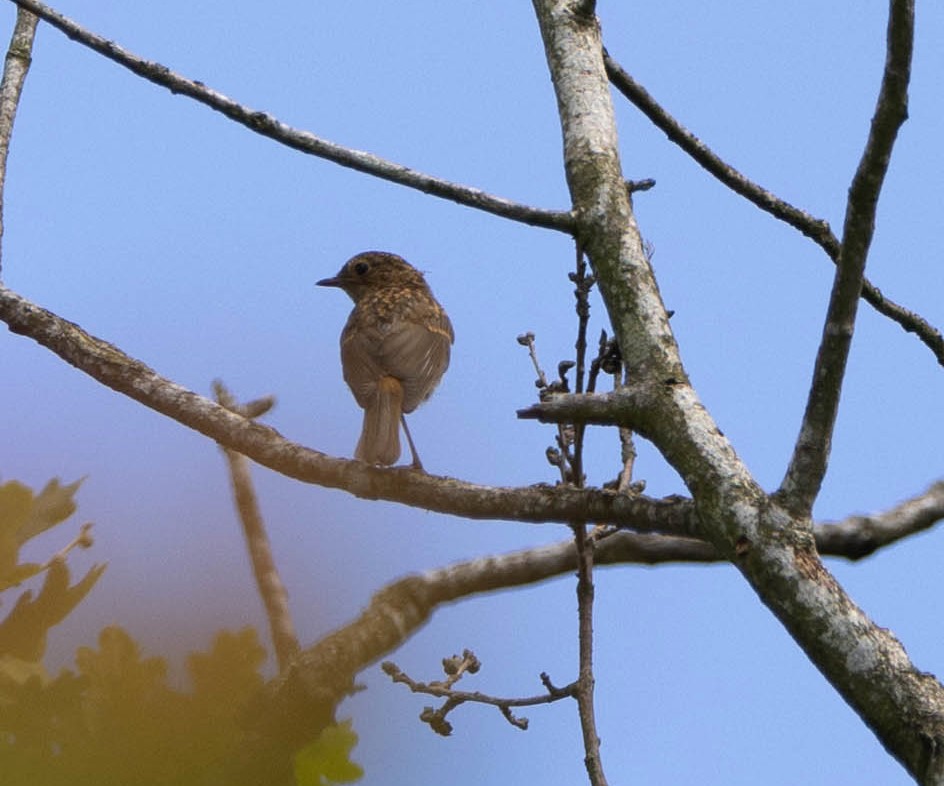
Mr and Mrs Robin have young to feed.


High up in the trees the youngsters wait.

Goldfinches share the trees with them.

Camera-shy goldfinch.

Meanwhile, a very small crab spider on the mallow played hide and seek with Barry’s camera.

Can you see it?

Here's a close-up


Peep-oh!


It wasn't playing - it was hunting!


It managed to trap a tasty meal.

Wednesday, 10 January 2024

The North wind doth blow . . .


The North wind doth blow . . .

 . . . except that it dothn’t. True, the wind was ‘from the North’ at one mile per hour or something ridiculous. That was fine by me. It was quite cold enough without it being shunted along at speed, and I was indoors, for goodness’ sake. The house isn’t hermetically sealed but most of the draughts have been denied access.

. . . and we shall have snow

Well, yes, we have had snow, not enough to write home about, but snow nonetheless. It came down in big, soft flakes, quite impressively, for a while. I noticed from my Reolink camera that it was settling abjectly and rather sulkily on the cars on the drive, as though it would rather be somewhere else.

 . . . and what will the robin do then, poor thing?

He’ll sit in a barn

To keep himself warm . . .


. . . well, he would, if he could find one that hasn’t been snapped up and converted at vast expense to make a desirable property for a human, but if he manages to find a vacant barn being used for its original purpose . . .

He’ll sit in a barn

To keep himself warm

 And hide his head under his wing, poor thing.


There are four more verses to this rhyme. The second one asks,

And what will the swallow do then, poor thing?

Oh, do you not know

That he’s off long ago,

To a country where he will find spring, poor thing.

The third and fourth verses speak of the dormouse and honey bee, both of which hibernate until the spring, and the final verse refers to children.

When lessons are done

They will skip, jump and run,

Until they have made themselves warm, poor things.

Much is made of the joy to be had in the snow – tobogganing, building snowmen, snowball fights, making snow angels. All such pursuits are great fun, but the cold! Who can forget the frozen fingers and the agony of warmth returning to icy hands and feet, the face flayed by bitter wind, nose pinched and cold, drawing arctic breath into aching lungs?

Snow is lovely, in small amounts, for a short while, for those who do not have to travel.

Today the wind is from the East-North-East at 4 miles per hour. The sun is shining fitfully and blue tits are busy in the garden.

Is there a poem that starts, ‘The East-North-East wind doth blow’?


Thursday, 31 August 2023

The Gardener’s Friend


The Gardener’s Friend

When working in the garden, one may have the sensation of being observed. A rustling in the leaves and a glimpse of bright red indicates that the watcher is the friendly robin. He will hop and fly after the gardener, perching on nearby branches, closely watching for tasty morsels.

Robin Redbreast (Erithacus rubecula, European robin) may be a friend to the gardener but he is extremely territorial and very aggressive to other birds. Males and females, alike in appearance, defend their territories rigorously, singing loudly from perches. Although they look indistinguishable, each robin’s red breast pattern is unique.

In the breeding season, which starts around March, male and female work as a pair to hold their ground and are among the first birds to sing in the dawn chorus and the last to finish singing at night. Some sing all night and are often mistaken for nightingales. This used to be attributed to street lighting but is now thought to be because their song is more easily heard in the still of night. Apart from when they’re moulting in mid-summer, robins sing all year round, unlike most other birds in UK, which sing only during the breeding season.

These little birds, with their bright black eyes and red breasts, are always a welcome sight in the garden and can become very trusting of people, even feeding from their hands. They have learnt to associate gardeners with an easy source of food, following them as the ground is turned over to reveal wriggling invertebrates. Young robins don’t develop a red breast until after their first moult, but can be recognised by their spindly legs and speckled brown feathers.

There are several legends concerning how the robin acquired its red breast. One says that a small brown bird was present when the fire keeping the baby Jesus warm died down. The bird flapped its wings to fan the flames and a burst of flame scorched its breast. Another story claims that the bird drew a thorn from Christ’s crown of thorns and was splashed with blood. A third folk tale says that the little bird took water to the tormented souls in Purgatory and was singed by the flames.

Until 1861, during the reign of Queen Victoria, postmen wore red waistcoats as part of their uniform. They were nicknamed ‘robins’. As they delivered Christmas cards and letters the association with the birds became stronger and they started being pictured on Christmas cards, perhaps representing the postmen. Thus, the centuries old belief that robins were harbingers of good luck and happiness and messengers of joy and peace was reinforced.

There is an old belief that robins bring messages or even visits from departed loved ones – ‘When robins appear, loved ones are near.’ Such beliefs bring comfort and peace. As robins are widespread across the British Isles, the chances of seeing one are very good.


Sunday, 11 December 2022

Reflections on Christmases past


The holly . . . but no ivy
In the post-war years of the mid to late forties, and even into the fifties, the UK was struggling to recover from years of devastation and hardship. Food was still rationed and people thought carefully about how they used their allowances. Christmas was a time to enjoy something a little different, a treat.

'Rationing remained in effect until the early 1950s. Meat was the last item to be derationed and rationing ended completely in 1954, nine years after the war ended. The UK was the last country involved in the war to stop rationing food.'

In our house we children would wake to the exciting heaviness of a Christmas stocking at our feet. Although we would try to stay awake on Christmas Eve, we never saw the person who delivered the stockings and so could be deceived into half-believing that Father Christmas really existed. Packed inside would be all manner of small inexpensive gifts and in the toe of the stocking we would find a tangerine and a handful of nuts.

I recall my mother drawing and plucking a chicken for our Christmas dinner. I wonder how many ordinary people would do that now? Certainly, I have never done it. I wonder, too, how many children, today, accustomed to seeing 'oven-ready chickens' never make the connection to the feathered, living birds they might see on a school trip to a farm. Having said that, my soon-to-be son-in-law's nine-year-old son recently presented us with a pheasant he had drawn and plucked himself. I was very impressed!

Chicken was a rare luxury and we had one at Christmas and perhaps another at Easter. Dinner was roast chicken 'with all the trimmings' which allowed the meat to go a little further. My mother cooked roast potatoes, parsnips, Brussels sprouts, carrots, giblet gravy and bread sauce. To follow there were mince pies and Christmas pudding with brandy butter with the hopeful anticipation of finding a silver sixpence in your helping. Christmas crackers were fun and we liked the silly hats and trinkets inside and the groaning jokes.

In the afternoon we would unwrap presents. Each child would take it in turn to pick a parcel from beneath the tree and give it to the named recipient. The (real) Christmas tree, delightfully pine-smelling, was decorated with glass baubles and tinsel and real candles. Lighting the tiny candles must have taken a long time and there was obviously a real fire risk, but I don't recall any disasters. Cutting one's hand on a broken glass bauble was a more likely event.

We would all enjoy the pleasure of the unwrapping and the final display of the gift. Often it would be an item of clothing which would have to be tried on and modelled for our delight. When that present had been thoroughly appreciated by everyone the next parcel would be picked. So an enjoyable afternoon would be spent giving, receiving and thanking.

Christmas robin

I remember how shocked I was to discover that the 7 and 8 year-olds I worked with in the seventies and eighties, knew in advance what they were getting for Christmas. Not only that, they knew exactly how much it would cost. Where was the fun in that?

Tea followed – Christmas cake with silver ball decorations and a Father Christmas standing on the white icing 'snow'. After that, before bed-time, we would play board games or cards or read. It was a warm, relaxed time in front of a crackling fire. Thinking back now I wonder just how relaxed my mother felt by the end of the day!

On Boxing Day we would have soup, cold meat and bubble and squeak. My parents tried to make the special feeling of Christmas last a while longer by holding back a few little gifts which were always said to be 'from the tree.' Around the room were small boxes of chocolates, dates, nuts, figs and bowls of fresh fruit. We enjoyed them for their rarity and because it would be another year before such a feast was spread again.

Shopping for food in the late forties and fifties entailed visiting many specialist shops – bread from the baker, dry goods like tea, flour and sugar from the grocer, meat from the butcher, fruit and vegetables from the greengrocer, fish from the fishmonger, confectionery from the sweet shop.

The shopping list would follow the route to be taken, starting with the greengrocer at the far end of town. Shops were open for a matter of hours, from 8:00 or 9:00 a.m. until 5:30 or 6:00 p.m. for five or five and a half days. They shut at close of business on Christmas Eve and opened again on the first working day after Boxing Day. If someone had forgotten to buy something they needed they would have to go without it until the shops re-opened. Provided all the necessities were in the larder, there was a tremendous feeling of relief once there was no possibility of shopping again until after the holiday.

Now everything is available throughout the year. The seasonal foods no longer hold sway since whatever is desired may be purchased at any time, fresh, frozen, dried, produced locally or thousands of miles away. In the western world we live in a bubble of self-indulgence, able to satisfy our every whim and fancy at any time of day or night. If the local shop is closed there's always an all-night garage or a twenty-four-hour store if we really cannot wait.  Nonetheless, a siege mentality persists and supermarket aisles are thronged with stressed shoppers pushing laden trollies of goods to see them through the 24 hours or so that the shops will be shut.

During the last thirty years or so Christmas increasingly has developed into a festival of greed and commercialism. From August the Christmas catalogues start arriving, each charity begging expenditure on often tawdry items. Later 'Good causes' encourage us to support them and in December, Salvation Army and silver bands pluck at our heart and purse strings with their brassy renditions of carols, many of which will be unfamiliar to young school-children. The carols most young children sing at school will be unfamiliar to all apart from their teachers and parents.

The supermarkets blare out endless repetitions of ghastly versions of seasonal songs old and new and worse still, shoppers find themselves singing along. Television and radio do their best to plug any gaps, so that it is nigh impossible to pass a day without an assault on the eardrums, unless those devices are out of service.

Houses sprout unlikely decorations – blinking, twinkling, nerve-rending flashing lights in all colours, while jolly Santas stride across roof-tops, and inflatable reindeer prance behind them. Is it because our winters are so drear that we embrace these gaudy decorations? Sunlight may be scarce but we can make our own brightness – and it all looks so sad when Christmas is over. There's a brief renewal in the lead-up to New Year's Eve, a final flash of brightness of fireworks as the Old Year dies and finally we face cold, dull January and wonder if there will ever be dazzling days again.

Where is the true meaning of Christmas now? Is our anticipation always to be disappointed because we have so much all the time, and salve our consciences for those who have nothing by dropping coins in a collection tin? Where is the joy? 

For me it is in the faces of my family in the moments when they are laughing or day-dreaming or simply enjoying each other's company, in the wonderment of small children as they see something they have never seen before, in the quiet moments when walking alone or waking in the night when everyone else sleeps. These times are present throughout the year but take on special significance at Christmas. 

There is a tingle of magic about Christmas, a vision beyond the everyday, a hope of better things to come.

Redwing enjoying a meal of holly berries

Whatever your beliefs or lack of them, this annual holiday affords a time for reflection. Take a moment from the rushing crowds or the press of visitors and look up, maybe (probably!) through the rain at the vastness of the sky and consider your place in the universe. We are insignificant organisms struggling towards the light. We came from stardust and to stardust we will return.

'For dust thou art, and unto dust shalt thou return' Genesis 3:19

Monday, 21 May 2012

Feed me!


Feed me!

May brings an explosion in the garden. Everything burgeons and each day offers fresh delights. The month becomes increasingly noisy as young birds demand that their parents feed them. The parents are on the go from just before break of day until the last vestiges of light have left the sky - they are being worn ragged by their demanding offspring. Feeding several bottomless pits is exhausting and some of the adults are beginning to look rather unkempt, their usually pin neat plumage dishevelled. There is little time to preen when there are so many mouths to feed.
It was flirting my tail like this that got me into trouble in the first place.
Me too!
I'm exhausted - no time some days even to  run a comb through my feathers . . .

. . . but at least my babies say 'Please' and 'Thank you', unlike those rude starling youngsters.
Feed me!
FEED me!!
FEED ME!!!
Say Please . . .
Feed me PLEASE - I'm starving. I'm a starving starling . . .
That's better, dear - now don't gobble.

We have seen blackbirds, goldfinches, nuthatches, coal tits, magpies, blue tits, great tits, greater spotted woodpeckers, wood pigeons, robins and a chaffinch at the feeders.  It’s very unusual to see a chaffinch – they prefer to feed on the ground. The long-tailed tits are noticeable by their absence – no doubt they’ll be along later for they must have young too. The jackdaws have been back to take food from the bird table and the local crows are vigilant and noisy when a red kite soars above their nests, looking for an easy meal.
My youngsters are hungry, too . . .
 . . . and mine  . . .
. . . mine, too . . .
Look right.
Look left.
All clear? Tuck in.
I wait till it's quiet.
Our most conspicuous visitors are the starlings. A few days ago we saw only three or four young birds but in the last couple of days the numbers have proliferated. Yesterday Barry counted forty starlings perched on the arches. They chatter and shriek from early morning until dusk. They enjoy communal feeding on the pergolas and communal bathing in the pond. Watching the harassed adults it’s difficult to ascertain whether the parents feeds their own young or whether they respond to all gaping beaks – I suspect the latter. 
Wood pigeons need food, too. Some chance with all those starlings.
I watched the plump, cheeky starling babies as they alternately preened vigorously and called vociferously. One of them was paying more attention to his plumage than his safety. Good grooming is essential for a bird but he wasn’t looking about as frequently as he should, as, indeed, the adults do. I feared for his welfare. I knew a sparrowhawk would appear on the scene sooner or later and today was the day. He swooped down from the roof and carried off a screaming youngster. Barry was startled when he walked along the garden path a few minutes later to see the sparrowhawk on the ground preparing his feast. We may deplore the depredations of the sparrowhawks but they have young to feed, too.
                         A few soft feathers are all that's left to commemorate a brief existence.