A to Z challenge 2023 – B is for . . .
My
theme for this challenge is Nature in all much of her wonderful
diversity. My posts will reflect the fact that I am resident in the south of
England.
All
photographs in this post are the property of the writer.
I grow
herbs for culinary purposes, but my main purpose is to allow them to flower.
The masses of tiny flowers attract bees and other pollinators.
Spearmint (Mentha spicata) in flower

Rosemary (Salvia rosmarinus)
Rosemary (Salvia rosmarinus) in flowerChives with visiting honey bee
Basil (Ocimum)
A pot of
Basil (Ocimum) in the house scents
the air and lifts the spirits, though it was a spirit of a different kind that
inspired John Keats’ 1818 poem, ‘Isabella, or the Pot of Basil’. It would have to have been a very strongly
aromatic variety of basil to overcome the stench of a decomposing head.
Basil is
not a hardy plant, but will grow outdoors in what passes for summer in England.
It requires sun, shelter and water. It can also be grown indoors on a sunny
windowsill.
It is reputed to be an excellent companion
plant for tomatoes because its strong smell repels pests like aphids and spider
mites and also deters caterpillars. Slugs and snails are attracted to the soft
leaves, so growing it in a container rather than in the soil can reduce the
risk of it being destroyed. If it is grown in a planter, it will need
regular watering, but doesn’t like to sit in water as the roots might rot.
Flowering
reduces the quality of the leaves but provides pretty white or purple flowers,
beloved of bees and other nectar-gathering insects.
My second B is for Blueberry (Vaccinium sect. Cyanococcus)

We have a
productive blueberry bush in our garden.
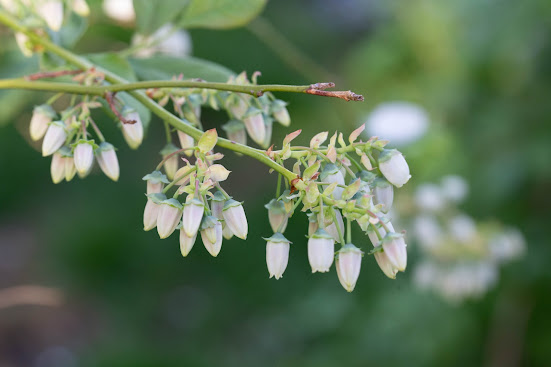
Its tubular flowers attract bees . . . 
. . . and
many birds (and squirrels, mice and rats)
enjoy the fruit that follows. The autumn foliage is bright and colourful,
particularly on a drizzly, dank day.

Ready to be picked
Sweet, juicy berries to be enjoyed on their own, or with yoghourt, or with porridge
Blueberries
are rich in vitamin C, low in sugar and are a good source of fibre. Alongside
several ‘may’ statements (may help
prevent heart disease, may help maintain eye health, may alleviate UTIs, et
cetera) there is a rider. Blueberries, like some other fruits, such as
apples, peaches and raspberries, contain chemicals called salicylates, to which
some people are sensitive and which may cause (there’s that ‘may’ again) allergic reactions, including skin rash
or swelling.
As ever, common sense is the great protector – if in doubt, don’t!
Salicylates
are natural chemicals produced by plants to protect themselves against disease
and insects. Extracts from salicylates have been used for thousands of years in
medicine. The most common is salicylic acid, known to most of us as aspirin.
My final B is for Bunny mouth (Antirrhinum majus)
A flower that
reminds me of childhood is the bunny mouth. I never tired of squeezing the
sides of the flower to make the little mouth open. Some people know these
flowers as snapdragons or dragon flowers but their 'official' name is Antirrhinum
majus. They have also been called lion’s-mouth, bonny rabbits, calf-snout,
toad’s mouth, bulldogs and lions’-snap.
They are
native to rocky areas of the Mediterranean, the United States and North Africa.
Thomas Jefferson (1743 – 1826) first
noticed snapdragons at his home in Shadwell in 1767 and subsequently grew the
seeds and recorded their growth.
Primarily
grown for cutting, edible oils have been extracted from the seeds and used like
butter in Russia. The leaves and flowers are believed to possess anti-inflammatory
properties and have been used in poultices for ulcers. The flowers are edible
and make a colourful addition to salads or desserts.

In German
folklore, a bunch of antirrhinums would be hung near a baby, believing that it would
grow up unafraid of evil spirits. This reflects the belief among Romans and
Greeks that the plant would protect them from witchcraft.
For the
Victorians, a bouquet of antirrhinums was an indication of a forthcoming
proposal. To further the chances of this happening, a snapdragon hidden in the
clothing was thought to make a person fascinating and alluring. Perhaps they
were hedging their bets when, in the Language of Flowers, they decided that
snapdragons meant either deception or graciousness, a case of ‘You pays your
money and takes your choice.’


.jpeg)


.jpg)