Showing posts with label nasturtiums. Show all posts

Tuesday, 19 November 2024

November garden


November garden

 
Antirrhinum, snapdragon, bunny mouth


Nasturtiums

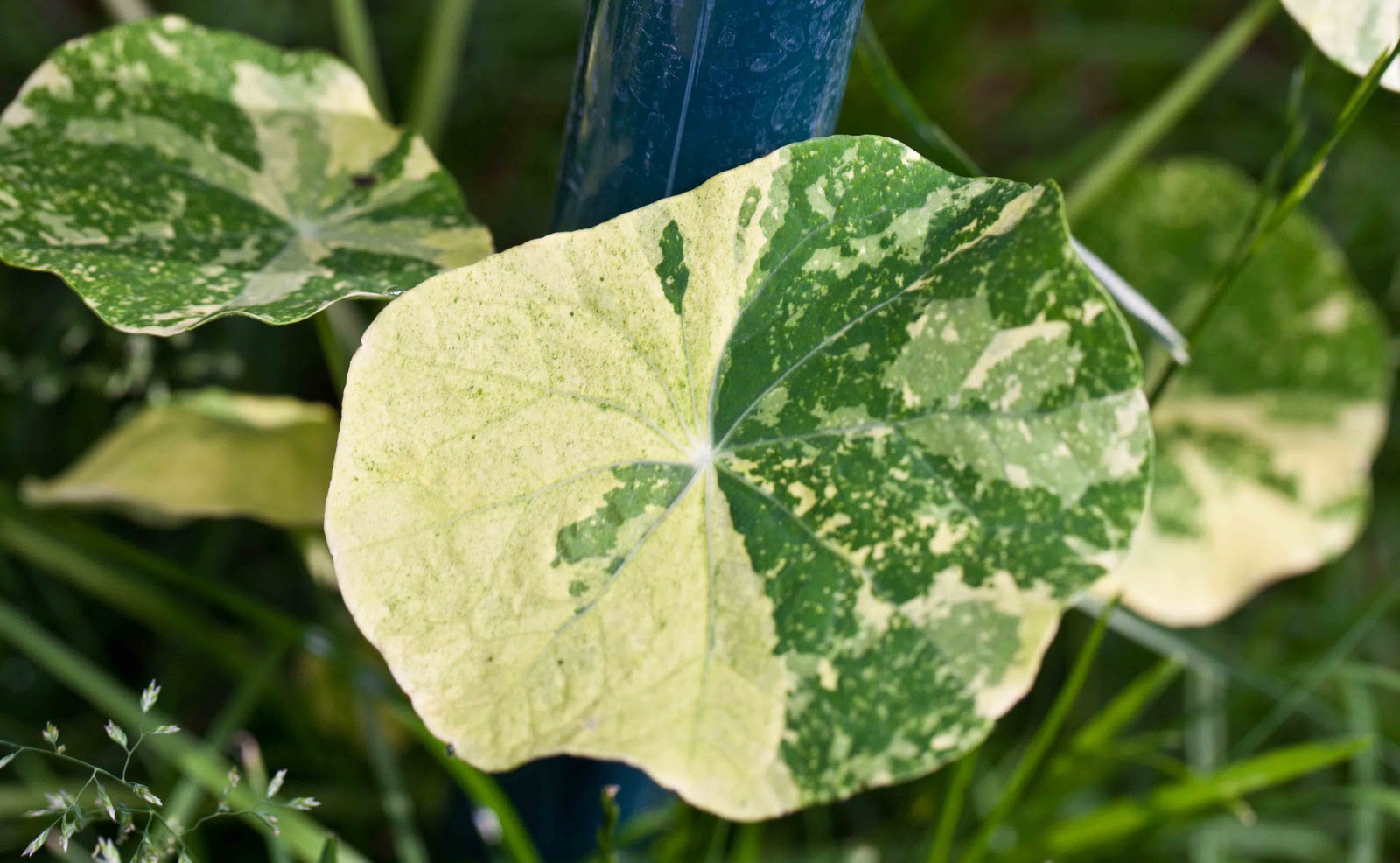
Variegated nasturtium leaves. The marbling on these leaves is beautiful.

                            Herb Robert - Geranium robertianum

I love this wildflower that grows so freely in the garden. The foliage turns red as the plant matures. The leaves and flowers are edible, fresh or dried, and can be made into a tea. It is thought to repel mosquitoes if the leaves are rubbed on the skin.


Mahonia japonica flowers from late autumn to early spring and is a valuable source of pollen for early bumblebees. It has a strong sweet scent, a delight on a still winter day.

                                Three of the stages of raspberries 

Raspberries

I ate two  raspberries from the garden on Wednesday. I don’t think the rest will ripen now.

Courgette with teaspoon for comparison of size

This is from our courgette plant. I think it will be fine, maybe stuffed.


                                             Sweet pepper


                                                    Chillies

Begonia fuchsioides indoor plant in the last days of its summer holiday. It will have to come back into the conservatory soon.

Tuesday, 18 June 2024


Pussy cat, pussy cat . . .  


where have you been are you going?

This cat came to live with us a little while ago. He just looks like a boy cat to me and I love his smiling face and pink cheeks.

He is going to live on the front door step, with a pretty plant growing in him.

I actually bought a plant – the one plant I bought at the garden centre a while ago - a bright verbena, which may have been pink or red. I cannot tell the colour now, as it seems to have died a death. I suppose it may resurrect itself but I’m not optimistic.

I’m considering what I might try in there instead. At the moment, I’m thinking of nasturtiums, but I’m not sure. I’ll keep you posted.

Pussy cat, pussy cat,

Where have you been?

I’ve been up to London

To look at the Queen.


Pussy cat, pussy cat,

What did you there?

I frightened a little mouse

Under her chair.

This traditional rhyme was first published in 1805. The queen referred to in the nursery rhyme is believed to have been Elizabeth I, who reigned from 1558 until 1603. Illustrations often depict the queen of the verse in Elizabethan costume, some 200 years after her death. Some suggest the queen might have been Caroline of Brunswick, the estranged wife of George IV, again based on the style of dress illustrated, but she was queen from 1820 until 1821. The truth is that we do not know the exact origins of the rhyme and it really doesn’t matter.          

Friday, 27 July 2012

Green Day 6

Fiona at Raindrops and Daisies hosts Green Day. Just post a photo of something green and link back to her blog. Quick and easy . . . 
I love the marbling on this nasturtium leaf. It makes a very pretty foil for the yellow and orange flowers. All parts of the nasturtium are edible - the seeds can be pickled to make Poor Man's Capers. The only trouble is that you have to get to the plant before the black fly do . . .

Tuesday, 3 January 2012

ABC Wednesday Y is for Yellow


Yellow is such a cheerful colour in the garden particularly after the often dreary winter days when daffodils bloom in Spring . . .
 . . . followed by Kerria japonica which often flowers again in summer
Yellow Archangel (Lamiastrum galeobdolon ) is a wildflower native to central and southern England and common in Europe. It is a plant of ancient woodlands and old hedgerows, its yellow flowers in May and June bringing brightness to damper, darker areas. It grows well on chalk or heavy clay but can be invasive in the garden. Young leaves and shoots and flower tips can be eaten when cooked. In herbal medicine it has been used to treat sores and ulcers and to stop bleeding. It is rich in nectar and attractive to bees.
Yellow nasturtiums and marigolds also attract bees
Yellow pansy
Yellow courgette flower followed by green or yellow courgettes
Yellow honeysuckle
Yellow roses
Yellow honey bee (Apis mellifera)
We saw very few of these in 2011. I hope there will be more in 2012.
Yellow sunflower. 
Until last summer I thought all sunflowers were yellow but there are some very pretty red ones.

Click here for more Wise Ys

Tuesday, 18 October 2011

ABC Wednesday N is for . . .

Nasturtiums (Tropaeolum majus) are still flowering vibrantly in the garden though not for much longer.  As the days grow colder and the nights colder still we shall soon have the first frosts to stop these pretty annuals in their tracks. They have clambered and scrambled and climbed through other plants and opened their colourful blooms to the insect population for several months. Often the undersides of their leaves are populated with aphids which means that the rest of the garden may escape infestation.
Nasturtiums’ needs are minimal – earth and water and sun. If they are looked after too well they will produce huge leaves and fewer flowers. As well as looking cheerful and brightening the sometimes dull, damp days of a British summer, all parts of this member of the cabbage family (Brassicaceae) are edible. 

I have only ever used them in salads and pickled the seeds as Poor Man’s Capers but there are some interesting recipes here. The following video clip is interesting, too.

The leaves are as pretty as the flowers and may be plain or variegated.
Nemesia is a fragrant, pretty flower that is usually treated as an annual though sometimes ours have survived for two or three years. They rapidly fill a tub or trough with masses of flowers, the perfume wafting on warm summer air to delight someone walking in the garden or standing at an open door or window. They bloom from June to October.
Nepeta cataria, often called catmint or catnip, is a rather straggly plant with furry leaves and spikes of white and blue-purple flowers. It attracts bees and butterflies as well as cats. Winston, however, is unimpressed by it, whether growing or dried!

Catmint can be used as a herbal medicine to relieve colic in children, as an antipyretic in cough mixtures and to treat haemorrhoids. It is believed to deter rats – it should be tied in bunches and hung in places where they are not wanted. As rats are generally not welcome anywhere I wonder if there is enough catmint in the world to carry out this job!
Preying on sticklebacks!
There are common or smooth newts (Lissotriton vulgaris) in our pond. 

We rarely see them but occasionally have watched them stalking small sticklebacks. I have written about them here.
The annual Nigella damascena, often called love-in-a-mist, has been grown since Elizabethan times and is an old cottage garden favourite. It is a member of the buttercup family (Ranunculaceae) The flowers are attractive at all stages. The spherical buds open to delicate flowers commonly in a range of blues, though they may also be white or pink.

After flowering the balloon-like seed heads can be used in dried flower arrangements. Left in situ they will eventually disperse their seeds thus ensuring a pretty show the following year. The ‘mist’ of the common name is created by the delicate greenery surrounding each flower – from a distance the flowers appear to be surrounded by a green haze. 

Some gardeners call this flower ‘Devil-in-the-bush’ – and maybe it is a nuisance if it grows where it’s not been invited. Not for me, though – anything that succeeds in growing in our garden is welcome – well, nearly anything.
Night-scented stock (Matthiola longipetala) has not grown well in our garden. I have just discovered that it prefers a light soil and ours is heavy with some clay. It’s a shame because it has a lovely scent, particularly noticeable in the evening.
Nuthatches (Sitta europaea) can often be seen walking headfirst down tree trunks. They look rather like small woodpeckers and are welcome visitors to our garden feeders. They eat a varied diet of insects, seeds and nuts and may live for eleven years – quite a long span for a small bird, about the size of a Great Tit.
Ripening hazel nuts in June

Finally, Nuthatches may care to feed on the Nuts from our corkscrew hazel, though I think the squirrels are probably the prime recipients of this year’s bounteous harvest.

Click here for more Ns.

Sunday, 24 July 2011

Today's Flowers #153 July garden flowers

dianthus
dianthus
dianthus
pyracantha with hoverfly
pansy
calendula
nasturtium
Do you think the little hoverfly knows how beautiful it looks against the nasturtium?
The colour certainly suits him!

To see more lovely flowers click here.

Sunday, 24 October 2010

Shadow Shot Sunday #127, Today's Flowers #116 Nasturtiums

This year the nasturtiums have been outstanding. The colours have ranged from cream through orange to scarlet and crimson. We are enjoying their final flourish before they finally succumb to the frost. We have had two or three heavy frosts in the last week and it is only the flowers in sheltered places that are surviving. 
The bees are still working hard.

This bee is using an alternative method of reaching the nectar. It's called 'robbing' because the bee approaches from the back to find the nectary, denying the flower the chance of pollination. The bee may probe between the petals or bite a hole through the flower.
Thank you to Tracy from 'Hey Harriet' who hosts this meme.