Showing posts with label crows. Show all posts

Saturday, 24 August 2024

Helpful crows


Helpful crows


Not picking up cigarette butts or litter, but dog biscuits!

Six years ago, an unusual initiative began in the city of Södertälje in Sweden. It was designed to cut down on litter and the expense of cleaning the streets. Christian Günther-Hanssen, the founder of Corvid Cleaning, believed that trained crows would reduce the litter of cigarette butts by about 75% in the city.

Cigarette butts take an incredible ten years to decay, releasing lead, nicotine and arsenic into the soil and water.

The crows quickly learnt that if they picked up cigarette butts and put them in a special machine, they would get a food treat in exchange. In a theme park, Puy du Fou, in France, the falcons in a falconry display, demonstrated how they had been trained to pick up items and take them to specific locations. Inspired by this, crows were trained to pick up cigarette butts and other litter in exchange for food treats.

If only we could train humans to stop dropping litter everywhere they went!


Thursday, 2 March 2023

Crows


Crows

We live in Crowthorne, in Berkshire, UK. It is home to two well-known institutions, Wellington College and Broadmoor Hospital. The former is a fee-paying co-educational school for pupils from 13 to 18, which opened in 1859 as a national monument to honour the Duke of Wellington. The latter is a maximum-security psychiatric hospital, one of three in England, and has housed some of the most dangerous criminals in England. It opened in 1863. Is there a sinister link between the two? (insert wink emoji)

The Crowthorne badge, top left of the sign, shows a crow on a branch or thorn. The village is named after a local landmark, the Crow Thorn
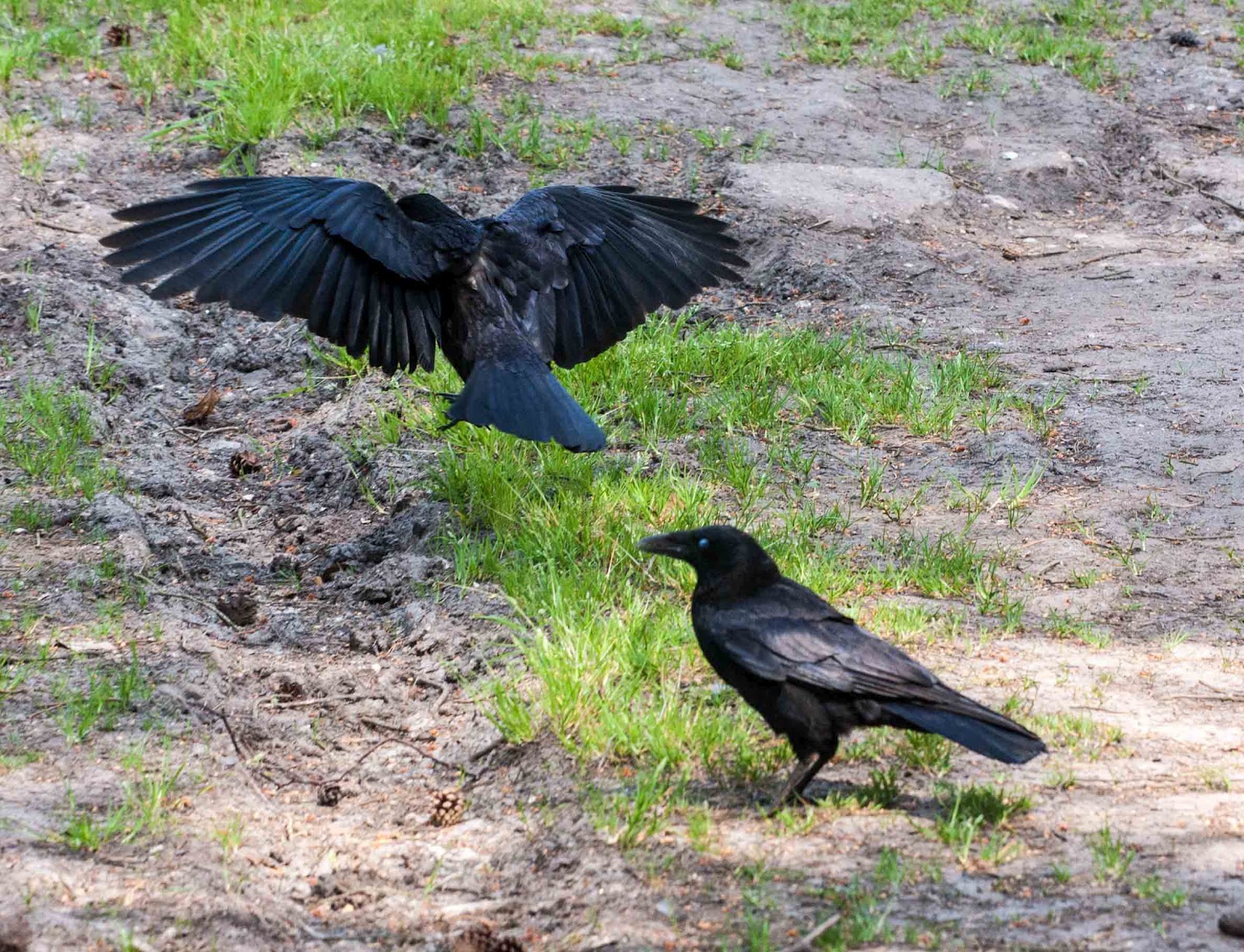
There are many crows in the area, as might be deduced from the name. These clever birds are noisy, bold and entertaining. They quickly recognise food sources and follow dog walkers who carry treats.

Several years ago, we used to feed two crows we called Bill and Beatrice, and subsequently their two offspring. They were opportunistic feeders and would switch their allegiance readily from us to others. The ground where we walked in Crowthorne Forest, more properly Swinley Forest, was open and the family could easily see the biscuits.

There are many small ponds in the woods, very attractive to dogs and ducks, and we used to throw biscuits in for the crows. It was amazing to watch them dive down, almost submerge and then flap up and away with the prize in their bill.


Simon’s Wood, where we walk at present, has thick layers of leaves, rotting beautifully into a rich, aromatic mulch. 
There is a fairly large pool which hosts a variety of water birds – Canada geese, little grebes, coot and mallard among others. The crows do not dive for biscuits here.


It is apparent that the crows have territories in which they are comfortable, for when we reach the boundaries, invisible to us, they no longer follow us. At present, we have another family of four to feed. They seem to recognise us, or perhaps it’s the dogs, or the treat bags we carry. Maybe they just watch to find out if they’re going to be lucky.

Crow 1:‘Oh, there’s a human. Let’s follow him for a while and see if he’ll feed us.’

Crow 2: ‘Watch out for the dogs. They’ll steal our grub.’

Crow 1: ‘Children alert. They often drop food.’

Crow 2: ‘Look, more dogs. I wonder if they’ll have treats?’

One of the current family has a degree of leucism, only clearly visible when she flies. Unoriginally, we call her White Wings. She can easily be mistaken for a magpie from a distance.

We also have crows in the garden. A few years ago, when Jenna, our little black Labrador, was very young, one of the crows used to sit atop one of the arches and bow to her. I think he must have been an immature male to have mistaken a four-legged dog for a two-legged crow and start courting her. At least, I think that was what he was doing. I’m not an expert and am willing to be corrected.

Crows can be extremely vocal, particularly if they feel threatened. A crow will chase away a red kite, even though a kite is substantially larger than a crow.

Aesop was a Greek slave and story-teller who lived around 620 BCE. He recognised the intelligence of the crow and illustrated it in his fable of the Crow and the Pitcher.


Is this crow engaged in trickery or is he about to burst into song?
'Me and my shadow . . . ' 

Wednesday, 6 June 2012

Bill and Beatrice Crow


Bill and Beatrice Crow
Waiting . . .
Our suspicions that Bill and Beatrice Crow were expecting the patter of tiny claws were confirmed last week when we spotted two young.
 Demanding . . .
The parents are very assertive around us now, demanding food as soon as we appear in their territory. Bill approaches very close, followed at a safer distance by his mate. He has always been bold, Beatrice less so, but I suppose the demands of their offspring have made them both more confident. The two youngsters can fly but still depend on their parents to provide sustenance.
Beatrice flies off. Bill has pale blotches on his wings.
We cannot tell whether they recognise us, or the dogs, or a combination of the two. They were a little wary when Elliot, Eve and Louis were staying with us and accompanied us on an evening walk a couple of weeks ago. They soon seemed to realise that the children were part of our pack and meant them no harm. That’s probably anthropomorphic but it’s difficult not to apply human reactions and reasoning to them. They know the route we normally take and fly ahead of us and wait for us to catch up. 
How much can I fit in my beak?
Bill is greedier and more observant than Beatrice and tries to collect as much as he can fit in his beak. He picks up the food immediately and flies off with it. Beatrice is more cautious and picks it up, then drops it and picks it up again.
Approaching . . .
Touchdown!
Water-skiing?
They are so used to the dogs that they fly down to gather biscuits from the water while the dogs are swimming in it.  Invariably they pass over the pond to spot exactly where the food is then swoop down and grab it. Legs and tail feathers are momentarily dipped in the water – a heart-stopping moment for us as we wonder what would happen if they miscalculated and found themselves submerged.

However, strong wings carry them safely away from an environment that is not their natural element.
This is Bill, with the blotchy wings
Gotcha!
Water-softened food . . .
We have not yet managed to take photos of the young ones - they're very wary. We wonder if the youngsters will learn from their parents that we are a source of food or whether, when they are independent, Bill and Beatrice will chase them away like other crows.


Wednesday, 8 February 2012

Crow Lake

Swans are graceful and elegant so it is appropriate that they have a ballet dedicated to them. Other birds, too, inspire poetry and music, crows among them.

Now, crows would be the first to admit that they do not have musical voices –far-reaching, attention-seeking, interesting, yes, but not musical. That is not to say that they do not appreciate the finer things in life – a cordon bleu meal, a night at the opera, glorious architecture, stunning art and ballet. We did not realise this – perhaps you, too, are ignorant of their sensitive nature.

The two crows who greet us each day in the forest (their names are Bill and Beatrice, by the way) noticed our scepticism about their aesthetic tastes and resolved to persuade us of their artistic leanings. We were treated to an impromptu performance of their latest oeuvre. Unfortunately they were still working on the choreography for their pas de deux so I can only show you stills from their solos. I think you will agree that their footwork is faultless. 

The photos were taken in poor light at sunset.
petit jeté(small jump)
beginning of pirouette
petit saut (small jump)
 en pointe
completion of chassé 
échappé
For comparison I have downloaded a YouTube clip of Gillian Murphy, Principal Dancer of American Ballet Theatre, dancing Odile.

Monday, 30 January 2012

Bird dogs?

Our World Tuesday Graphic
Bird dog is not a term commonly used in UK. Dogs used for hunting are generally known as gun dogs, a term which brings to (my) mind a vision of a retriever holding a shot gun. A bird dog, particularly in the Southern USA, is a dog trained to flush, hunt or retrieve game that has been shot.

However, we may have discovered a different type of bird dog. Strictly speaking, it shares few of the physical characteristics of canines but can be trained encouraged to retrieve.
Master of Hounds?
 We usually carry dog biscuits – as rewards or distractions or for training – and the bird dogs have observed this. For many years we have noticed them watching closely, particularly near water, and collecting treats that our own dogs have omitted to pick up.

In recent months a pair of bird dogs has been following us soon after we begin our walk. They have excellent eyesight and keep us in view from a safe distance. They are not domesticated and are wary of humans and dogs but associate them – or, at least, us – with food. It may not be the food that you or I would choose to consume (although as a child I enjoyed the smell and taste of dog biscuits) but the wild bird dogs are less discerning in their habits and will eat almost anything, alive, dead, fresh or decomposing. They are omnivores – one might even call them obligate omnivores – and they look well on their diet, bright-eyed and wearing glossy coats.

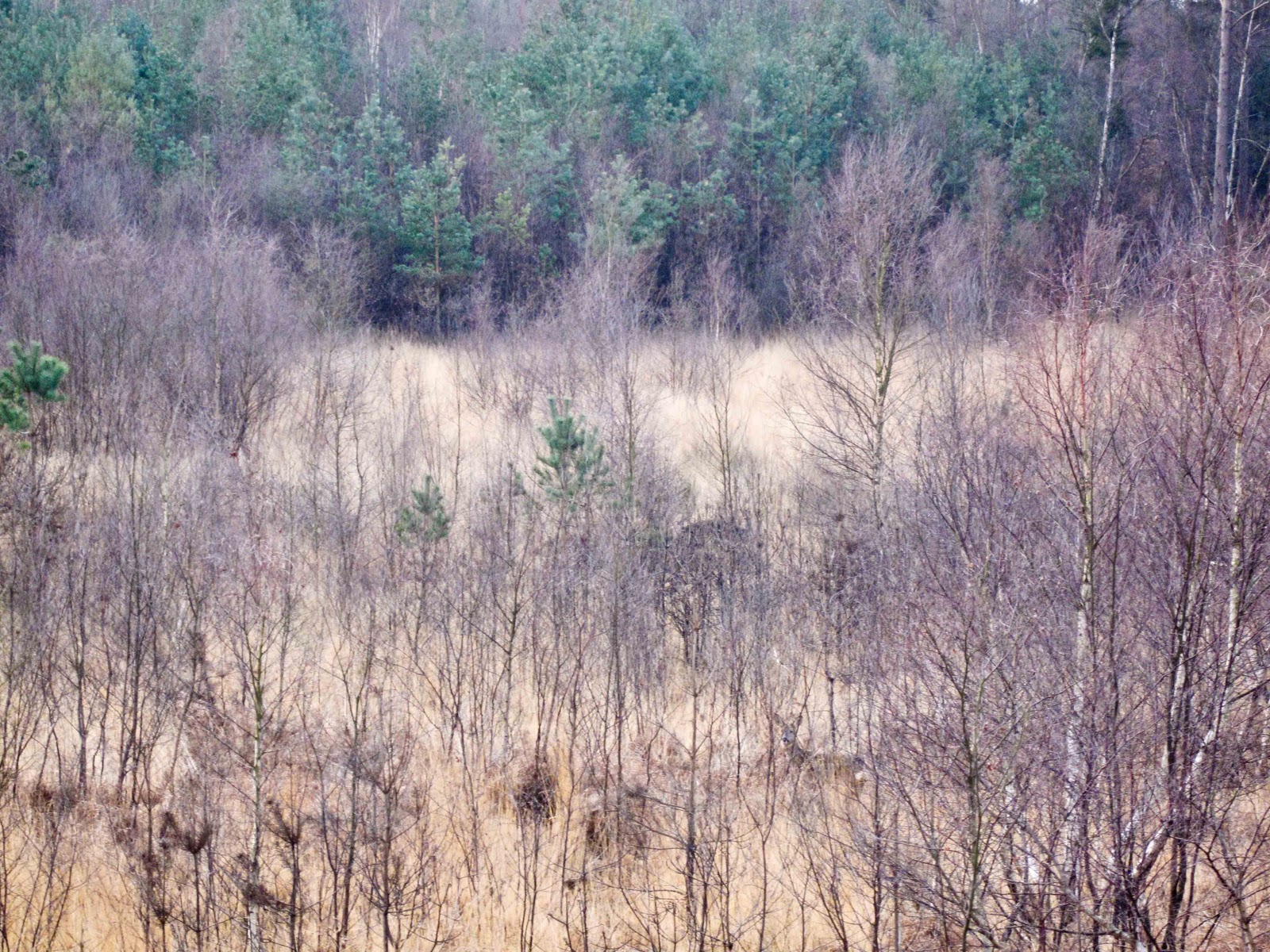
Today, the bird dogs, a mating pair – they mate for life – met us early in our walk and followed us up the hill, past three ponds to the big pond at the top. They waited patiently, calling to each other, as we watched a couple of deer, well camouflaged in the sere grasses and leafless saplings of winter.
 Can you see the deer in this photo? In fact, I've just realised there are two.
Any clearer now? There's one dead centre and  
another smaller one bottom right.
In this photo there are three deer, left, right and centre.

Eventually they were rewarded. The dogs plunged into the water, Jenna and Gus chasing the Aqua Kong and Frodo and Bertie retrieving biscuits. When they emerged the bird dogs stood at the edge furthest from us, watching and biding their time. Then they swooped over the water, because of course they’re birds, not dogs, and snatched the biscuits in their beaks, one at a time.
Waiting, maybe admiring their reflections
This one has successfully grabbed a biscuit
Its mate has also succeeded
We dub them bird dogs because they follow us and ‘fetch’ biscuits. We suspect that other people have observed their characteristics and, equally fascinated, have taken to throwing titbits for them to pick up. They followed us at a discreet distance all the way back, almost to the car, sometimes flying up to perch on branches, sometimes waddling along behind us on the track, watching and hoping for more treats. 
Following us back to the car
Striding out
Carrion crows are very intelligent and my admiration for them grows. The following video clips demonstrate their determination and their ability to solve problems. The first clip will not endear them, I’m afraid, but the second is impressive.


I'm linking to Our World Tuesday where you can find out more about other people's worlds.

Wednesday, 31 March 2010

March Full Moon 2010


Moonlight

The stars around the fair moon fade
Against the night,
When gazing full she fills the glade
And spreads the seas with silvery light.

Sappho (c.610 – 570 BC)
Translated by H. De Vere Stacpoole

 
There was a full moon last night or so I believe. We couldn't actually see it as it was overcast and raining so these photographs are from March 2006. I love the golden glow and it is apt that one of the names for this month's moon is the Lantern Moon.
Another of the names for the March Full Moon is the Sap Moon which seems appropriate for a month in which dormant plants are waking up and sending out leaves and tendrils and getting on with life. Even on a blustery, dull day such as today, the fresh green leaves and the daffodils which have finally put in an appearance brighten the view and gladden my heart. The birds are busier than ever, flying in in pairs, trios and gangs. Yesterday I saw goldfinches flirting in and out of the holly tree and the woodpeckers are drumming vigorously, pointing out decaying trees. The starlings, as ever, squabble and screech and long-tailed tits skitter in like tiny, prettily painted shuttlecocks.
This full moon is also called the Crow Moon.
There are always crows to be seen in and around the garden – after all I live in Crowthorne! – and though they are the rapscallions of the bird world, I very much enjoy their antics. They are remarkably big birds but somehow manage to balance on the bird feeder to peck energetically at the fat cake.
They will also perch on the arches and bow solemnly to Jenna-the-Labrador and call to her. Although she's the same colour as them I don't really think they regard her as a four-legged crow but it is amusing to watch. She just gazes back at them. I think Gus will answer them – he's rather more vocal than his sister and, of course, still only a pup. This morning a pair of magpies, also corvids, courted gravely on the bird table. Occasionally, jays and jackdaws visit but they are shyer relations and rarely stay long.
The final name I have for the moon is the Lenten Moon which really needs no further explanation.
As we approach Easter I wish you all a peaceful weekend, whatever your beliefs or lack of them.
'Shalom'

Thursday, 20 August 2009

SkyWatch Friday #58

Photographs this week were taken from the passenger seat of the car as Gillian and I drove from Berkshire to Dorset. We were caught in slow-moving traffic. Tom Tom informed us that there were delays just after we passed an alternative road - very helpful! We were told repeatedly that we were on the fastest route as we chugged along at 4 mph!


It was a pleasant sunny day and the sky was interesting. Despite the 'No U-turn' sign some drivers decided to risk it!
Beyond the fence there was a pig farm.
They had plenty of room to root around, adequate shelters and water and there were many crows keeping them company. Pigs need shade as they can suffer from sunburn.
It's good to know there are parking lay-bys ahead with public telephones. Cars overheat or break down and it's not always possible to get a signal on a mobile (cell) phone.


When we reached the turn off to Stonehenge we saw the cause of the traffic jam. There had been an accident on the opposite side of the road. Ambulance and police were in attendance and people on our side of the carriageway had been rubber-necking. Ghouls!

The traffic flowed freely thereafter.

If you would like to see other skies from around the globe please click here

Thank you to the hosts of this meme, Klaus, Sandy, Ivar, Wren, Fishing Guy and Louise.