Showing posts with label Kent. Show all posts

Thursday, 21 May 2026

Small world


Small world


City Walls and north-east Bastion, Free School Lane, Rochester, Kent.

This photograph, from the 1920s, shows St Nicholas' School on the left. The grass in the foreground became the lower yard of Sir William Josephson's Mathematical School for Boys. It is now  a car park!

Image courtesy Medway Archives Centre

Today, my middle daughter is working, by chance,  with someone from my old home town. In the course of discovering how much her colleague and I had in common, in terms of local landmarks, I found myself looking back to my young life.

My first school was St Margaret’s in St Margaret’s Street, Rochester. I spent my infant years there, from five to seven. I learnt to read, but was rarely called out to read to the teacher, which I later realised was because I was a ‘good reader.’ The school no longer exists.

My junior school years were spent at St Nicholas’ School in Free School Lane, Rochester. This had been built in 1857 alongside the mediaeval City Walls, and north-east Bastion. A bastion is a defensive, angled extension built out from the main wall, enabling defenders to fire along the wall’s sides and cover blind spots.

Records state that it educated boys and girls, but there were no boys when I was there. Possibly, there were boys in the infant department, but not in the junior school. The school was demolished in 1968.

                                            Rochester Cathedral

Image courtesy Wikimedia Commons

 Another school built inside the city walls was King’s School, Rochester. It is a cathedral school, founded in 604 AD, and forms part of the foundation of Rochester Cathedral, which was constructed in the same year. It is claimed to be the second oldest continuously functioning school in the world. The oldest is The King’s School, Canterbury, which was founded in AD 597.

Rochester is an attractive small city on the banks of the River Medway. The Norman castle keep looks out across the river. The fortress was designed to control the Medway bridge and protect the road to London.

                                             Rochester Castle

Image courtesy Wikimedia Commons
The cathedral, castle, and walls form one of the most complete Norman landscapes in England.

                                                        Image source

Charles Dickens lived near Rochester for most his life and it features in much of his work, often under other names, like ‘Dingley Dell’ in The Pickwick Papers, and ‘Cloisterham’ in Edwin Drood. Other buildings appear, too, like The Bull Hotel, Guildhall, and Eastgate House, which was renamed Westgate House for The Pickwick Papers.


Eastgate House, Rochester

 Image courtesy Wikimedia Commons

Friday, 11 July 2025

Underneath the spreading chestnut tree . . .


Underneath the spreading chestnut tree . . .

. . . there are thousands of spent catkins. They are about thirteen centimetres (five inches) long and carpet the woodland floor.

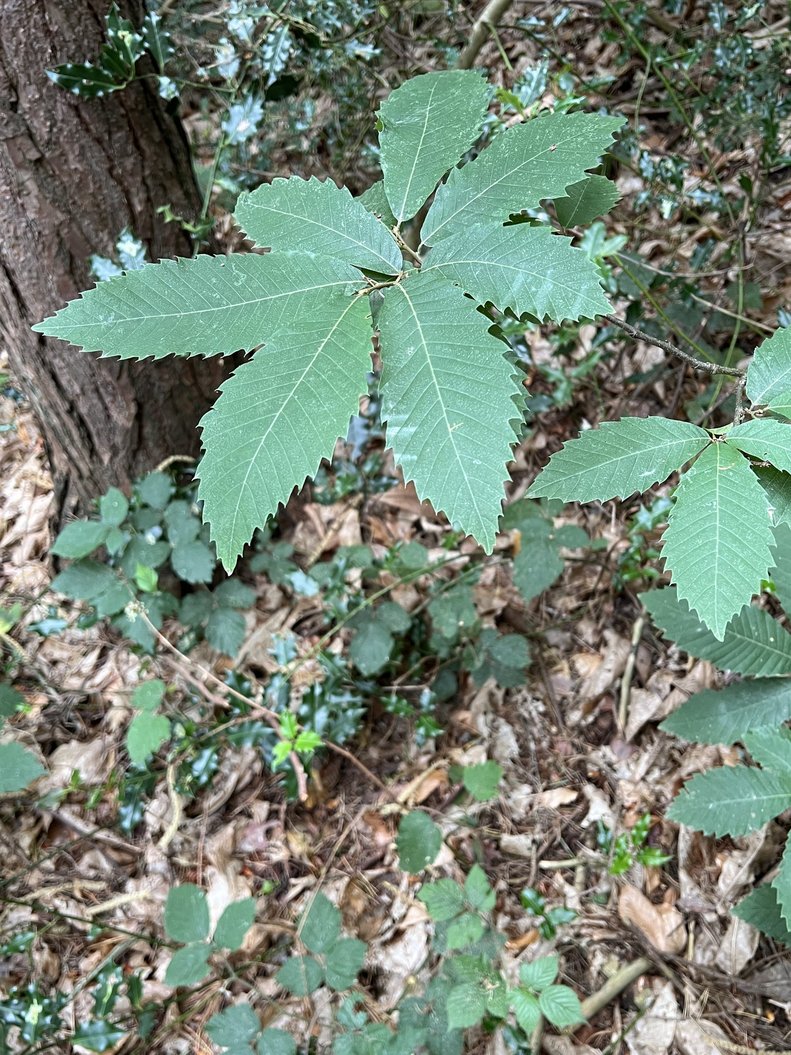
 Sweet chestnut sapling

The sweet chestnut tree (Castanea sativa) has grown in the UK for so many centuries that it is regarded as native, but it hails from southern Europe and Asia Minor. It was once thought to have been introduced by the Romans, but scientific methods have suggested that it was introduced much later. The first confirmed planting dates from around 1640 AD, though some ancient specimens probably existed in Tudor or Stuart periods.

It is believed to have survived the last Ice Age, approximately 115,000 to 11,700 years ago in southern Europe.

 It is a long-lived deciduous tree, attaining several hundred years and growing to heights approaching thirty-five metres with a girth of two metres. Some ancient examples are over two thousand years old, but most should be able to survive for around seven hundred years.

It belongs in the Fagaceae family alongside oaks and beeches.

As a young tree, its bark is smooth and greyish, but as it ages, it develops fissures which spiral upwards around the trunk. At about twenty-five years of age, it begins to produce fruit, shiny brown soft-shelled nuts enclosed in spiky, green cases.

The dried remnants of the catkin hang below the prickly casing of the chestnut.

The sweet chestnut is monoecious, meaning that it bears male and female flowers on the same tree. The strongly-scented catkins are mostly male flowers, with insignificant female flowers at the base. After they have been pollinated by insects, including blowflies, house flies, beetles and bees, the female flowers develop the fruits.

In late summer or early autumn, the woodland floor is littered with the ripe chestnuts, mostly all still within their prickly cases.

The wood of the sweet chestnut is similar to oak but easier to work with. The trees were extensively planted in Kent to be used in producing hop poles, because their wood was strong and rot-resistant. The hop industry has declined, although Kent is still the main hop-growing region in the country, but the wood is still used for fencing and stakes.

Strangely, although I was brought up in Kent, I don’t recall sweet chestnut trees being prominent in the landscape. They are much more prevalent where I now live, in Berkshire.

Thursday, 19 September 2024

County flags – Kent


County flags – Kent

Invicta flag

Image courtesy Wikimedia Commons

The first county flag I became aware of was the Kent flag. I was born and brought up in Kent, known as the Garden of England, with its fruit orchards and hop fields. I lived there until I left home for college in Lincolnshire and didn’t live there full-time after that.

The flag depicts the rearing, (rampant in heraldic language) White Horse of Kent on a red background. It is seen everywhere in the county, though not always in colour. It is also known as the Invicta flag. Invicta means ‘unconquered’ and is the motto of Kent.

The White Horse of Kent dates from the Jutish Kingdom of Kent in the 6th to 8th centuries. The legend holds that the horse was the symbol of Horsa, the brother of Hengest/Hengist. The Old English name Horsa means ‘horse.’ Hengest means ‘stallion.’

It is believed that Hengist and Horsa were Germanic warrior brothers, who led the Angles, Saxons, and Jutes to invade Britain in the 5th century. At first, they supported Vortigern, King of the Britons, but turned against him. Horsa was killed in the fighting, but Hengist conquered Kent in 449 and is regarded as the first Jutish king of Kent. He is said to have been buried at Hengistbury Head, in Dorset.

However, the assertions made by the Venerable Bede in his 8th century ‘Ecclesiastical History,’ could not be proved. The general consensus is that Hengist and Horsa were creatures of legend, probably based on real people, but we shall never know for certain.      

Sunday, 9 July 2023

Leprosy in England


Leprosy in England

 Images courtesy of Wikimedia Commons

                            Church of St Nicholas, Harbledown

I used to travel to Canterbury occasionally when I lived in Kent. I was always intrigued by the sight of the Leper Hospital in Harbledown, just outside the city.

St Nicholas’ Hospital is on the old main London road, which was once England’s chief pilgrimage route. Chaucer’s fictional pilgrims in the Canterbury Tales (written between 1387-1340) would have journeyed along this road, as would other travellers. Leper hospitals were located on main roads in order that inmates could beg for alms from passers-by, in exchange offering prayers for their souls.

St Nicholas’ Hospital was founded by Archbishop Lanfranc of Canterbury in 1084-5, not long after the Norman Conquest in 1066. It is thought to be England’s first Leper Hospital.

Today leprosy is known as Hansen’s Disease. It is a chronic infectious disease, caused by a bacteria called Mycobacterium leprae, and affects the skin, peripheral nerves, the mucous membranes of the nose and mouth and the eyes.  It is transmitted through prolonged contact over months with a sufferer but is easily treated and cured with multi-drug treatment that lasts between six and twelve months. It cannot be spread through casual contact, for example, by shaking hands or having a meal with someone.

It still occurs in over 120 countries, but the majority of new cases recorded annually are from South-East Asia.   

It emerged in England in the 4th century AD, possibly brought in by Viking traders, and was a commonplace feature of life by 1050. It affected people of all walks of life in town and country. People understood that it was contagious but did not know how it was contracted so sufferers were shunned from society. They had to wear distinctive clothing and carry a bell or clapper to announce their approach. (In Biblical times, lepers had to cover their mouth and call out ‘unclean, unclean’.)

                                            Leper with bell

 In mediaeval England, some saw the ravages of the disease as a punishment from God while others believed it was similar to the suffering of Christ and was a living Purgatory, and that the afflicted would go straight to Heaven. In its advanced stage, leprosy led to gangrene, blindness, collapse of the nose, muscle paralysis and general weakening of the skeleton.

                                             Christ cures a leper

In the leper or lazar hospitals lazars were treated respectfully. Those who looked after them - the monks and the Church - or made charitable donations towards their care thought that such good works would reduce their own time in Purgatory.

Most hospitals consisted of cottages built around a separate chapel, for the care of the lepers was spiritual as well as physical. Much attention was paid to good food and cleanliness and many establishments had gardens of flowers and herbs in which the inmates worked. Gradually, the incidence of leprosy abated, declining from the 15th century, perhaps due to increased immunity in the general population, and the leper hospitals became almshouses for the poor. 

                            St Nicholas' almshouses, Harbledown

St Nicholas’ Hospital is now an almshouse, providing sheltered accommodation for elderly people.

Wednesday, 22 September 2010

ABC Wednesday J is for Jezreel's Tower

Jezreel's Tower
Image courtesy of Martin Smith
Jezreel’s Tower, near the top of Chatham Hill in the south-east corner of Kent, UK, was the largest religious building ever to have been built in Britain. Sometimes known as Jezreel’s Folly, it was designed by James Jershom Jezreel, formerly James White. It was to be the headquarters of his sect and a sanctuary from the Last Judgment.
James White enlisted in the British Army in 1875 and was based in Chatham, where he soon became interested in the teaching of Joanna Southcott, a seer and prophet. She wrote prophecies in rhyme and announced that she was the woman spoken of in Revelation 12: 1-6
 v.1: And there appeared a great wonder in heaven; a woman clothed with the sun and the moon under her feet, and upon her head a crown of twelve stars:
Her most startling claim was that she was to give birth to the new Messiah, Shiloh.

White joined a Southcottian sect of Christian Israelites and soon took over the leadership. He wrote ‘The Flying Roll’, a message to the scattered tribes of Israel, a favoured 144,000 of whom would achieve true immortality.
In 1881 White was discharged from the army and began to expand his following, finding sympathisers in the USA and Australia as well as locally. He established several businesses including a print firm, a bakery and a grocery store and invested the profits from these and money that had been donated. By the end of 1884, Jezreel decided that work could start on his Sanctuary.
Architect's drawing - provenance unknown
It was to be constructed of steel and concrete with yellow brick walls and eight castellated towers. He had wished to build a perfect cube but was persuaded that such a design would be technically difficult and prohibitively expensive. The walls were to be decorated with symbols of Jezreel’s sect, featuring the Flying Roll, the Trumpet (he considered himself to be the Sixth Trumpeter to sound the alarm, following Richard Brothers, Joanna Southcott, George Turner, William Shaw and John Wroe), the Crossed Swords of the Spirit and Prince of Wales feathers to signify the Holy Trinity.
Building began in 1886 and was proceeding well when Jezreel died, quite unexpectedly. His wife, who styled herself Queen Esther, took over the project and by 1887 the exterior of the tower was complete apart from the roof. The ground floor was finished and furnished with steam printing presses that were producing the sect’s publications. On the first floor many steel girders were in place ready to construct the hall, which was intended to hold 5,000, balconies, hydraulic choirs and a revolving platform for the preacher.
The money ran out in March 1888 and work ceased. Jezreel’s huge tower lay surrounded by scaffolding, roofless and open to the elements. Queen Esther died in June of 1888 and without her leadership the sect split and eventually lost ownership of the tower. In 1905 demolition was begun but the building was so strongly constructed that it proved impossible to destroy. It remained as a monument to man’s folly and vanity for more than fifty years but eventually, following the local council’s refusal to adopt it as an historical relic, it was scheduled for demolition in 1960.The job was expected to take three months but took thirteen – the tower built to last was finally reduced to rubble and the landmark beloved of many and seen from as far away as fifteen miles was gone.  
All that remains now is a bus stop called Jezreel. When I used to catch the bus from school there was sometimes talk of the curse of Jezreel’s. It was said that those called to work on the demolition would suffer injury or death. Indeed, one company was put out of business and one demolition worker was killed. Strangely, I can’t remember ever seeing the Tower, but I suppose I must have done so. Barry recalls it quite clearly.
Thanks go to Denise Nesbitt and her Jolly, Jovial team members who organise and host this weekly meme. To see more Js please click here.

Thursday, 17 September 2009

Rockets and explosions


Barry has always had a lively inquiring mind and a need to test theories for himself. When he was around 15 years old, he became interested in creating rockets. Acquiring the components was simple enough and he entertained himself trying different ‘recipes’, concoctions he discovered in the Public Library. All fuses were ‘Jetex’.
A by-product of the rockets was explosions. On one occasion while testing the latest prototype in the back garden the rocket flew off at speed into the next-door neighbour’s cabbage patch, destroying it.

A far more serious event happened at school when the rocket propellant Barry was trialling badly scorched and blew a hole in the cricket pitch. The experiment had been conducted at night and he had selected a test site in the middle of the sports field as far as possible from habitation. Not being a cricketer he was unaware that the chosen location was destined to be the coming season’s cricket pitch. (Bear in mind that this was in Kent, one of the eighteen first class cricket counties in all of which cricketing is taken very seriously. Kent, together with Sussex, is the birthplace of the sport. It is believed that cricket was invented by children living in the Weald in Saxon or Norman times.) The grounds man was very unhappy the following morning, muttering that the last time this happened was during WW2 when a German aircraft bombed the place.
A search for explosive substances revealed that Barry’s locker was a veritable jet propulsion lab. Unaware of the fracas he had caused, Barry was ordered to report to the headmaster’s study where he was presented with the evidence of the locker and the cricket pitch. He feared uncomfortable retribution. The head, a former Colonel during the Second World War and a Quaker, took a most enlightened view and, though he left no doubt in Barry’s mind that his activities had been noted and disapproved of and were not to be repeated, informed Barry that his punishment would last for two terms; he was ordered to report to the chemistry master and attend compulsory after-school lessons on explosives. He concluded, 'If you are going to do this sort of thing then you will do it properly and under supervision and ONLY under supervision.' It transpired that the chemistry master had been in the SOE (Special Operations Executive) during WW2 and knew a thing or two about 'doing it properly' as far as explosives were concerned. Barry learnt much and effected his future 'experiments' under the guidance of his ex-SOE mentor.
Eventually other interests developed and rocket-making became a thing of the past. Many years later, Barry was sitting with a very senior member of the armed forces waiting for a meeting to start. They were of a similar age and started reminiscing about school days and it emerged that he also had carried out similar 'experiments' in his youth. The difference was that he wasn’t caught.

Postscript: Barry recalls these events with some horror - but it was not at all uncommon for schoolboys to engage in dangerous activities. Even schoolgirls in Chemistry laboratories could be observed mixing various chemicals 'to see what would happen.' Nothing ever did (in my school anyway) but we were poorly supervised in the days before 'Health and Safety' ruled.