The Blind Men and the Elephant

John Godfrey Saxe (1816-1887) was an American poet who began his adult career as a lawyer, but turned to writing poetry, when the practice of law palled. The poem for which he is best remembered now was not the most admired one when he was alive.
‘The Blind Men and the Elephant’ refers to an old Indian parable, some of the earliest versions of which were recorded in around 500 BC in Buddhist, Hindu, and Jain texts. The parable explores the question of perception and man’s failure to see another’s point of view.
The six men meet an elephant for the first time and, each touching a different part of the beast, declare their description of the animal to be the correct interpretation. The first man claims that the elephant is like a wall, while the second, touching the tusk, says that it is like a spear. The third disagrees, for he has felt the trunk and so says the elephant is like a snake. When the fourth man touches the knee, he says the elephant resembles a tree, but the fifth man scorns him and says the elephant is like a fan. The part he has touched is an ear. The sixth man encounters the tail and says that the elephant is like a rope. The men then argue, each believing his interpretation and description to be the accurate one.
The
penultimate verse states:
And so
these men of Indostan
Disputed
loud and long,
Each in
his own opinion
Exceeding
stiff and strong,
Though
each was partly in the right,
And all were in the wrong!
In a slightly different vein, Irma E. Webber (1905-1995), wrote and illustrated, ‘It looks like this’ in 1949.
In this book, four mice called High Mouse, Side Mouse, Front Mouse and Back Mouse, live in different parts of a barn. They discover what a cow, a donkey and a pig look like from their different perspectives.


One day, they hear a new sound, a ‘Meow,’ and run to hide. To cover their discomfiture, they begin to talk about the animals they’ve seen that do not frighten them, and draw pictures of them on the wall with their tails. As they see each other’s drawings, which differ markedly, they begin to argue ferociously, each insisting he is right.
.jpg)
The ‘Meow’ comes again. The animal making it, a cat, is standing on a box outside the window, looking in.
All the mice see a front view of the cat, and Front Mouse feels he has been vindicated, until the cat turns sideways, proving that Side Mouse has also been right. After that, the cat turns its back on them, and Back Mouse’s view is corroborated. High Mouse fears that his opinion will not be justified, but the cat jumps to the ground and the mice are able to view it from above.
Just as High Mouse is about to comment, the cat rolls over on its back, showing yet another ‘side’ of itself, and the mice laugh and laugh, for, as the last page tells the reader, ‘ . . . that was how they all found out that one thing can look many different ways - as many different ways as there are ways to look at it.’
I’ve loved this book for many years and used to read it to my children at home and to my classes in school.

 I was the first one to check it out.
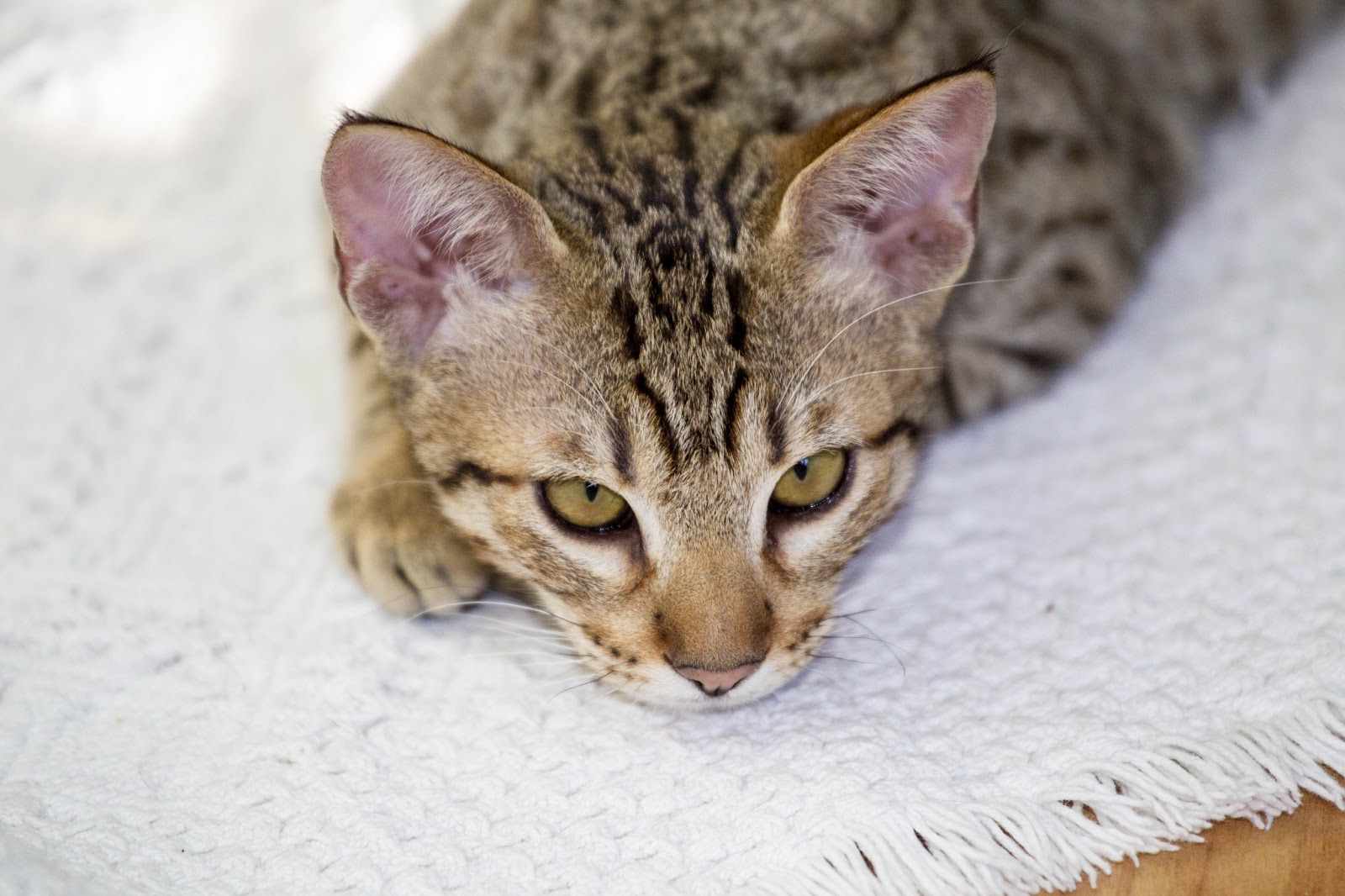
  Monty joined me and we posed prettily for our photos.
 This was one of the things in the box - I don't think we would have fitted in anything smaller. Monty just had to get in the box - it's a cat thing, don'tcha know. Never known a cat yet that could resist a box.
 This is the basket I was in earlier. Monty don't know whether he's coming or going!
  Everything had to be explored.
  It all smelt very strange but we think we like it, specially when the humans put our nice prawn treats in the different bits.