Showing posts with label oak. Show all posts

Saturday, 21 December 2024

A typical scene?


A typical scene?

Christmas cards come in many designs, but frequently snow is featured on them in UK. We used to have snowy winters, though I cannot remember ever having a white Christmas in the south of England. I have lived in many other regions, but a white Christmas has always been most elusive.

 Nonetheless, many cards depict pretty scenes of snow-covered roofs, or churches nestled in the hearts of picture postcard villages. Not many people live in such locations.

This mug shows a snowy house on a fine, bright day, with a cheerful robin in the foreground. It looks idyllic. Imagine the roaring fire in the drawing room and the kitchen bursting with tempting smells. In the dining room the table is laid with the best china and silver and glassware in expectation of a fine feast, impeccably cooked and served. Everyone’s plate, warmed beforehand, of course, is laden with delicious fare and no-one’s food is cold.

If you can manage that, I applaud you. Etiquette dictates that no-one may start to eat until everyone has been served. That is possible if there is a party of four or five, but with a family of fifteen or more, which happens as people add to the company with spouses and offspring, it is well-nigh impossible.

The reality is rather different. The house, old, draughty, with uncertain air currents and ill-fitting windows and doors, gives its inhabitants cold noses and toes. The fire gutters and goes out, the roof leaks, and everything feels damp. Lunch was planned for one o’clock, but the oven is unpredictable and those in charge of the cooking had forgotten about the gravy or the sprouts. The huge turkey, which barely fits in the oven, should have been started on its culinary journey at least three hours earlier. Eventually, everything is ready and the meal commences hours later. Despite the delays, everyone enjoys their meal, but most of all, it’s being together that can be pleasing.

The other side of the mug shows a little more of the village in which the big house stands. Splendid trees, crowned with snow, provide a background to the gabled roofs of houses. The stream that runs under the bridge is frozen. It is a peaceful, bucolic scene.

Again, the truth may be more prosaic. Heavy rains fall and melt the snow, the water level in the stream rises, and the inhabitants find their homes flooded. Services are cut off and those who had the foresight to stock up with candles try to enjoy the strangeness of a home without any noise from appliances, hoping that the novelty will not last long.

However, it’s fun to dream.

The bands at the top and bottom of the mug show oak leaves and acorns, national symbols of the UK. They represent strength and fortitude, good fortune and health.


Actually, I must have liked this mug enough to buy it ten years ago, but I really don’t care much for it now. What was I thinking?

Sunday, 26 November 2023

Golden afternoon


Golden afternoon

On a cold, clear November afternoon the sun blesses the leaves of the oak trees, burnishing them with gold. Many leaves have already drifted to the ground. Soon the rest will join them and the trees will stand stark against the sky.

The further tree is the one on which the red kite rests after it has tired of wheeling across the sky. The magpies make their harsh complaints, the squirrels skitter and chase each other up and down the tree trunk or leap from branch to branch, tails frisking, but the oak stands, impassive, majestic, a haven for so many creatures.

Thursday, 27 October 2011

ABC Wednesday O is for Oak and Oregano

Blackbird in summer oak tree
There are many oaks (Quercus) growing in our neighbourhood – one of our local primary schools is called Oaklands and the name of its accompanying nursery school is Acorns. 

Wood pigeon in spring oak tree
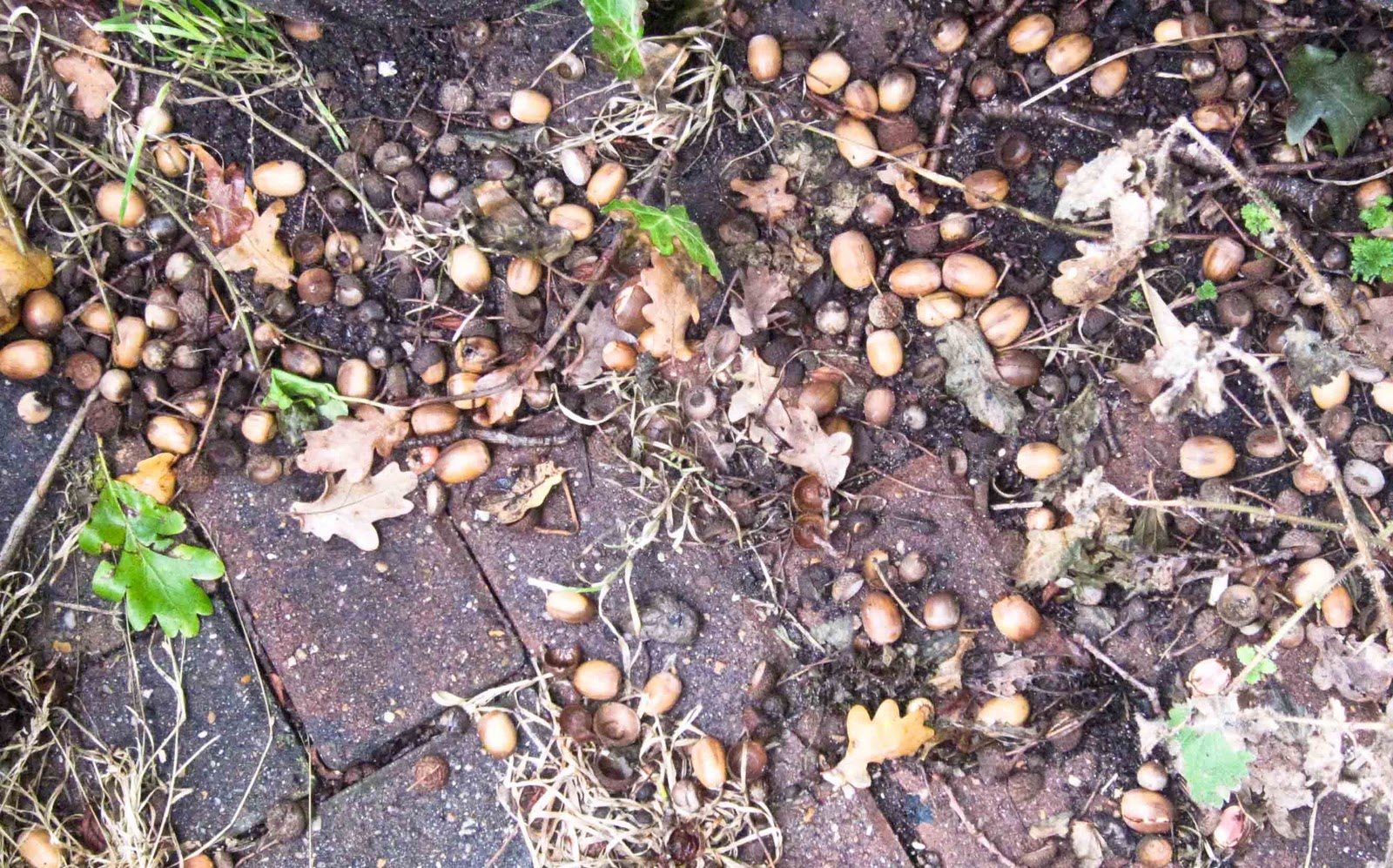
The acorn harvest has been remarkable this year and the squirrels will not go hungry. A year of abundant harvest is called a mast year. From late August acorns begin to rain from the trees, hitting shed and summer house roofs and any other hard surface with a resounding clatter. The resulting litter of nuts begin to germinate, seeking any crevice in which they may root. Our garden hosts many saplings each year – sometimes they have been buried by squirrels or jays as part of a winter cache.
Oregano coming to the end of its useful life. Already the leaves are dying back.

Oregano (Origanum vulgare) is a perennial herb closely related to Marjoram (Origanum majorana or sweet marjoram) and is sometimes known as wild marjoram. Its name means ‘mountain joy’ from the Greek ‘oros’ for mountain and ‘ganos’ for joy or happiness. In the Mediterranean it grows all year round but in our temperate climate it is perennial, dying away after the first frosts in winter to emerge with fresh growth in spring. It belongs to the Mint family (Lamiaceae) and has a stronger, more robust flavour than marjoram.

Oregano is used widely in cooking and its pungency is particularly good with tomatoes, aubergine and lamb. It is best added towards the end of cooking so that its piquancy is retained. It is often sprinkled liberally over pizza and gives added zest to fresh salads.

When left to flower it produces spikes of pretty pink or white flowers in July which attract insects. Once the flowers have set seed the taste of the leaves becomes more bitter. To avoid this the flower heads can be removed – this lengthens the growing season to late October/early November. 

Click here for more Os.

Tuesday, 5 October 2010

My World Tuesday - Wildmoor Heath

It may sound like something from Wuthering Heights but Wildmoor Heath rarely looks threatening and thunderous. An area of mixed woodland, heath and bog, it is a Site of Special Scientific Interest, one of three SSSIs within walking distance of our house. The Nature Reserve covers 99 hectares (just over 244½ acres) We took the dogs there yesterday, the first time we’ve visited for about a year. Between March and September rare birds breed on the lowland heath and dog walkers are asked to keep their dogs on leads or away from possible nesting sites.
We started and finished our walk through areas of tall, old sweet chestnut trees. 
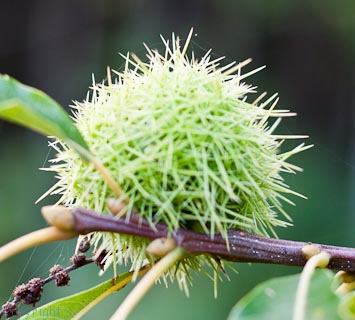
The ground was littered with the prickly husks of chestnuts, some with two to four nuts still inside, others empty. It's a good idea to wear a hat at this time of year as the nuts regularly fall from the trees!
Many areas of the forest are grazed by Highland cattle and ponies and are fenced and accessed by kissing gates, stiles or weighted swinging gates. At the end of this ride there is a padlocked gate to allow access to forest maintenance vehicles. A pedestrian weighted gate is adjacent to it. This worried Gus, so he scrambled through a hole in the fence. By the time we had completed our walk he had become accustomed to following us through these strange devices. 
The next part of the forest was dominated by silver birches. Jenna and Gus didn't mind where they were so long as they could play. Frodo was at my side as usual, but enjoying all the sniffs.

First Jenna had the kong . . .
. . . then Gus carried it.
Shortly afterwards we went through another gate into a boggy area. A notice informed us that livestock were grazing in this part but though we saw signs that they had been there we didn't see any of them. On the right there is evidence of the fire last year that destroyed much of the habitat of Silver-studded Blue butterflies. It was believed that the butterflies would not have survived but a few males and females were observed and thus fears were allayed.
There’s a great deal of water . . .
 . . . which Gus and Jenna thoroughly appreciated. Frodo went in for a cooling paddle too.
The water table is very high – in places it is higher than the board walk but contained within a bog system . . .
. . . and draining into ditches.
Passing through yet another gate we walked alongside a fenced-off body of water, full of interest for botanists and entomologists. It gives way to heath and heather where roe deer are safe from questing dogs, although the deer easily leap the low fences and can be seen anywhere in this part of Berkshire.To the other side were puddles and ponds, all of which had to be splashed in by the dogs.
Simple benches are placed at various places, some overlooking valleys, others positioned to allow people to watch the world go by.
Boards are laid down at strategic points where the ground becomes very soggy. Wires are criss-crossed over the boards to give grip.
Out into more open countryside again we were struck once more by the colours. There are many shades of green and the bracken is mostly brown now. 
The leaves are beginning to change as they lose their chlorophyll and allow the reds and yellows to show.
The heather that was so vibrant just a short while ago has lost most of its colour. With the young Scots pine saplings and the tall bracken it is a wonderful place for Labradors to practise their retrieving skills . . .
 . . . and everywhere the spiders set their larders. 
Thanks go to the My World team for organising and hosting this meme. To see more corners of this wonderful world please click here.
I'm also linking to Watery Wednesday as this is quite a 'wet' post! Thank you to 2sweetnsaxy